Hadi Zaccak’s Documentaries Revive Lebanese Memory at Shoman
Amman4 min read
Share
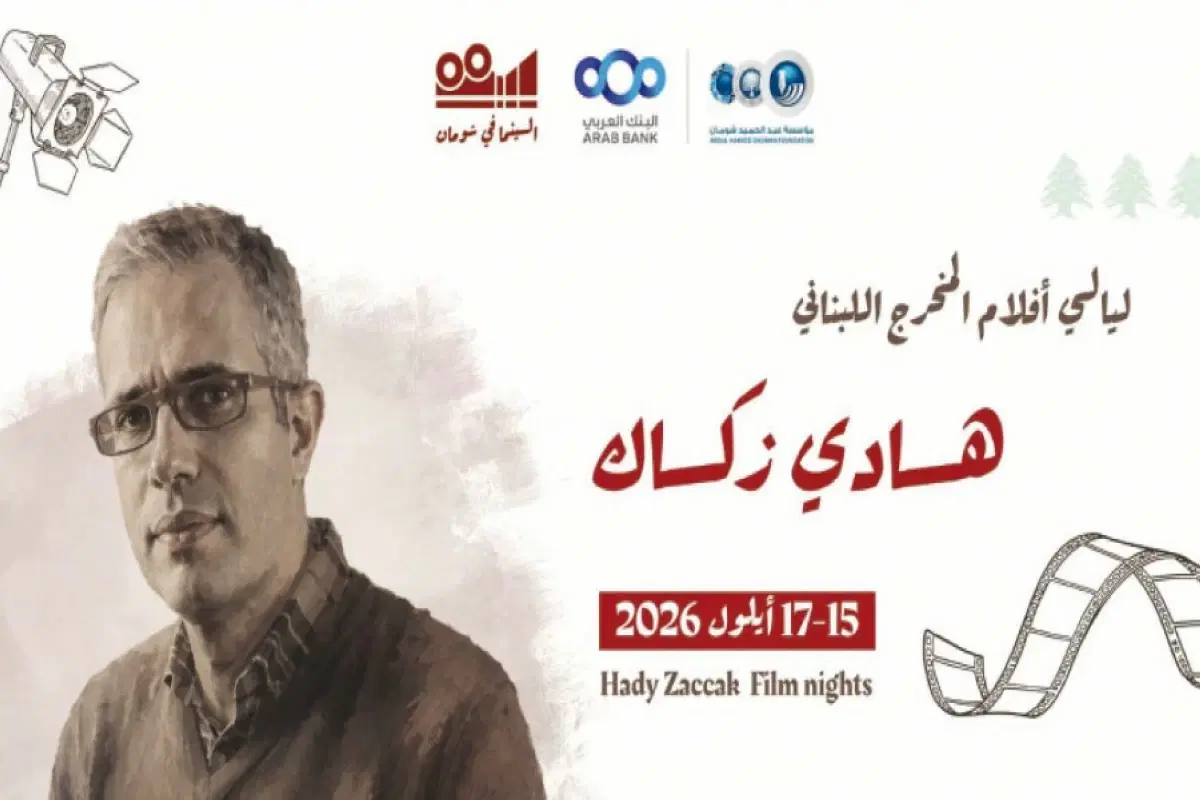
Starting this Tuesday evening, September 15, the Abdul Hameed Shoman Foundation will host a series of documentary film screenings by Lebanese director Hadi Zaccak, continuing until next Thursday. The cinematic program revisits aspects of Lebanese memory through stories of family, migration, the history of cinemas, and the social and political transformations witnessed in Lebanon.
Screenings will take place in the Foundation’s cinema hall at 6:30 PM, while films will also be shown outdoors at 8:00 PM at the Foundation’s headquarters in Jabal Amman.
The program opens with the film "Ya Omri" (My Life), which follows the life of grandmother "Henriette" from 1992 until she reached the age of 104. This documentary experience spans nearly a quarter of a century, combining the recording of her personal transformations with the family archive of photos, documents, and footage.
Through the grandmother's biography, the film observes the history of a family linked to migration from Lebanon to Brazil, along with the accompanying shifts in marriage, motherhood, and aging. Zaccak adopts a visual style where the present and past overlap, moving away from traditional chronological order to make family memory a gateway to contemplating time and human change.
The film has received several awards, including the Jury Prize at the Malmö Arab Film Festival and the Silver Award at the Geneva International Oriental Film Festival.
On Wednesday, the film "Selma"—a colloquial Lebanese term for cinema—will be screened. It explores the history of movie theaters in the northern Lebanese city of Tripoli and the cultural and social presence they held before gradually declining and disappearing.
Through testimonies from various figures, photographs, and archives, the film recalls the relationship between the people of Tripoli and the cinema, the stars, the films, and the social ritual associated with visiting theaters. It highlights the role cinema played as a space for entertainment, reflection, and interaction with the transformations experienced by Lebanese society.
The screenings conclude on Thursday with the film "Mercedes," which uses the Mercedes car as a lens to read six decades of Lebanese history. It covers its arrival in Lebanon in the 1950s, its transformation into a part of daily life for various social classes, and its presence during the years of the Lebanese Civil War (1975-1990).
The film does not treat the car merely as a means of transport, but as a social, cultural, class, and political phenomenon. It was linked to working-class neighborhoods and taxis, while also being present in the lives of politicians, the wealthy, and the influential, becoming a witness to the transformations and divisions known to Lebanese society.
The film also monitors the popular names Lebanese people gave to Mercedes models, such as "Al-Mudaa'bala," "Al-Shabah" (The Ghost), and "Al-Ghawassa" (The Submarine), reflecting the special relationship that grew between the car and popular memory. During the war years, the Mercedes transformed from a symbol of luxury and civilian life into part of the landscape of violence, checkpoints, and front lines.
Through these films, Hadi Zaccak offers different approaches to Lebanese memory, using daily details, objects, people, and places as tools to read history in an experience belonging to documentary cinema, where personal testimony intersects with collective memory.
Zaccak is considered one of the most prominent documentary filmmakers in Arab cinema. He also teaches audiovisual arts and film studies at Saint Joseph University and has completed more than 25 documentaries, including "A Lesson in History," "Echoes from Lebanon," "Ya Omri," "Kamal Jumblatt: The Witness and the Testimony," and "Mercedes." Through these works, he has addressed multiple facets of Lebanese society and its transformations, establishing the presence of documentary cinema as a space for preserving memory and raising questions about humanity, place, and history.