Israeli Election Committee rejects request to extend voting period
Amman3 min read
Share
The Israeli Central Elections Committee rejected the Likud party's request to extend the voting period in the legislative elections, which is set to end in a few hours at 10:00 PM local time, according to Israeli media reports.
Likud, the Shas movement, and the Jewish Power party had requested an extension of voting hours beyond the scheduled time, in light of the high turnout at polling stations.
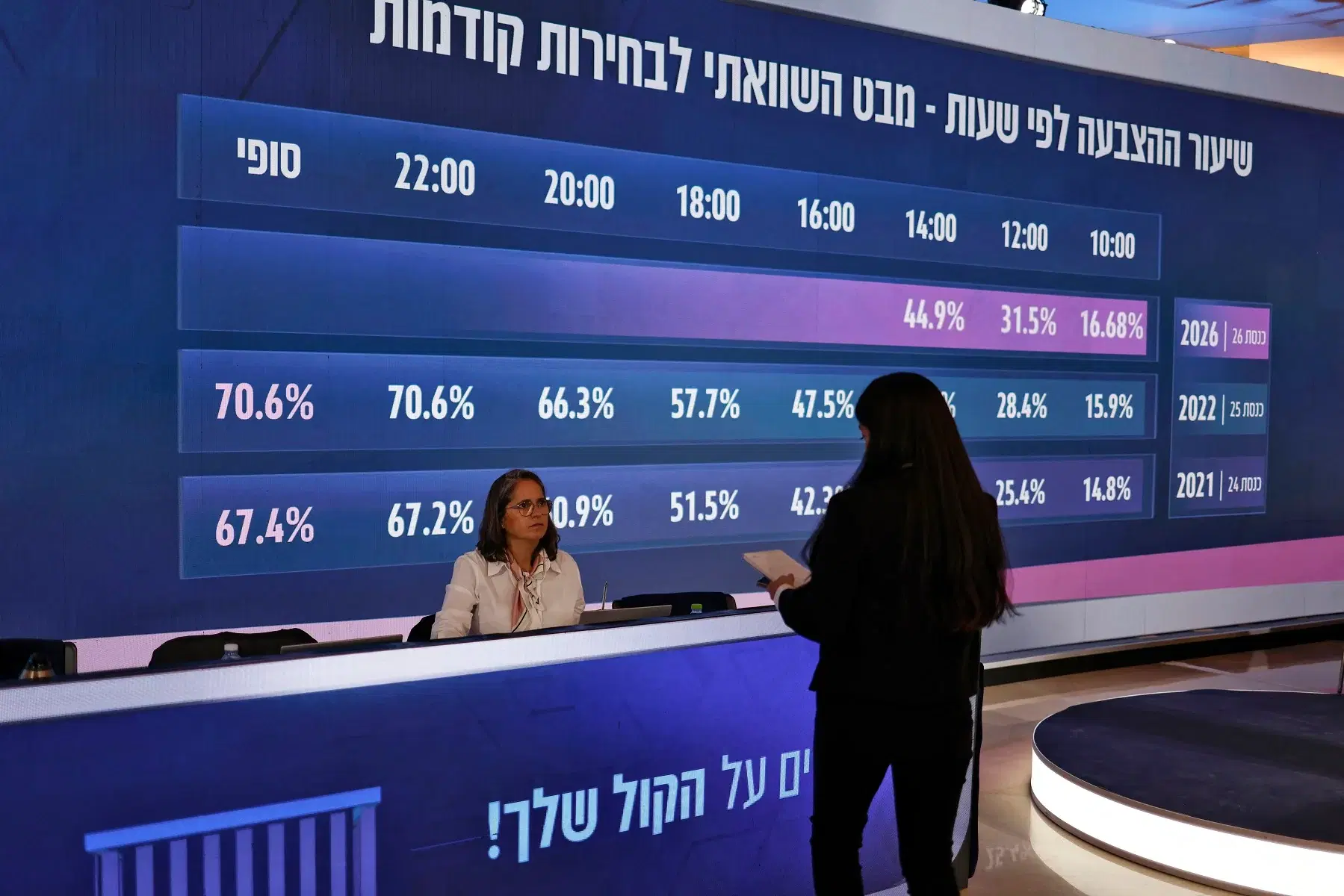
The voter turnout reached 66.7% by 6:00 PM, totaling 4,892,186 voters, surpassing the total number of voters in any previous election, according to the Israeli Central Elections Committee.
The committee noted a 9% increase in voter turnout compared to the same period in the previous elections, while it was considering the possibility of extending voting hours before rejecting the extension request, according to Israeli media.
In contrast, the "Yeshar" party, led by former Israeli Chief of Staff Gadi Eisenkot, rejected the extension of voting, considering that there is no exceptional event to justify this step.
Eisenkot accused Prime Minister Benjamin Netanyahu of resorting to his "usual tricks," lies, and fear-mongering to mobilize voters, warning that these methods jeopardize the chances for change.
The party also warned that Netanyahu is paving the way to claim that the integrity of the elections has been compromised, while Eisenkot called on voters to bring down what he described as the "worst government" in Israel's history.
In light of the voting figures, Israeli media reported that Netanyahu and Finance Minister Bezalel Smotrich will hold an emergency meeting with dozens of heads of local authorities.
Netanyahu had called on Israelis to vote for his Likud party, writing on the "X" platform: "4 hours left to save Israel," warning that leaving the battle to the left and the Arab parties would, according to him, lead to an end to the Jewish state.
For her part, the Israeli Minister of Transportation accused Mansour Abbas and Ahmad Tibi of using private bus companies to mobilize voters, saying that there is not a single bus available.
The head of the Arab Joint List, Yousef Jabareen, said that Netanyahu continues to incite and spread lies, adding that he is aware of the List's ability to put an end to his rule in the elections.
In this context, the Israeli army announced that the voter turnout among military personnel reached 68%.
38 lists are competing for the 120 seats in the Knesset, while Israeli opinion poll averages indicate that seats are likely to be distributed among three main camps: Netanyahu and his allies' camp, the opposition camp led by Eisenkot, and the Arab lists.