"Far from Men" at Shoman.. A cinematic journey that evokes questions of identity and belonging
Amman5 min read
Share
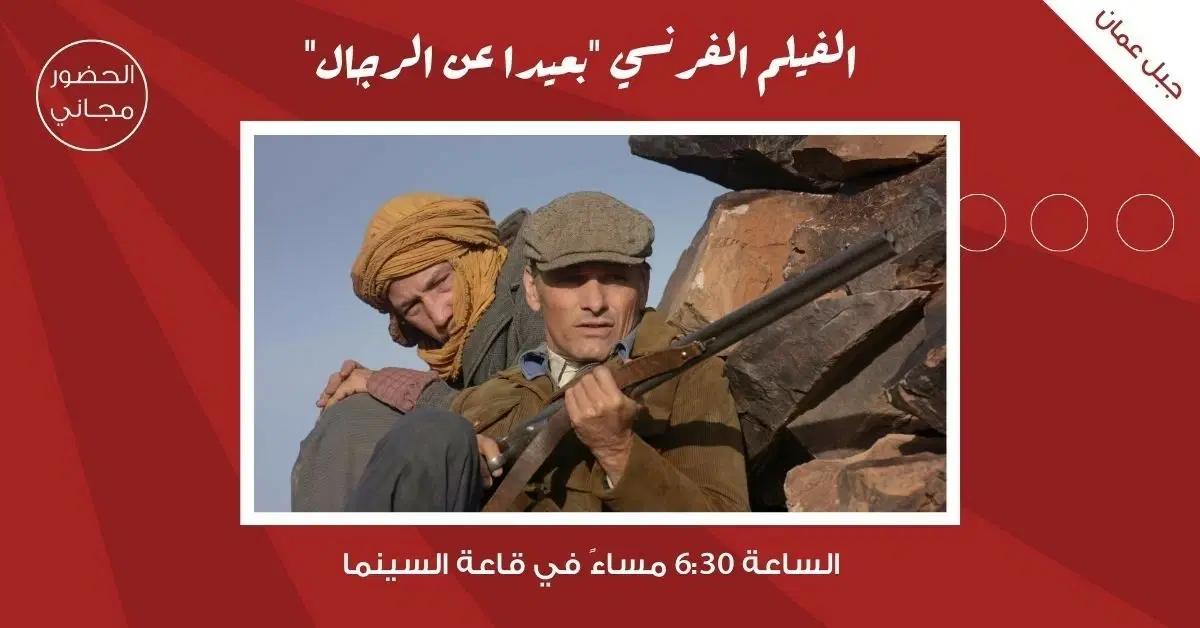
The Cinema Committee at the Abdul Hameed Shoman Foundation will screen the French film "Far from Men," directed by David Oelhoffen, tomorrow evening, Tuesday, at 6:30 PM in the foundation's cinema hall at its headquarters in Jabal Amman.
The film, set in Algeria during the 1950s, takes the viewer to a pivotal stage in the country's history, at the onset of the confrontation between Algerians and French authorities. It offers a cinematic treatment that moves away from battle scenes and direct rhetoric, drawing closer to the human being and their moral questions in the face of history.
The events revolve around Daru, a teacher played by actor Viggo Mortensen, who lives a quiet life in a remote school in the middle of a harsh mountainous region, far from the atmosphere of war and its repercussions. However, the arrival of Mohamed, played by Reda Kateb, an Algerian accused of killing one of his relatives, places him before the task of handing him over to the French authorities. A shared journey across the mountains begins, gradually turning into a difficult test of trust, conscience, and human choices.
As the two men venture into the mountainous regions and approach the conflict zones, Daru finds himself facing a moral dilemma that transcends the limits of his assigned mission; he is required to choose between adhering to the authority's orders and protecting a man whose life has become linked to his decisions. In this process, the nature of the relationship between the two characters shifts from caution and silence to building trust, amidst the danger pursuing them from multiple sides.
In building the narrative, Oelhoffen relies on a clear visual language that employs the vastness of natural landscapes, mountains, plateaus, and valleys to highlight human fragility before the environment. The characters appear small against the vast nature, as if the land is reclaiming its presence as the most steadfast element in the face of political and historical transformations.
The film also pays attention to details related to the time period in which the events take place, from clothing, weapons, and tools to the movement of crowds, which enhances the realism of the scenes, while music, natural sounds, and silence contribute to establishing an atmosphere of isolation, tension, and danger.
The cinematic structure of the work stands out through a tight script that avoids verbosity and gives the image space to express the psychological transformations of the characters. The relationship between Daru and Mohamed develops gradually through movement, glances, and silence, far from artifice or direct explanatory dialogues, which gives the journey its human dimension and makes it the focus of the film's fundamental questions.
The implications of the work do not stop at the boundaries of the relationship between the two men, but extend to questioning the concept of neutrality under colonialism. Daru, who is connected to the place and treats his students with love, rejects killing and seeks to protect Mohamed from becoming a victim; he also confronts the representatives of the French authority and condemns their practices against the Algerians. Nevertheless, the film places him before a fundamental question: Can a person remain neutral within a colonial system, simply because they did not take up arms?
The school where Daru lives and works gains symbolic importance in the context of the events; it represents his private world and his sanctuary away from the conflict, but as the journey progresses, it turns into a space incapable of protecting him from questions of identity and belonging. The plant that Mohamed gives to Daru also carries a significance that transcends its material value, as it reveals the difference between knowing the land through maps and knowing it through the experience of its people and their direct relationship with it.
By moving from the map of France that children learn from at the beginning of the film to the Atlas Mountains that appear at the end, the work depicts a transformation in Daru's awareness of the place where he lives. The man who initially seemed settled in his world gradually discovers that his identity is more complex than he thought, given his Spanish roots, his upbringing in Algeria, and his connection to France—elements that leave him suspended between multiple affiliations that offer no final answer.
The film does not present the character of Daru as an ideal model of heroism, nor does it reduce him to the image of the colonizer; rather, it leaves him in a gray area that allows the viewer to contemplate the contradiction between loving the land and understanding its history, and between human intentions and their limits when they collide with a complex political and social reality.
"Far from Men," through the combination of script, image, performance, and music, poses open questions about colonialism, identity, neutrality, and belonging, confirming that the relationship with the land is not reduced to residing in it or loving it, but requires understanding its history, the experience of its people, and the memory and conflicts it carries.
Thus, the film transcends the boundaries of an individual story to offer a cinematic experience that invites a rethinking of the human position in history and the ability to take a moral stance when finding oneself before choices that are not without loss, leaving the viewer with ample space to reflect on the meaning of belonging and human responsibility.