Shoman Opens Discussion on the Future of Humanity in the Age of Artificial Intelligence
Amman5 min read
Share
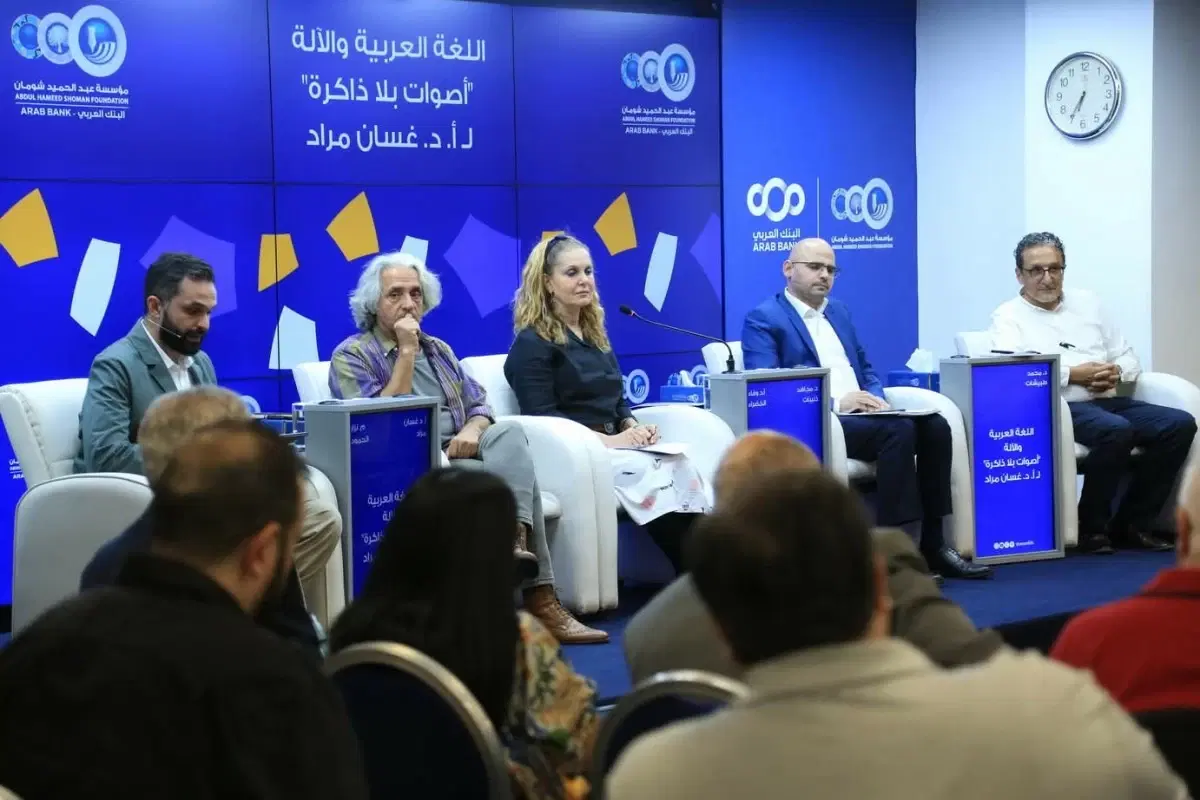
The Abdul Hameed Shoman Foundation Cultural Forum hosted a dialogue yesterday evening discussing the book 'Voices Without Memory: The Alienation of Meaning in Machine Intelligence', by Lebanese researcher and academic Dr. Ghassan Murad, in the presence of a group of researchers, academics, and those interested in cultural and intellectual affairs.
In addition to the author of the book, the dialogue was attended by Dr. Wafa Al-Khadraa, Dr. Mujahid Al-Dhunebat, and Dr. Muhammad Tabishat, while the dialogue was moderated by Nizar Al-Hamoud, Director of the Public Library at the institution.
The meeting addressed a series of philosophical and ethical questions related to artificial intelligence and the impact of the digital transformation on human consciousness, language, and culture, as artificial intelligence transitions from a mere technical tool to an active party in the production of language, knowledge, and reshaping the methods of thinking and expression.
Dr. Murad said that the motivation to write the book came from living in 'a historical moment in which the machine has become a partner in the production of language and meaning', pointing out that the deeper question is what the meaning is, and whether it is limited to language or extends to other dimensions related to human, consciousness, and memory.
He added that these transformations require reconsidering fundamental questions related to human, consciousness, and memory, and the future of humanities and educational sciences, stressing that he does not view artificial intelligence as a replacement for the writer, as writing, in his opinion, is not a technical process of producing words, but a human act linked to consciousness, experience, and memory.
He explained that the book does not provide definitive answers but rather opens the field for discussion and dialogue about digital intelligence and the regulations governing it, stressing that more important than enacting legislation is its implementation, along with anticipating the future of humanities, educational, and media sciences.
Murad pointed out that the book also raises a number of issues related to digital hybridization, reading ideas, and organic artificial intelligence, in an attempt to understand the changing boundaries between humans and technology.
For her part, Dr. Wafa Al-Khadraa said that Arabs are facing a 'new civilizational test', pointing out that the Arab Renaissance heritage made translation a means of producing knowledge and questioning a path to discovery.
She added that the question today is with new tools, to what extent Arabs can move from consuming artificial intelligence to contributing to shaping the knowledge that will reshape the world, stressing that the responsibility lies in 'moving from receiving the future to participating in defining it'.
She pointed out that civilization is not measured by what it has inherited from knowledge, but by what it has added to what humans can know, imagine, and create, stressing that the future is shaped by those who have the courage to question, the ability to know, and the imagination of the beginning.
For his part, Dr. Mujahid Al-Dhunebat believed that the author of the book succeeded in 'provoking the reader' towards artificial intelligence, by presenting it as an entity present in the details of daily life, affecting decisions and consciousness, while pointing out at the same time that the book does not call for rejecting technology, but rather for building an aware digital citizenship based on criticism and thought, which are among the most prominent characteristics of the human mind.
Al-Dhunebat explained that the book builds the relationship between humans and machines in a gradual manner; the first chapter deals with digital intelligence and its levels and effects on the individual and society, while the second chapter discusses humans in the age of digitization and its impact on their culture, in addition to raising questions about the impact of humans on technology and the impact of technology on values, privacy, identity, and ways of thinking.
He added that the book also raises questions about data ownership and the entities that control the knowledge that reaches humans, while the third chapter deals with humanities in the digital age and their role in activating thought and criticism in the face of the massive influx of digital information.
He pointed out that the author ends his vision of the relationship between humans and machines by raising a question about the future of humans in an age in which the boundaries may gradually disappear between the natural and the artificial, and between human intelligence and algorithmic intelligence.
For his part, Dr. Muhammad Tabishat said that his reading of the book starts from a balanced position calling for responsible governance and overcoming sharp dichotomies, leading to the establishment of a philosophical and political thesis that explores the intersection of contemporary technology with embodied consciousness, the neoliberal political economy, and the ethical experience of human suffering.
He added that artificial intelligence cannot be understood in isolation from the history of the capitalist colonial system, which has extended for more than six centuries, since the European commercial expansion and the subsequent military occupation and cultural colonization.
Tabishat believed that getting out of the modern dilemma is not through the nihilistic rejection of technology, but through two paths represented by political and economic deconstruction, and taking advantage of the phenomenological perspective, aesthetic priorities, and cosmic justice.
Dr. Ghassan Murad is one of the researchers specialized in Arabic language, artificial intelligence, translation, and digital humanities, and he has a number of reference books, most notably 'Mirrors of Digital Transformations and Mental Representations of Artificial Intelligence', 'The Cunning of Social Networks and the Secrets of Artificial Intelligence', and 'Digital Humanities: Taming Language for the Sake of Its Automatic Processing', in addition to his book 'Voices Without Memory: The Alienation of Meaning in Machine Intelligence'.
Murad also participated in the authorship and preparation of a number of collective books, and published about fifty peer-reviewed scientific research papers in Arabic, French, and English, dealing with topics of Arabic language, artificial intelligence, translation, and digital humanities.