Shoman Discusses Challenges of Artificial Intelligence in Scientific Research and Literary Creativity
Amman6 min read
Share
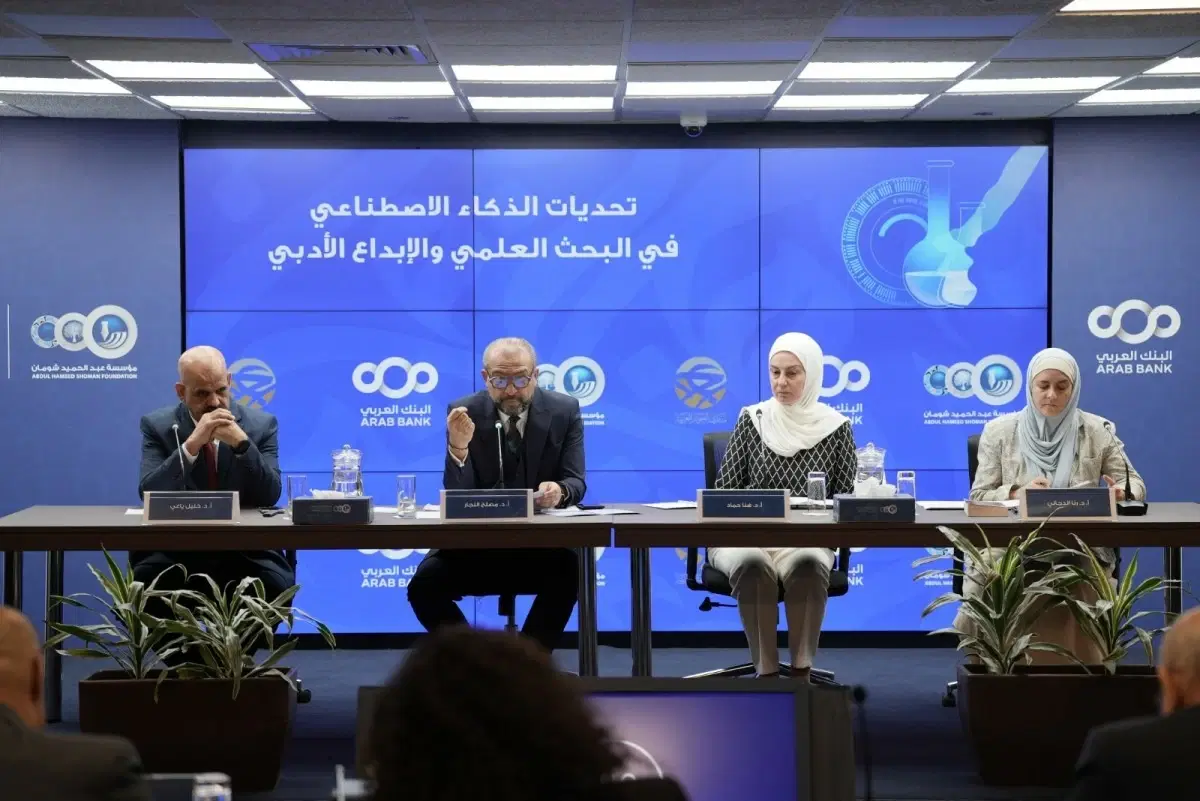
The activities of the symposium “Challenges of Artificial Intelligence in Scientific Research and Literary Creativity” were launched at the Abdul Hameed Shoman Foundation, on Wednesday, organized by the Foundation in cooperation with the Arab Prizes Forum, with the participation of a group of scientists, experts, and researchers in the fields of technology, science, literature, and arts from Jordan and a number of Arab countries.
The symposium, which lasts for two days, discusses the rapid transformations brought about by artificial intelligence in the fields of knowledge, education, scientific research, and creativity, and what this development has imposed of new questions related to the nature of the relationship between humans and tools, and the limits of employing modern technologies in the production of knowledge and creative works.
Abdul Aziz Al-Sabeel, President of the Arab Prizes Forum, emphasized the importance of discussing artificial intelligence and its relationship with the Arab Prizes within a scientific and academic framework, explaining that the subject was raised during the last meeting of the Forum's Executive Council, in light of the rapid development of these technologies and their entry into the fields of science, literature, and arts.
He pointed out that the Executive President of the Abdul Hameed Shoman Foundation, Valentina Qassis, expressed the Foundation's readiness to organize specialized symposiums on the subject in coordination with the Secretariat of the Arab Prizes Forum, which made it possible to hold the current symposium to explore the challenges posed by artificial intelligence to the prizes system.
Sabeel said that this transformation “has forced the Arab Prizes, scientific and literary, to reconsider their criteria and procedures,” especially with the possibility that the submitted works may include varying contributions from artificial intelligence tools.
He added that one of the most prominent questions raised today is determining the boundaries, if possible, between human creativity and the role of artificial intelligence, and determining the intellectual property of works that use these tools, in addition to the question of who deserves the prize in the event that artificial intelligence has a significant contribution to the production of the work.
He explained that the task of the prizes has become more complex in this context, affirming that the Arab Prizes Forum is concerned, at the collective level, with reaching broad outlines that can be used by the prizes in setting their conditions, accepting nominations, and evaluation mechanisms, up to grant decisions.
For her part, the Executive President of the Abdul Hameed Shoman Foundation, Valentina Qassis, said that the discussion is no longer about accepting or rejecting artificial intelligence, “as the rapid developments have surpassed this question,” pointing out that the goal is to establish a roadmap for dealing with it and benefiting from its potential, while maintaining the standards on which scientific knowledge and human creativity are based.
She explained that artificial intelligence provides the researcher with wide possibilities in accessing information, analyzing it, and summarizing large amounts of sources and data, and helps the writer in generating ideas, reviewing texts, and suggesting formulations, which can contribute to saving time and effort and opening new horizons for research and creativity.
Conversely, Qassis pointed to a number of challenges accompanying the use of these technologies, including data quality, bias, originality, scientific theft, the possibility of the decline of some research skills, and the difficulty of verifying the extent of human contribution in the submitted works, in addition to the reliability of information and sources produced by smart tools, and issues of privacy, transparency, accountability, and intellectual property.
In the literary field, she pointed out that the use of artificial intelligence raises the question of the author when the machine participates in the production of the text, and the boundaries separating its use as an auxiliary tool and its transformation into an actual producer of the work, in addition to questions related to its ability to produce a real human experience, and what can remain of the individuality of voice, memory, and imagination in the light of the availability of producing texts with the push of a button.
Qassis explained that the symposium seeks to address the issue from multiple angles, combining technical, ethical, legal, and creative dimensions, noting that the scientific research axis discusses the impact of the increasing reliance on artificial intelligence tools on research skills, the difficulty of evaluating research and verifying its originality, in addition to intellectual property issues and data privacy.
As for the literary creativity axis, according to Qassis, it discusses the concept of the author, originality, and the limits of artificial intelligence's participation in the creative process, its potential impact on cultural diversity and human imagination, and the nature of the relationship that may form in the future between the creator and the machine.
She added that scientific and literary prize institutions are also facing new challenges related to how to ensure the originality of the works that reach the judging committees, determining the acceptable levels of artificial intelligence use, and the time when disclosure of the use of these tools becomes necessary.
Qassis emphasized that the real challenge is to build a conscious and responsible relationship with artificial intelligence, explaining that technology will continue to develop and be present, while the responsibility lies in ensuring that it remains a tool that expands human capacity for knowledge and creativity, not a tool that eliminates its role or weakens its responsibility.
The first day of the symposium witnessed three working sessions; the first was titled “Artificial Intelligence: The Revolution of Knowledge and Its Challenges,” chaired by Dr. Majdi Mamdouh, and featured speeches by Dr. Ghassan Murad, Dr. Walid Al-Halafawi, and Dr. Alaa Al-Faqeeh.
The second session was titled “Ethics of Algorithms: Between Bias and Transparency,” chaired by Dr. Yousef Rababah, and featured Dr. Hamza Al-Akalik, Dr. Shadi Halouh, and Dr. Mowaffaq Al-Mahamid.
The third session was titled “The Future of Scientific Publishing: Artificial Intelligence and Academic Integrity,” chaired by Dr. Mosleh Al-Najjar, and featured Dr. Khalil Ya'ghoub, Dr. Hanaa Hammad, and Dr. Rana Al-Dajjani.
The symposium's activities will continue on Thursday through three sessions; the first is chaired by the writer Fakhri Saleh, and discusses “Intellectual Property in the Age of Machines: Who Owns Creativity – Literary Creativity and Artificial Intelligence: Partnership or Replacement?” and features Dr. Hanouf Al-Dabbasi, Dr. Muhammad Al-Ja'afari, and Dr. Samer Al-Dala'a.
The second session, chaired by Dr. Nasser Shabana, discusses the topic “Artificial Intelligence and the Arts: New Horizons and Existential Questions,” and features Dr. Razan Ibrahim and Dr. Jihad Al-Amri.
The symposium will conclude with the third session, titled “Towards a Regulatory Framework for Artificial Intelligence: Future Visions,” and features Engineer Lama Arabiyat, Professor Bilal Al-Hafnawy, and Dr. Arafat Awjan.
The Arab Prizes Forum, hosted by the King Faisal Prize, includes 35 prizes sponsored by government agencies, private entities, and civil society institutions, including the Abdul Hameed Shoman Foundation prizes.