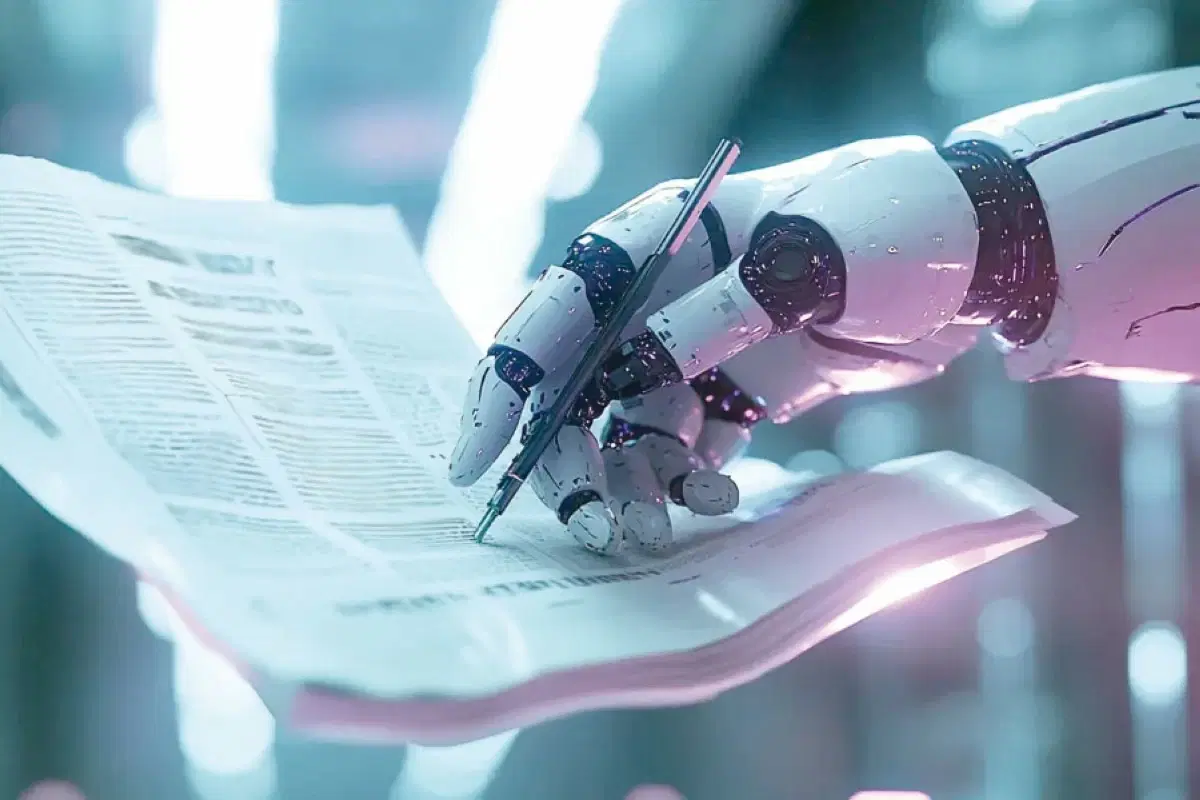
Experts to Alrai: Artificial Intelligence Accelerates Journalistic Work
A Partner for the Journalist, Not a Replacement
Amman12 min read
Share
Journalistic work is undergoing a rapid transformation with the entry of artificial intelligence into various stages of media content production, from research and information gathering and data analysis, to writing, editing, translation, design, montage, and visual content production, which has provided journalists and media institutions with new tools that save time and effort and increase production efficiency.
However, this transformation poses professional and ethical challenges related to the accuracy of information and the verification of sources, intellectual property and privacy, in addition to concerns about the decline of some routine tasks and jobs, and the possibility of content losing its human element if artificial intelligence is relied upon excessively.
Experts in media and linguistics who spoke to (Alrai) agree that artificial intelligence has become part of the media work environment, but it cannot replace the journalist in essential aspects, most notably critical thinking, understanding society, culture, and emotions, asking questions, verifying information, and making editorial and ethical decisions.
Assistant Professor of Linguistics at the American University in Madaba, Munir Al-Qawasmeh, says that the profession of journalism is fundamentally based on research, investigation, and reaching accurate and correct information from multiple reliable sources, noting that obtaining information in the past required significant time and effort in research and verification before presenting it to the reader or listener.
He explained that the journalist in the past relied heavily on reading, research, and study to reach reliable and correct information, a process that takes time and effort, but in return contributes to the consolidation of knowledge and the development of general culture, which is why journalists and media professionals were known for their linguistic proficiency, eloquence, and broad culture, such as Dr. Omar Al-Khatib, Professor Rafe' Shaheen, Ghalib Al-Hadid, Sawsan Tafahah, Montaha Al-Rumaihi, and others.
Al-Qawasmeh pointed out that artificial intelligence has contributed significantly to the development of journalistic work, particularly by speeding up the process of research and access to information smoothly, and the ability to analyze large amounts of documents and data in a short time, as well as drafting initial news drafts, summarizing reports, translation, language proofreading, and suggesting titles and ideas.
He added that artificial intelligence techniques help in detecting misleading content and manipulated images or videos, but these tools also require human intervention, noting that this development has led to a change in the role of the journalist; instead of spending long hours collecting data and performing certain tasks manually, they can now dedicate more time to analysis, investigative reporting, understanding the context of events, and building news stories more comprehensively.
He pointed out that artificial intelligence has enabled media institutions to provide more personalized content according to the interests and preferences of the audience, in addition to transcribing audio recordings and converting them into text, suggesting topics and headlines that match the interests of readers, and contributing to translation into global languages, which has expanded the audience base and reached new global markets.
In the field of content production, Al-Qawasmeh explained that artificial intelligence has contributed to shortening the time required for some stages of writing, design, montage, brainstorming, proofreading, and translation, which can increase production efficiency and reduce some operational costs, stressing that the human element remains the basis of the journalistic process, especially in verifying information, understanding the context, making editorial decisions, and ensuring content quality.
However, he pointed out that excessive and exaggerated reliance on artificial intelligence poses a set of challenges, most notably the absence of the human touch; content produced entirely by artificial intelligence may lack human sensitivity, understanding of social and cultural context, and the ability to deal with sensitive issues.
The risk of falsifying facts or providing inaccurate information also emerges, as some artificial intelligence models generate false information, fabricate entire sources and events, or attribute statements and information to non-existent sources, presenting them in a convincing manner, a phenomenon commonly known as 'AI hallucination,' which makes the verification of information and sources an indispensable necessity.
From an ethical perspective, Al-Qawasmeh believes that the automation of content production raises questions about intellectual property rights and the loss of some traditional jobs, in addition to not indicating the original source or the primary link of the news, which may lead to credibility issues.
Regarding the impact of artificial intelligence on journalists, he said that some routine tasks, such as preparing short news, drafting some bulletins, transcribing interviews, and translating reports, are expected to be affected, which may reduce the need for some jobs.
He added that automation may threaten some jobs, such as writing simple breaking news, drafting sports bulletins, and translating reports, which reduces the need for novice journalists or fast news editors, in addition to the fact that excessive use of artificial intelligence may lead to a loss of human touch, and may also overwhelm newsrooms with the additional work of verifying the accuracy of vast amounts of information and data on the internet produced or contributed to by artificial intelligence.
Al-Qawasmeh emphasized the importance of clear professional and ethical guidelines, stressing the necessity of subjecting any content produced with the help of artificial intelligence to review and scrutiny before publication, because the legal and ethical responsibility remains with the journalist and the media institution, regardless of the tool used, to avoid publishing false information.
He also called on media institutions to establish clear charters that determine when artificial intelligence can be used and what tasks it should not be relied upon for, especially in sensitive topics and important editorial decisions, in addition to the necessity of transparency in using artificial intelligence, by indicating the content produced or modified with its assistance when necessary, to maintain integrity and credibility.
He stressed the importance of protecting intellectual property rights by documenting sources, attributing materials and content to their owners, and not using protected materials without written permission, stressing that artificial intelligence can be utilized in initial research, organizing information, brainstorming, drafting, translation, and summarization, but it should not be an independent source of information.
For her part, Professor of Digital Media at the Private University of Applied Sciences, Dr. Samar Maknai, believes that artificial intelligence will have a clear impact on the media industry and media creativity, but it will not be able to replace human creativity, human experience, and the ability to think critically and ask unexpected questions.
Maknai explains that media dialogue is not only based on pre-prepared questions, as the guest's answers may lead to generating new and innovative questions that were not part of the original dialogue plan, a skill that depends on quick wit, the ability to analyze, and deriving questions from the content and context of the answers, which are among the most important human skills that are difficult for the machine to fully emulate.
She emphasizes that understanding society, culture, emotions, and the human context remains a fundamental human field, in addition to the ability to 'humanize' the media story and turn facts into stories capable of influencing the audience and evoking their emotions, especially in human coverage, interviews, and stories related to people's issues and experiences. The importance of professional judgment and making ethical decisions at various stages of media work also stands out.
According to Maknai, the human will remain the one who determines: what to produce? Why produce? For whom? What is the expected impact of this content on society? And what message do we want to convey to the audience? Emphasizing that the 'humanity of the human' remains a core element in media work, and artificial intelligence cannot cancel or replace it.
She points out that artificial intelligence has become a fundamental part of the modern technology system and has brought about a transformation in various sectors and work styles within institutions, including media institutions. According to her, some media jobs are expected to change, and some routine tasks will decline, in light of the rapid development in areas of information gathering, data analysis, content production, text editing, image and video processing, and audience interest analysis.
Maknai believes that the future of media in the era of artificial intelligence will not mean canceling the role of the human, but will redefine this role within the media institution and in the content production process, which imposes new challenges, foremost of which is verifying information, confronting misleading content and content generated by artificial intelligence, and maintaining credibility and trust with the audience.
She adds that 'the media of the future will be a hybrid media in which humans cooperate with artificial intelligence,' explaining that the machine is capable of processing huge amounts of data quickly and efficiently, but it does not bear the ethical and legal responsibility for the media decision.
For his part, Professor of Digital Media at the Private University of Applied Sciences, Dr. Saddam Al-Mashabqa, said that artificial intelligence has clearly contributed to speeding up journalistic work and has also helped to improve its quality, whether in terms of writing texts and producing content, or in terms of the visual aspect, such as infographics and videos, and even videos generated by artificial intelligence.
He added that artificial intelligence has also entered the editing and montage processes, and has become present in all stages of producing journalistic material, explaining that its use can start from the stage of proposing an idea and determining the angle of journalistic treatment, through data collection and organization, up to editing the text and producing the visual and output form of the material, whether it is journalistic, television, or digital.
Al-Mashabqa believes that it has become difficult today to talk about a modern media institution or a journalist working in isolation from artificial intelligence tools, explaining that the issue is no longer related to the desire to use these tools or not, but has become part of the nature of the media work itself.
He said that a journalist who does not know how to use artificial intelligence in his work may find himself, over time, lagging behind his colleagues and the development witnessed by the media sector, and therefore believes that artificial intelligence is no longer just an additional tool for the journalist, but has become part of the journalistic work environment that the journalist must understand and know how to benefit from it in a professional and conscious manner.
On the other hand, Al-Mashabqa pointed to a number of risks associated with the use of artificial intelligence, primarily the protection of intellectual property, privacy, and information, explaining that one of the main issues is that artificial intelligence may present information from a certain angle or cultural context, and often this angle is influenced by the sources and knowledge available in Western environments and countries, which may not necessarily reflect the viewpoint of Arab or Eastern societies and their cultural and intellectual specificity.
He added that artificial intelligence may provide some information without clearly showing its sources, or without enabling the user to easily access the original reference on which it is based, considering that this matter poses a real challenge, especially for researchers, journalists, and users who have become receiving information directly from artificial intelligence tools without verifying its source or comparing it with other sources.
He emphasized that the danger lies in the possibility of weakening the culture of verifying information, which is one of the most important principles upon which journalistic work and scientific research are based, and therefore artificial intelligence should not be turned into a final source of information, but rather a tool that helps the journalist or researcher to reach and analyze it, while the responsibility of verifying the sources, accuracy of information, and the context in which it was received remains on the user himself.
Al-Mashabqa believes that dealing with these challenges requires a clear institutional effort, and the responsibility of dealing with artificial intelligence cannot be left to the journalist or researcher individually, explaining that there is a responsibility that falls on professional institutions, such as the Jordanian Journalists Syndicate, institutions concerned with developing journalistic work such as the Areej Network for Investigative Journalism, as well as media colleges and departments in Jordanian universities. He said that these entities have the ability to establish a clear professional framework that determines how to employ artificial intelligence in journalistic work, and set a set of standards related to verifying information, transparency, protecting intellectual property, privacy, and the method of indicating the use of artificial intelligence tools in content production.
At the same time, he stressed that the solution is not limited to issuing guides or setting standards, but must be accompanied by continuous training programs for journalists, researchers, and media students, explaining that the journalist must learn how to use artificial intelligence tools efficiently, including 'Prompt Engineering' or prompting engineering, but more importantly, he must know when and how to use these tools, the limits of relying on them, and how to verify the information they provide.
Al-Mashabqa emphasized the need to build a professional and ethical awareness alongside technical skills, so that artificial intelligence becomes a tool that helps the journalist to develop his work and speed up his production, and not a substitute for journalistic thinking or professional verification of information.
With the increasing presence of artificial intelligence in newsrooms, journalism seems to be facing a new phase that does not eliminate the role of the human, but rather redefines it. The speed of accessing, processing, and producing content is not enough alone to produce professional journalism; the value of the journalist remains in his ability to question, investigate, verify, understand the context, choose the appropriate angle, read society, and deal with its issues responsibly and humanely.
Between the efficiency of the machine and the creativity of the human, the features of a new media are taking shape in which artificial intelligence appears as a partner in the tools of work, not a substitute for its owner, leaving the most important equation in journalism: technology that speeds up work, a journalist who verifies, and an institution that bears responsibility.