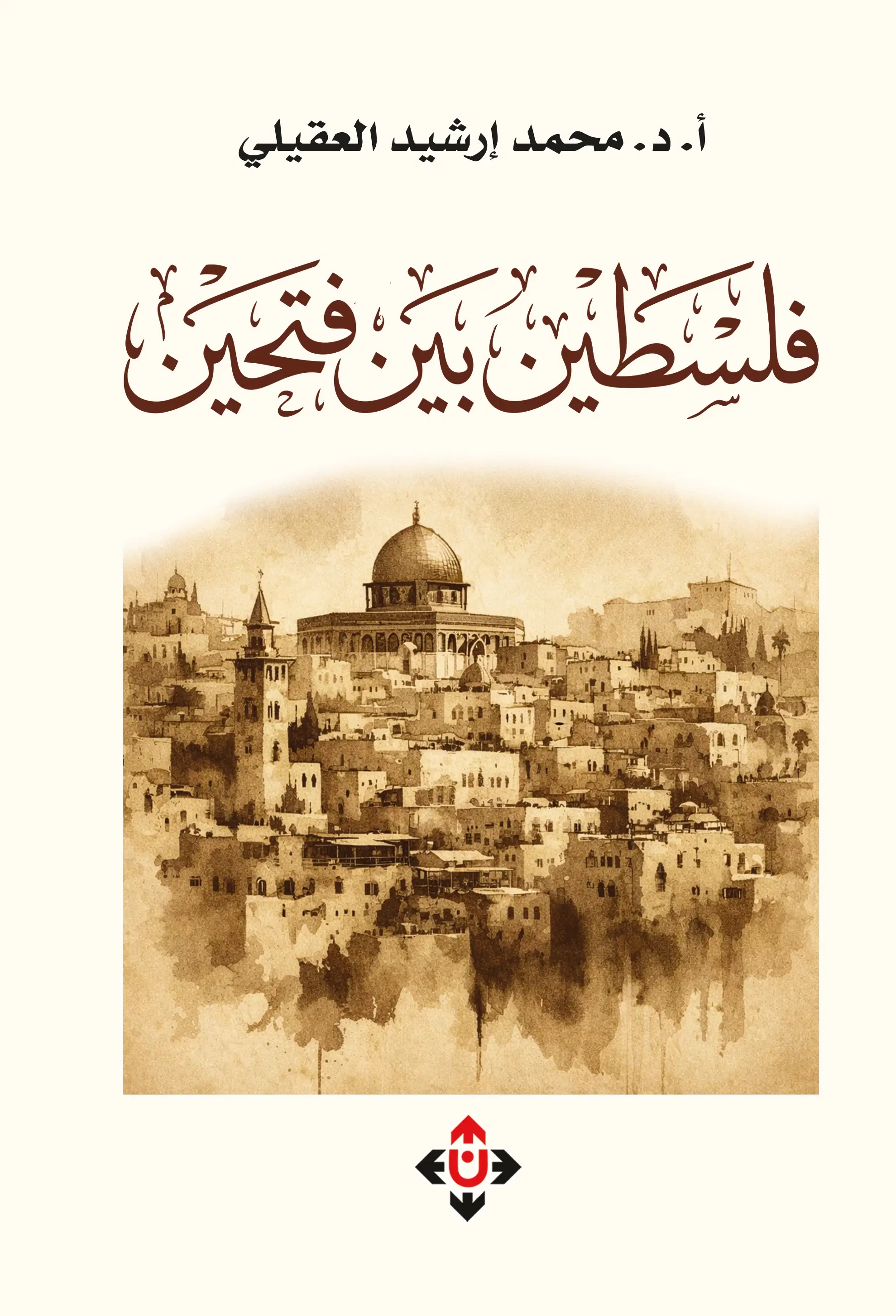
Historian Al-Oqaili reads the history of Palestine between the Umari and Ayyubid conquests
Amman8 min read
Share
Ever since Palestine entered Islamic history, its status has transcended geographical boundaries, due to the religious and civilizational weight it represents, and because it has been, throughout the centuries, a subject of competition for powers seeking to control the Levant. Between the conquest of Jerusalem during the reign of Caliph Umar ibn al-Khattab and its recovery at the hands of Saladin al-Ayyubi following the Battle of Hattin, lies a historical era full of political and military transformations, conflict over land and identity, and attempts to impose influence and alter the features of the place.
In this context, the book "Palestine Between Two Conquests" by historian Professor Dr. Muhammad Irshid Al-Oqaili, published by "Al-Aan Publishers and Distributors" in Jordan in 2026, offers a historical reading of Palestine's path from its ancient eras, through the Islamic conquest and the subsequent ages, up to the Crusades and the Ayyubid liberation, and then the Mamluk role in ending the Crusader presence in the Levant. The book recalls pivotal milestones in the region's history, extracting their political and civilizational implications, and highlighting what the author sees as similarities between the historical experience of confronting the Crusaders and the challenges facing Palestine in the modern era.
The book, which spans 384 large-format pages, includes twelve chapters, an introduction, and a conclusion. The first chapter covers the ancient history of Palestine until the advent of Islam, and the second chapter reviews the Arab presence in the Levant and Palestine, the kingdoms that succeeded one another, and the Arab tribes that settled there. The third chapter is devoted to the vanguard of the Islamic conquest of the Levant and Palestine during the lifetime of the Prophet, may God bless him and grant him peace.
The fourth chapter pauses at the Islamic conquest movement during the Rashidun era, and the conquest of Damascus, Jerusalem, Caesarea, and the rest of the regions of Palestine. The fifth chapter discusses the history of Palestine during the Umayyad rule, and the sixth chapter revolves around the history of Palestine during the early Abbasid era, the position of the people of Palestine regarding this rule, and the issue of Charlemagne's alleged protection of Jerusalem.
The seventh chapter reviews the history of Palestine from the Tulunid era to the Fatimid era, while the eighth chapter discusses the Crusader invasion of the Levant and Palestine, and the establishment of the Crusader kingdoms, foremost among them the Kingdom of Jerusalem. The ninth chapter focuses on the signs of unification at the hands of the Zangids: Imad ad-Din and his son Nur ad-Din, and their position on the power struggle in the Islamic world. The tenth chapter explains the role of Saladin al-Ayyubi in completing what the Zangids began in raising the banner of Islam after the fall of the Fatimid Caliphate in Egypt, and the unification of the Levant and Egypt.
The eleventh chapter deals with the administrative systems in Palestine during the Crusader and Ayyubid eras, and how the Crusaders tried to imprint Palestine with their own character and erase its religious and civilizational Islamic character. The twelfth and final chapter focuses on the important role played by the Mamluks, after they assumed rule over Egypt and the Levant, in stopping the Mongol advance at Ain Jalut, and in eradicating the Crusader presence from the Levant and Palestine from its roots.
Historian Al-Oqaili shows in the first chapter of his book that Palestine was, in its ancient and medieval history, part of the Levant and a natural extension of the Arabian Peninsula, just as it is in its modern and contemporary history the "heart of the Arab world." He emphasizes that Palestine's strategic location gave it special importance throughout the centuries, as it was a crossing point for invading armies from East to West or vice versa, and this became clear from the Persian invasion of the West or the Greek invasion of the East to Napoleon's campaign in Egypt, and even in the First World War, as it was a crossing point for the Allied armies.
Al-Oqaili explains how this important location of Palestine "whetted the appetites of conquerors throughout the ages, and was a double-edged sword; it was both a curse and a blessing for its people at the same time, which made the interests of Western colonialism converge with the interests of the Zionist movement in establishing a national home for the Jews there." Palestine was the first line of defense for the ruling regime in Egypt against the powers hostile to it in the Levant during the Islamic eras, and likewise the first line of defense for the ruling regimes in the Levant against the powers hostile to them in Egypt.
Historian Al-Oqaili mentions that the Islamic expansion movement soon liberated the Levant in general, and Palestine in particular (including Jerusalem) from the hands of the Romans, and he says in this regard: "The conquest of Jerusalem by Umar ibn al-Khattab linked the first of the two Qiblas and the third of the two Holy Mosques to Mecca, so that Palestine, like other Islamic countries, became Arab and Islamic. Its inhabitants embraced Islam, and its life was completely imprinted with the Arab-Islamic character, and civilization prevailed in a way that expresses Islamic civilization in the Islamic world."
He clarifies that Palestine remained Arab and Islamic since the Arab conquest of it, and until the modern era, with the exception of that period during which it remained under the Crusader invasion that tried to erase its identity.
Al-Oqaili confirms that "there is a great similarity between our confrontation today with the Zionist movement and the confrontation of the Zangids, Saladin, and the Mamluks with the Crusaders, and that there are many lessons that we must draw through extrapolating the Islamic experience with the Crusaders. Foremost among them is that Saladin realized that before he could wage a decisive war against the Crusaders, he had to put an end to the state of Arab fragmentation between Egypt and the Levant, and that the meeting of the surrounding countries—even partially—is enough to be the strong foundation for the beginning of the end of the Crusader presence in the Levant and Egypt."
Al-Oqaili traces the similarities between the Zionist movement and the Crusader campaign, for "they were born from social, economic, political, and intellectual interactions in the European continent, and the goal of each of them was expansion to tear apart the Arab-Islamic nation under the guise of religion to settle in the land of (the Promise), because the two movements emerged from one ideology, which is the connection to the sacred promise and the chosen people of God." He adds that both movements "are united by the idea of civilizational alienation, as they are coming from outside the region, and they are originally part of the Western world," confirming that the Crusader movement would not have succeeded in controlling Palestine and the Levant had it not received comprehensive support from Europe. The same applies to the Zionist movement, which would not have been able to penetrate Palestine and aspire to expand had it not received absolute support from the major powers in the West and East alike. The most important factor is "the state of fragmentation, disintegration, and division that the Arab nation lived on the eve of the Crusades, just as it lived on the eve of the Zionist aggression against Palestine since the beginning of the twentieth century."
Historian Al-Oqaili focuses on the importance of unity "to confront opponents and resume the pride and glory that the Arab nation once had, and to be sincerely prepared materially and spiritually, and to benefit from all the available assets of this great nation."
It is noteworthy that Professor Dr. Muhammad Irshid Al-Oqaili obtained a Bachelor's degree in History from Damascus University in 1963, earned a postgraduate diploma in History in 1972, and then obtained a PhD in History from Saint Joseph University/Lebanon in 1978. He worked in Jordan as a supervisor, and progressed through administrative positions in the Ministry of Education, including Director of Education in a number of governorates, then worked at the Ministry's center as Director of Educational Planning and Research. He also worked as a part-time lecturer in the Department of History at the Faculty of Arts at the University of Jordan between 1978 and 1981. He was seconded to the United Arab Emirates University between 1981 and 1994 to teach and establish the Department of History at the Faculty of Arts at the UAE University, then returned to Jordan and worked as a professor and lecturer at Philadelphia University, then joined Jerash University to work as Vice President of the University. He has authored several works, including: "The Arabian Gulf in the Islamic Eras," and "The Shia: Its Origins and Development until the Middle of the Third Century AH," and he has prepared and published many research papers, and participated in regional conferences concerning modern and ancient history.