Shoman discusses the future of artificial consciousness and the potential of robots
Amman2 min read
Share
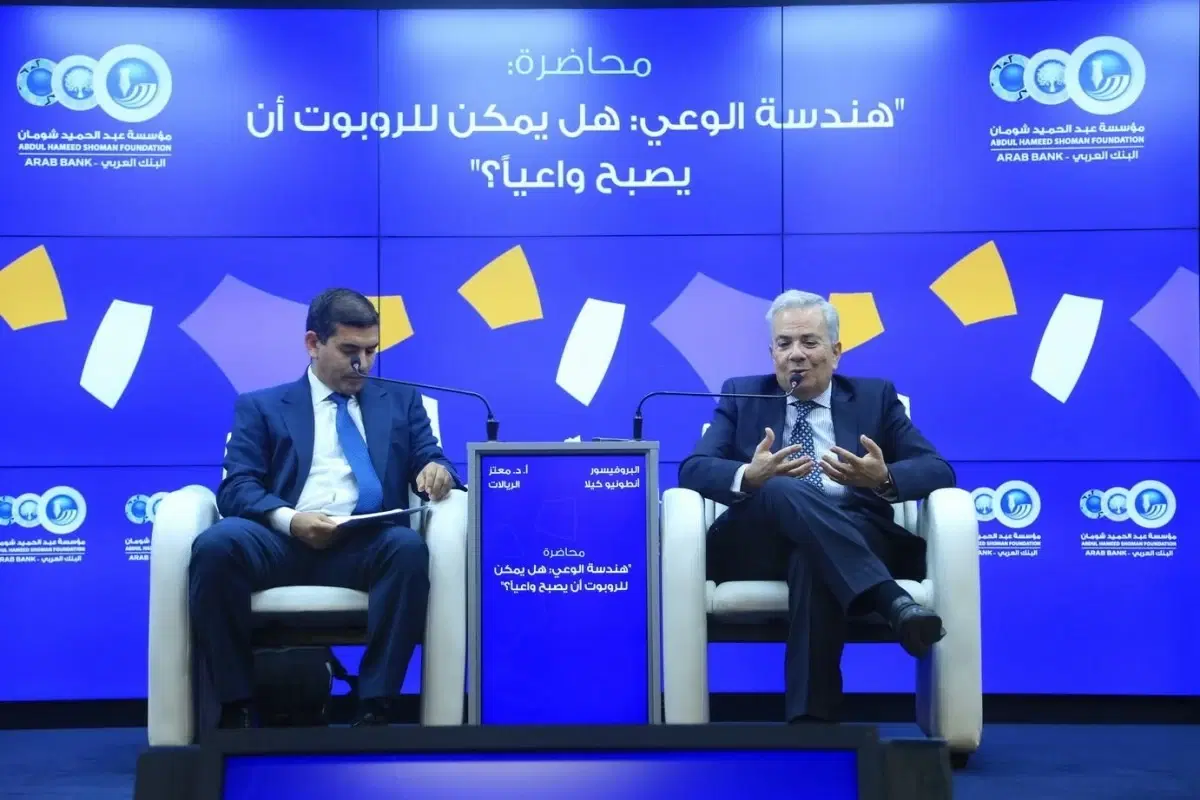
The Abdul Hameed Shoman Foundation Cultural Forum recently hosted Italian researcher, Professor of Robotics at the University of Palermo, and Director of its Robotics Laboratory, Antonio Chella, in a dialogue titled "Engineering Consciousness: Can a Robot Become Conscious?" The event addressed one of the most prominent scientific and philosophical issues related to the rapid development in the fields of artificial intelligence and robotics.
During the dialogue, moderated by the Chair of the IEEE Robotics and Automation Society in Jordan and Professor of Mechatronics Engineering at the German Jordanian University, Dr. Mutaz Al-Ryalat, Chella discussed the concept of artificial consciousness and the boundaries between intelligence and consciousness. He noted that the ability of intelligent systems to learn, analyze data, and make complex decisions does not necessarily mean they possess consciousness or a subjective experience similar to humans.
Chella reviewed part of his research in the field of cognitive robotics and artificial consciousness, pointing to scientific efforts to develop robots capable of interpreting their internal processes and interacting with the surrounding environment in more advanced and autonomous ways.
He emphasized that research into the nature of artificial consciousness is not limited to developing machines, but could open the door to a deeper understanding of human consciousness itself, as scientists continue to study how consciousness arises and the possibilities of simulating it within artificial systems.
The dialogue witnessed a remarkable turnout from those interested in technology and innovation across various age groups. The meeting included an extensive discussion with the audience on a range of issues related to the future of artificial intelligence, primarily the ethics of using these technologies, the future of robots in the labor market, and the boundaries of the human-machine relationship.
The discussion also addressed the potential for the development of more autonomous artificial systems in the coming years, the implications of this for human creativity, scientific research, and economic development, as well as questions regarding responsibility and ethical boundaries in light of the growing capabilities of intelligent systems.