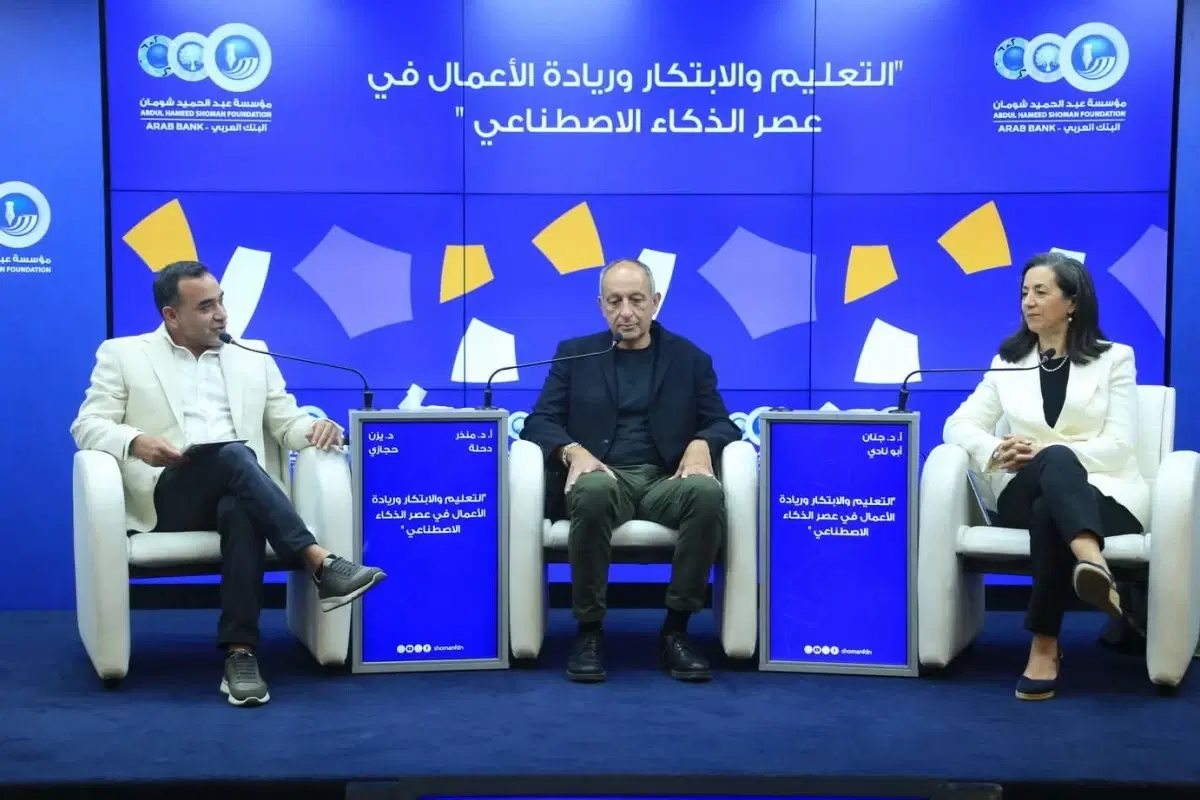
The participants pointed out that the world is witnessing a phase characterized by uncertainty in light of the rapid development of artificial intelligence, whose impact is no longer limited to traditional businesses, but has extended to include intellectual and creative work, contributing to the creation of new economic and knowledge opportunities, alongside challenges that may widen the gap between societies depending on their ability to keep pace with and benefit from technological transformations.
They stressed that education represents the primary starting point for dealing with these variables, which requires rethinking the philosophy and goals of education, not just by introducing smart tools into classrooms, but by moving toward educational models that focus on developing critical thinking, analysis, and problem-solving, and enhancing students' ability to ask questions and engage with knowledge consciously and responsibly.
They noted that the ease of accessing information and analysis in a short time necessitates the development of educational curricula and moving away from rote learning and memorization methods, in line with the requirements of the digital age, emphasizing the importance of educational institutions keeping pace with the successive developments in the field of artificial intelligence by qualifying teachers and developing their capabilities, in addition to consolidating the principles of academic integrity and ensuring the responsible use of modern technologies.
Regarding the economic aspect, the participants explained that artificial intelligence contributes to reducing the time and cost required to accomplish many tasks, and provides tools that help develop ideas and turn them into viable projects, which enhances the opportunities for entrepreneurs to establish businesses, develop products, study markets, and reach customers more efficiently.
They pointed out that the educational technology, healthcare, digital services, and Arabic content sectors offer promising opportunities for innovation and launching new projects, but benefiting from them requires overcoming multiple challenges, most notably the difficulty of obtaining funding, the dominance of global platforms, and rapid technical changes, as well as the need to develop business models capable of sustainability and achieving growth.
They warned that the concentration of data, computing power, and advanced technologies in a limited number of companies and countries raises important questions regarding the monopolization of knowledge, the protection of intellectual property, and technological dependency, which calls for strengthening local capabilities and expanding access to technology to ensure its benefits are realized in a more fair and inclusive manner.
The participants emphasized the importance of dealing with artificial intelligence as an opportunity to improve the quality of daily life by employing its applications in health, social, economic, and other fields, while stressing the need to balance benefiting from its potential with addressing the risks associated with its use, to ensure that innovation is directed toward serving humanity and meeting its needs.
Dr. Munther Dahleh holds the William A. Coolidge Professorship in Electrical Engineering and Computer Science at the Massachusetts Institute of Technology (MIT), and is a member of the Institute's Laboratory for Information and Decision Systems (LIDS).
Dr. Jinane Abounadi serves as the Executive Director of the MIT Sandbox Innovation Fund Program at the Massachusetts Institute of Technology, and possesses professional experience that combines academic research with leadership, operational, and strategic roles in startups and major institutions.