Artificial Intelligence.. A partnership with humans or the beginning of a new era for work?
Amman6 min read
Share
Experts to «Alrai»: Artificial Intelligence is reshaping work and putting human skills to a new test
«Artificial Intelligence has become one of the most important technologies that will change the way we live and work in the coming years», with this phrase Dr. Mohammed Khamis describes the rapid transformations brought about by Artificial Intelligence in various fields of life, from education, health, media, and business, down to the details of daily life.
Khamis believes that the value of Artificial Intelligence lies not only in its ability to speed up tasks, but in helping humans invest their time and capabilities better, explaining that the technology allows rapid access to and analysis of information, boosts productivity, and opens the door to creating new jobs and projects. Khamis emphasizes that the expansion in the use of Artificial Intelligence carries great opportunities, but at the same time imposes challenges related to privacy, misinformation, and excessive reliance on technology.
He points out that some users share personal or sensitive information with Artificial Intelligence tools without fully knowing how this data is handled, making privacy protection a key issue in the coming phase.
He also draws attention to the ease of producing fake images, videos, and news using these technologies, which may make distinguishing between real and synthetic content more difficult.
Khamis stresses the necessity of not treating Artificial Intelligence outputs as absolute truths, affirming the importance of keeping humans in the position of review, thinking, and final decision-making.
Regarding the future of jobs, Khamis does not expect Artificial Intelligence to completely replace humans, but he believes it will change the nature of many jobs and tasks.
He explains that routine and repetitive tasks will be the most vulnerable to automation, including data entry, preparing certain reports, some customer service tasks, basic translation, and basic content production. At the same time, he points out that new jobs will emerge, while the nature of existing jobs will change, noting that competition in some fields may not be between human and machine, but rather between an employee who knows how to employ Artificial Intelligence in their work and another who lacks this skill. In light of these transformations, Khamis mentioned that possessing Artificial Intelligence tools alone is not enough; rather, young people must develop critical thinking, creativity, problem-solving, communication, and continuous learning skills, alongside digital skills.
He emphasizes that professional specialization will remain important, explaining that a person who possesses real knowledge in their field—whether marketing, medicine, engineering, or media—and then learns how to employ Artificial Intelligence within their specialization, will be more capable of benefiting from these technologies.
Regarding the future of the relationship between humans and machines, Khamis suggests that the next phase will move towards a partnership between humans and Artificial Intelligence, rather than the complete replacement of humans.
He attributes this to humans possessing capabilities that are difficult to reduce to fast data processing, such as human judgment, creativity, empathy, and understanding of society, culture, and context.
Khamis stresses that dealing with Artificial Intelligence inside educational institutions should not be based solely on banning it, but on teaching students how to use it correctly, verifying the information it provides, and employing it as a learning tool rather than a substitute for thinking.
He also calls for setting clear legislation to protect privacy and data, regulate content generated by Artificial Intelligence, and limit uses that may harm individuals and society, while simultaneously preserving space for innovation.
In concluding his vision, Khamis emphasizes that Artificial Intelligence is a powerful tool, and its positive or negative impact will not be determined by the technology alone, but by the way humans decide to use it.
For his part, Professor Omar Al-Hunaiti points out that the rapid development of Artificial Intelligence could lead to broader transformations in how humans work and live, ultimately redefining the relationship between humans and machines.
Al-Hunaiti reveals that the scale of transformation associated with Artificial Intelligence requires setting clear controls to ensure these technologies are directed towards uses that serve humans and society, alongside laws and deterrent penalties for harmful uses.
Al-Hunaiti expects the spread of Artificial Intelligence to lead to a reconsideration of the work pattern itself, including working hours and retirement age, as a result of reducing the time and effort required to accomplish many tasks.
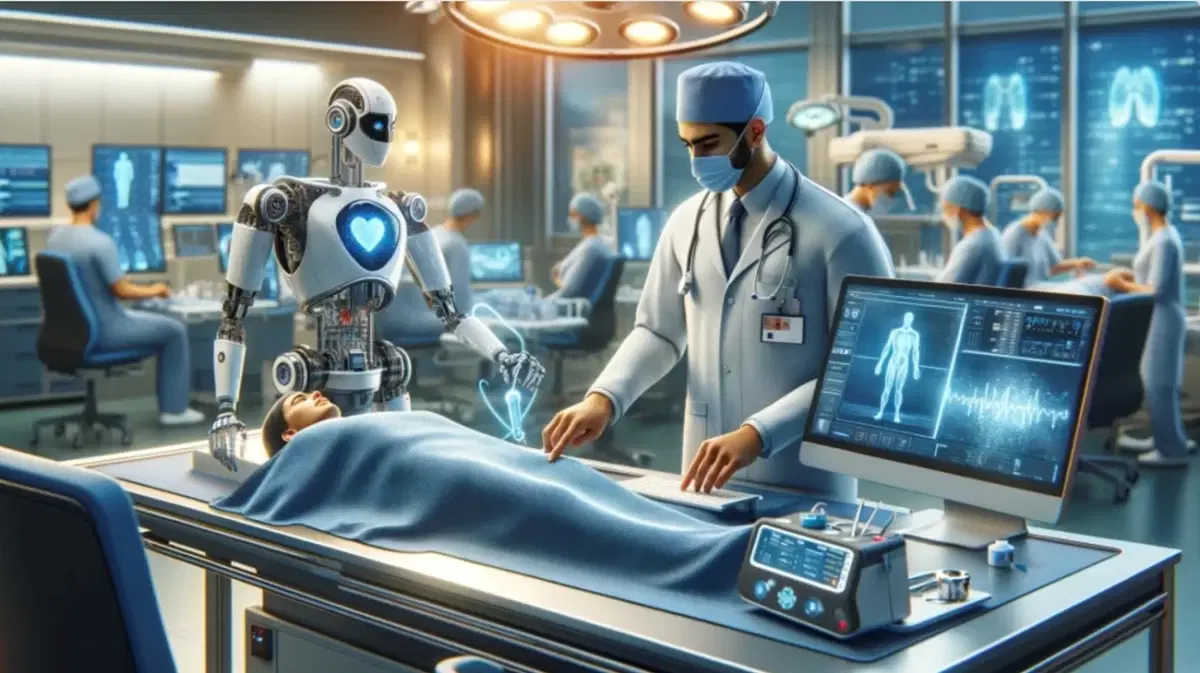
He gives an example of this in the medical sector, where a physician proficient in Artificial Intelligence tools can benefit from them in analyzing data and following up with a larger number of patients, alongside the possibility of supervising procedures carried out by robotic systems.
He notes that other sectors, such as tourism, can benefit from these technologies by removing language barriers and providing interactive services to visitors. Al-Hunaiti points out that the coming phase may witness an increasing integration between humans and Artificial Intelligence tools, such that the technology becomes an assistant in a large number of details of life, work, learning, and skill development.
Al-Hunaiti believes that Artificial Intelligence is capable of simulating broad aspects of thought and creativity, but points out that what distinguishes humans is that their decisions are tied to feelings, emotions, and passion.
Al-Hunaiti reveals that the rapid development of these technologies makes the need for legislation and oversight more urgent, calling for regulations and deterrent penalties for uses that could cause widespread harm. He cites examples from the history of human development, explaining that inventions and technological revolutions brought great benefits to humanity, but at the same time required laws and controls to limit their negative effects. Al-Hunaiti believes that the scale of the upcoming transformation requires preparing for it early by developing skills, reorganizing the labor market, and establishing clear legal controls.
The two experts agree that Artificial Intelligence will bring about an increasing transformation in the nature of work and life, without necessarily meaning the complete abandonment of humans, as human skills—foremost among them critical thinking, creativity, judgment, and decision-making—will remain essential elements in the coming phase. They also meet on the importance of preparing for this transformation by developing individuals' skills, promoting the responsible use of technology, and establishing legislation and controls to ensure Artificial Intelligence is directed to serve humans and society.