Three films revisit Lebanon's memory and transformations at 'Shouman'
Amman5 min read
Share
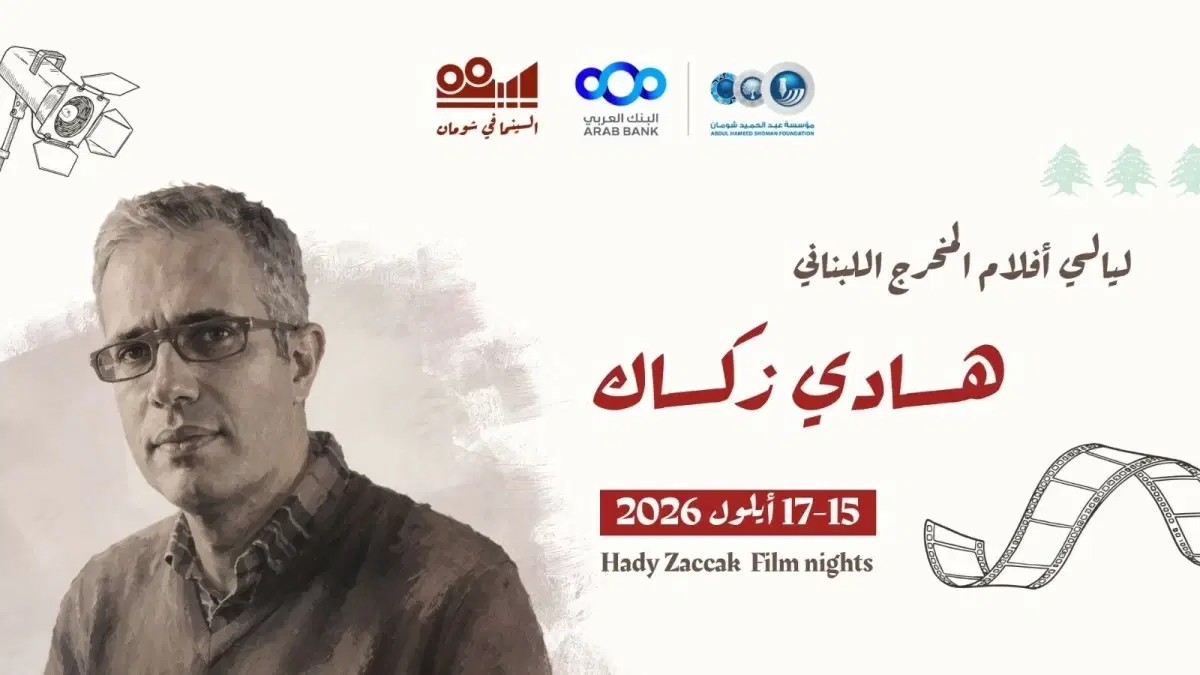
Starting tomorrow evening at the Abdul Hamid Shouman Foundation, selected screenings of Lebanese director Hadi Zakak's documentary films will continue until next Thursday, in a cinematic program that, through images, revives stories from Lebanese memory and observes societal transformations through family stories, migration, cinema, and objects that have turned into historical markers of the country over time.
The screenings will take place in the cinema hall at the institution's headquarters in Jabal Amman at half past six in the evening, while other screenings will be held outdoors at eight in the evening.
The program opens tomorrow with the film 'Ya Omri', in which the director follows the life of his grandmother 'Henriette' from 1992 until she reaches 104 years of age, in a cinematic journey that spans nearly a quarter of a century, during which the filming tools and techniques change in parallel with the character's changes and aging.
The film is based on the grandmother's memory to reconstruct the family's history, starting from their emigration from Lebanon to Brazil, through marriage and motherhood, to old age and the decline of physical and mental abilities. Zakak gives the viewer a chance to see the world from the perspective of a woman who has lived for more than a century, where times and memories overlap and the boundaries between the past and present blur.
Visually, the film goes beyond traditional chronological storytelling, utilizing the family's written archive, photographs, and video clips of family events, along with materials filmed by the director over many years. It also uses the image, especially out-of-focus scenes, to simulate the nature of vision in the elderly, making the cinematic form part of the story rather than just a means of telling it.
'Ya Omri' presents old age as a shared human experience, focusing on the relationship of love and care within the family, and the resilience and adherence of the individual to their personal traits despite declining abilities, making the film a visual testimony to the passage of time and the transformation of the body and memory.
The film has won several awards, including the Jury Prize at the Malmö Arab Film Festival and the Silver Prize at the Geneva International Festival of Eastern Cinema.
'Silma'... Cinema halls witness transformations
The Wednesday program is dedicated to the film 'Silma', a popular term for 'cinema', which deals with the history of cinema halls in the city of Tripoli in northern Lebanon, and the social, political, and cultural transformations it witnessed before they were closed and disappeared.
The film revisits, through the testimonies of several personalities, photographs, and archival images, a period when cinema halls were part of the daily life of Tripoli's residents, a place for entertainment and meeting, but at the same time a space for shaping awareness and learning about the world and different cultures.
'Silma' raises questions that go beyond the history of the halls to the relationship of society with cinema and its cultural role, benefiting from direct testimonies in front of the camera about the memories of those places, the events they witnessed, and the relationship of the audience with stars and films, and the impact of cinema on culture and the perception of reality.
Zakak relies on montage as a key element in building the film, combining still images, camera movement, and character testimonies, in an attempt to reconstruct a time when cinema halls were part of the city's fabric and memory.
'Mercedes'... Six decades of Lebanon through a car
The screenings conclude next Thursday with the film 'Mercedes', in which Zakak uses the Mercedes car as an entry point to read six decades of modern Lebanese history, from its arrival from Germany to Lebanon in the 1950s until the first decade of the 21st century.
The film does not treat the car merely as a means of transportation, but as a social, cultural, class, and political phenomenon that has experienced different segments of Lebanese society. Some were associated with taxis and the livelihood of the working class, while others were linked to politicians, the wealthy, and those in power.
Through the 'Mercedes family', the film observes the car's ability to cross the class, sectarian, and political boundaries that characterized Lebanese society, and stops at the popular names given to it by the Lebanese, such as 'Al-Mu'addabla', 'Al-Shabah', and 'Al-Ghoussa', reflecting the special relationship that developed between society and this car.
The film traces milestones in Lebanon's history, starting from the pre-civil war period, when the Mercedes became a symbol of prosperity, through the war years (1975-1990), when cars appeared at checkpoints and on the front lines, and some were even used in bombing and explosion operations, turning the symbol of luxury into part of the war and violence scene.
In Zakak's reading, the Mercedes becomes, over time, like a member of the Lebanese community; it carries its identity, divisions, and affiliations, and transforms from a mere witness to events into part of their details and conflicts, in a journey that makes the car's history parallel, in many of its stations, to the history of Lebanon itself.
It is worth noting that Lebanese director Hadi Zakak has been teaching audiovisual arts and film studies at Saint Joseph University since 1988, and is one of the most prominent documentary filmmakers in Arab cinema. He has produced more than 25 documentary films, including 'Lesson in History', 'Echoes from Lebanon', 'Ya Omri', 'Kamal Jumblatt... The Witness and the Testimony', and 'Mercedes'.
Zakak's works are characterized by their focus on individual and collective memory, and the exploration of transformations that have affected Lebanese society, through characters, places, and everyday objects that turn into living documents of a bygone era in his films, giving documentary cinema a human dimension that goes beyond documentation to question memory and reality and anticipate the future.