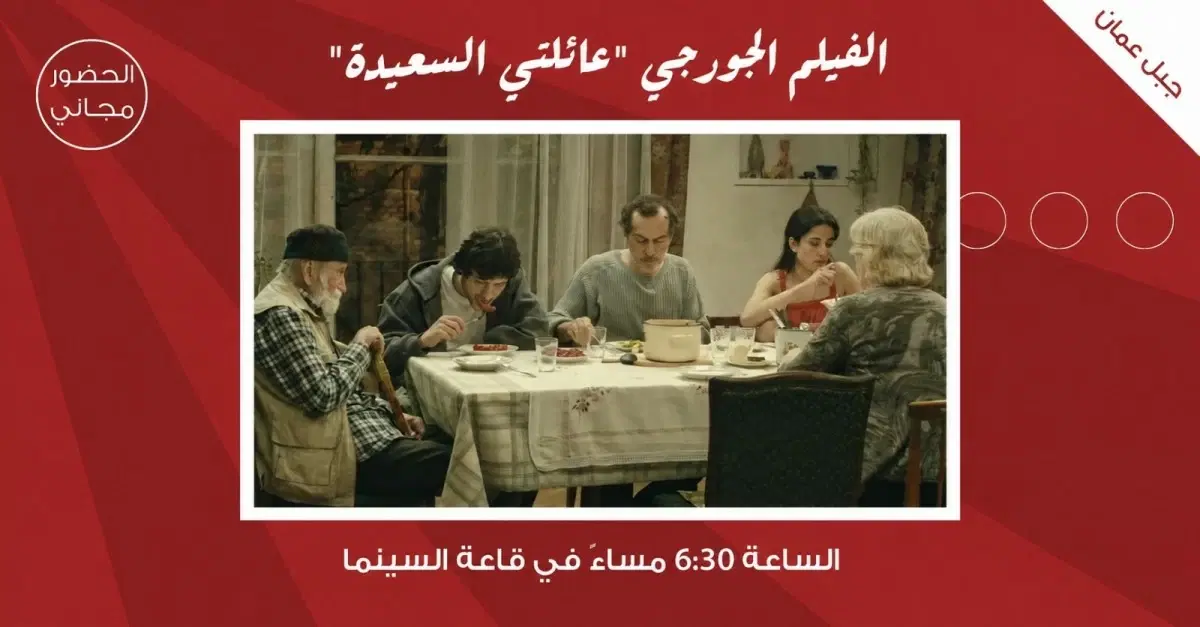
The Cinema Committee at the Abdul Hameed Shoman Foundation will screen the joint German-Georgian film "My Happy Family" (2017), by Georgian director Nana Ekvtimishvili and German director Simon Groß, tomorrow, Tuesday, at 6:30 PM, in the cinema hall at the foundation's headquarters in Jabal Amman.
The film, which has won a number of awards at international festivals, addresses the issue of women and their right to independence and to choose the lifestyle that suits them, through a human story that highlights the relationship between the individual and the family, and the conflict between personal desires and deep-rooted social traditions.
The film's events revolve around Manana, a 52-year-old literature teacher who decides to leave the family home and move into an independent apartment, a move that seems surprising to her family members who were accustomed to her presence among them as a wife and mother bearing her family responsibilities without paying much attention to her own needs.
Manana lives in a cramped apartment that houses her husband, her parents, her young son and his pregnant girlfriend, as well as her daughter and her husband, in a crowded space where the details of daily life overlap and the boundaries of personal privacy are narrowed. Despite the tension and fleeting arguments that accompany this lifestyle, the family members seem adapted to their reality, until Manana announces her desire to separate from this environment and live alone.
These transformations coincide with the celebration of her fifty-second birthday, which turns into an occasion that reveals her feeling of isolation among family members and relatives. While her husband wants to expand the circle of guests for the celebration, Manana prefers a limited family gathering, before choosing to move away from the noise of the attendees and sit alone on the balcony, in a scene that reflects the psychological distance separating her from her surroundings.
Her decision to move to an independent house raises a series of questions among family members, relatives, and acquaintances; everyone tries to know the reasons that pushed her to take this step, and they look for an incident or a dispute that could explain her position, while Manana confirms that she was not mistreated by any member of her family, and refuses to provide additional justifications or back down from her decision.
The film does not provide a direct reason for Manana's rebellion against her previous life, as much as it suggests that her decision came as a result of the accumulation of long years of routine and silent concessions, which finally pushed her to search for a private space in which to reclaim herself and rediscover her needs away from the roles imposed on her by family life.
In parallel with Manana's story, the work presents a comparison between her generation and the younger generations that have begun to deal with human relationships and family ties from a different perspective, away from the traditional concepts that make the continuation of a relationship an end in itself, regardless of the desires of its parties.
This is highlighted in a scene that brings Manana together with one of her students, who explains her absence from school by her preoccupation with divorce proceedings from her husband, explaining that the decision to separate was not the result of a specific dispute, but rather because of the difference in their desires and aspirations for life. The student summarizes her position by emphasizing that a person's knowledge of what they want is the first step toward achieving it.
The film's connotations do not stop at the issue of individual independence, but extend to the complexities of human relationships and what they require in terms of understanding, tolerance, and the ability to overcome the mistakes of the past. During a meeting with old friends, Manana discovers that her husband had previously had a secret relationship with another woman and had a son with her. However, she does not allow this fact to turn into an additional cause for conflict, as she later visits the woman and meets her son, in a treatment that avoids direct judgments and leaves space for reflection on the nature of marital and human relationships.
In one of the film's most significant scenes, Manana's husband is assaulted by three men in the neighborhood where she lives, after they considered themselves responsible for protecting her from the visits of strange men, based on an assignment from one of her brothers. This situation reveals the presence of social censorship in a woman's life, even after she has made the decision to be independent of her family, and raises questions about the limits of the guardianship exercised by society over her personal choices.
Through these details, "My Happy Family" poses a central question about the ability of the individual, and women in particular, to confront the customs and traditions that govern their lives, and the extent of their right to make their own decisions away from social pressures and the expectations of those around them.
The film is distinguished by its blend of seriousness and irony in addressing the paradoxes of daily life, benefiting from the traditions of Georgian cinema in portraying reality with its human and social complexities, without falling into directness or providing final answers to the questions it raises.