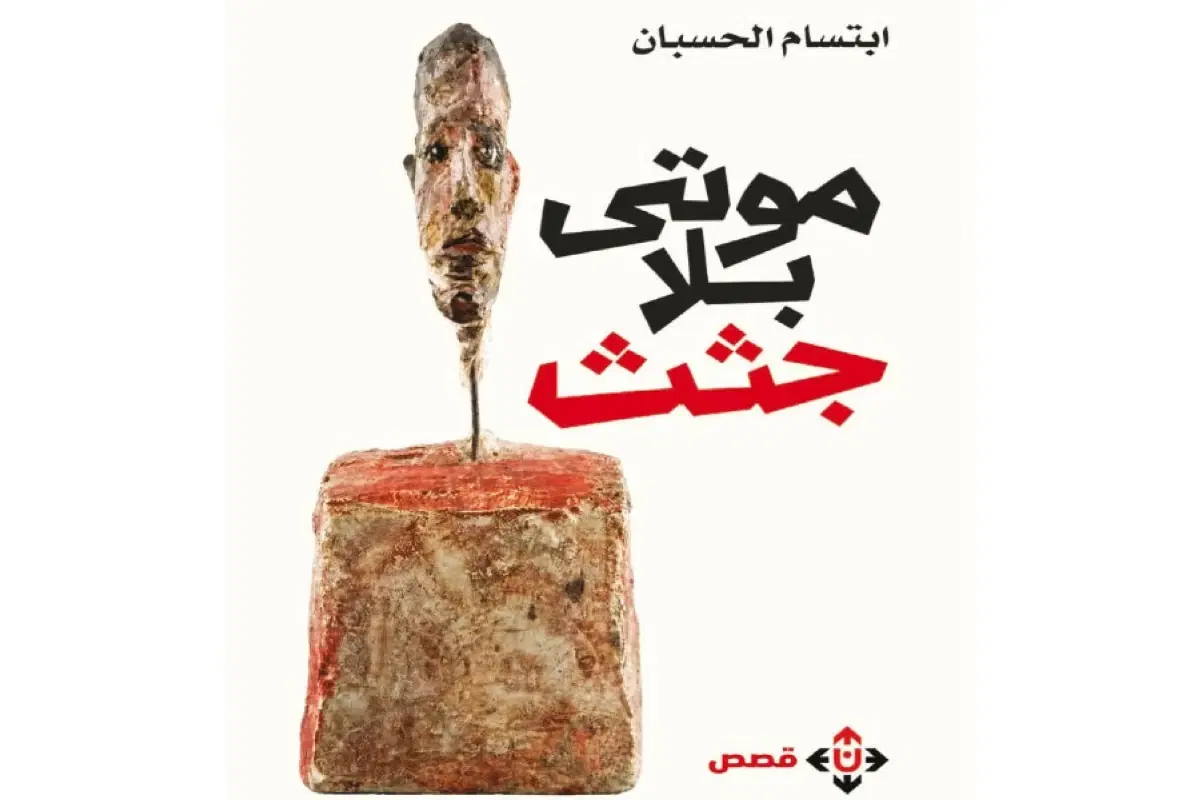
"Dead Without Corpses" by Ibtisam Al-Hasban... When death becomes a loss of certainty and memory
Amman4 min read
Share
In her short story collection "Dead Without Corpses," Jordanian writer Ibtisam Al-Hasban approaches the dark regions of the human psyche, exploring forms of loss, alienation, and helplessness in texts where death transcends its physical meaning to become an expression of the loss of certainty, love, and memory, and the blurring of boundaries between truth and illusion.
The collection is published by "Al-Aan Publishers and Distributors" in Jordan, spans 70 medium-sized pages, and includes 27 stories that address intertwined human issues, where personal experiences intersect with psychological and existential questions within narrative worlds that allow the reader multiple interpretations.
Critic and academic Dr. Razan Ibrahim, in her blurb on the back cover of the collection, believes that Al-Hasban's texts are distinguished by their interpretive richness and density of symbols, making them a mirror for human psychological crises and defeats. She argues that death constitutes a central theme in the stories, not only as a biological end, but as a loss of certainty, love, and memory, and a constant mixing of truth and illusion.
This approach reveals a wide semantic space opened by the collection's title; the dead here are not reduced to physical absence, but can be read as people exhausted by losses, or who have lost their ability to connect with themselves and the world around them. From this perspective, the texts are formed around questions of human existence, the fragility of certainty, and the cracks left within the psyche by harsh experiences.
On an artistic level, Al-Hasban relies in a number of her stories on intense and concise dialogue, which reveals hidden aspects of the characters and illuminates their contradictions without verbosity. This technique stands out in the story "City Courtesans," where focused dialogues contribute to revealing dark areas within the characters and give the narrative a fast pace that aligns with the nature of the story's moment.
The collection's language is characterized by brevity and intensity, with a clear reliance on capturing the significant moment and avoiding digression, while irony plays a fundamental role in building a number of stories by moving the reader from one expectation to another and creating endings that rearrange their understanding of events and characters.
This irony is manifested in the story "Gallows," which begins with a scene that appears to end in tragedy, before its conclusion reveals an unexpected meaning that opens the text to new interpretive possibilities. Al-Hasban says:
"He did not hesitate much; he moved the chair toward a hook hanging from the ceiling that was used at one time to lift provisions to the attic. He hung the rope, shoved his large head into the small loop, and contemplated the shining golden fields in front of him, so his eyes teared up. He made the decision, and he was not a man to back down from his decisions. At the moment he kicked the chair from under him, he was overcome with curiosity to know what the other paper contained. Was it fate pushing him? Or was it blind luck that had led his whole life? He did not have enough time to know."
After the police finished their work, one of his relatives came to clean the place. The pieces of paper were open and scattered on the clean table; on all of them, the same word was written: Swing.
The irony in the story is based on the contrast between the tragic fate the event is heading toward and the word revealed at its end, with the questions it raises about coincidence, fate, and the decisions a person makes in moments of fragility. The ending also returns the reader to the details of the previous scene and pushes them to review its implications, in a structure that leaves room for interpretation instead of providing a final answer.
Through these techniques, the collection presents a narrative world where intense language, symbolism, and irony coexist, and daily details turn into gateways to broader questions related to choice, loss, memory, and the ambiguous relationship between what a person lives and what they believe they know about their life and destiny.
"Dead Without Corpses" comes as part of the literary experience of the author, who holds a Master's degree in Arabic Language and Literature and is pursuing her doctoral studies in the same specialization at the Hashemite University, with an interest in literature, criticism, and linguistics.
Al-Hasban has published a number of works, including the novel "Oort Cloud" in 2021, the short story collection "A Very Bright Abyss" in 2024, and the book "Transformations of Linguistic Meaning" in 2024, in addition to scientific research published in peer-reviewed journals and participation in scientific conferences and cultural seminars.