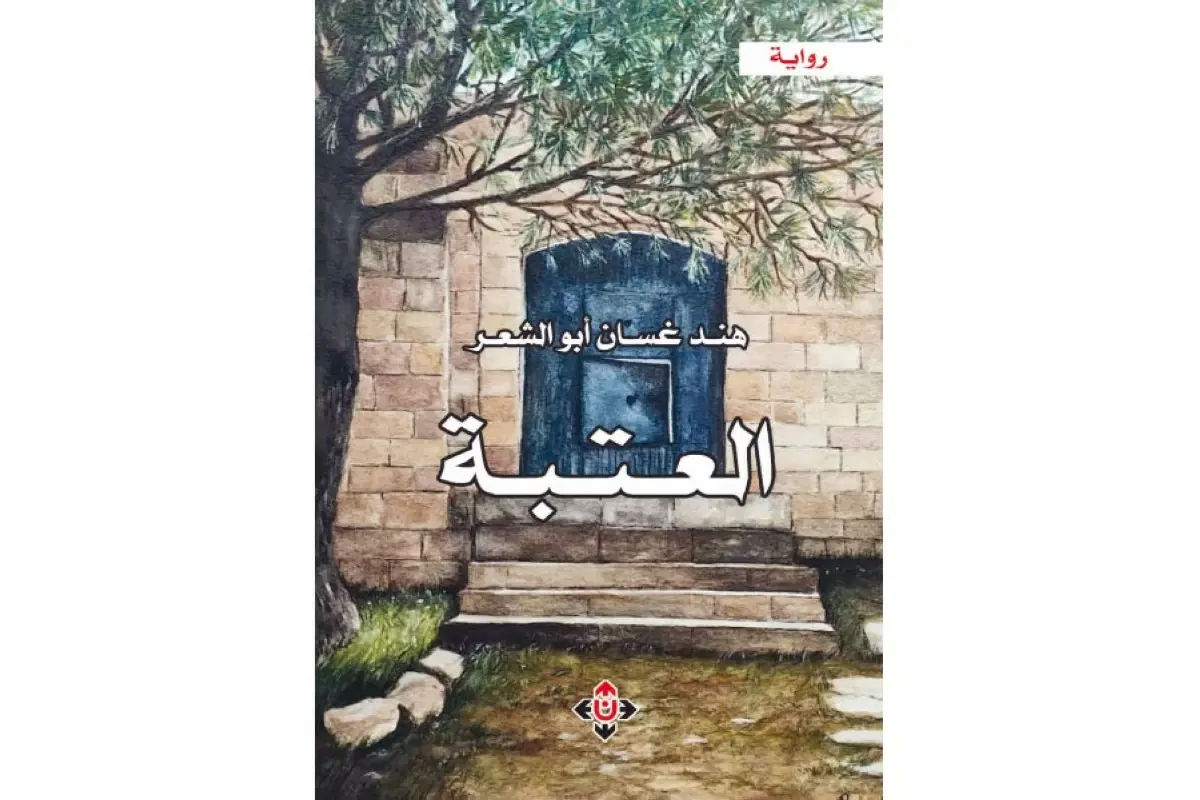
((The Threshold)) Hind Abu Al-Shaar.. A Biography of Memory and History
Amman7 min read
Share
In her first novel, "The Threshold," writer and historian Hind Abu Al-Shaar recovers the echoes of recent history, breaking into its forgotten threshold to breathe life back into places, people, and events, reclaiming every pulse that throbbed with love, pride, and sorrow.
In the large, abandoned family home, the journey through time begins to conjure up faces, laughter, and pains, as everyone has departed and the place remains, storing in its corners and walls the memories of a life that once existed.
In this house, built in 1890 in the town of Al-Husn, the first grandfather, Salim, lived with his family. He was the patriarch who embraced everyone—brothers, children, and women—with love and care, managing the family's properties, lands, livestock, and crops, distributing tasks, and attending to trade, travel, and relationships.
The picture is completed by Grandfather Salim's interest in education and study, and his keenness to provide this for his children and his brother, especially the study of law, in a time teeming with events, failures, and the squandering of rights.
The work focuses on two central characters who gained attention and status in their society through a professional and struggling career that left its mark and legacy. The first is the brother, Aqeel, a young man open to life through reading and a love for music. His brother, full of paternal care, sends him to the city of Jerusalem to study music and theology. There, he experiences his first wonder in a cosmopolitan city crowded with many languages, Russian and French tourists, many carriages, and people from all continents, such as Greek, Armenian, Italian, Coptic, and Maronite clergy, in addition to Aleppines, Georgians, consulates, markets, and hotels. There, he visited the Church of the Holy Sepulchre, the Al-Aqsa Mosque, and the Dome, and was exhilarated by a new world. Then comes his second stop in Rome to continue his studies. In Rome, he breathed art, music, and museums, and obtained his degree in philosophy, theology, and music. He then decided to end his life in the world of priesthood and return to Jaffa to devote himself to the world of journalism, corresponding with Western newspapers in more than one language, believing in the role of the word in exposing Jewish immigration and the evils of Ottoman rule. He also authored the book "Arabs Under the Turkish Yoke" and the novel "The Armenian Girl in Yildiz Palace."
As for the second character, it is the son, the lawyer Najib. Grandfather Salim wanted his children to be educated to become lawyers and writers of high standing. Thus, the destination was also the city of Jerusalem, where he was the first student to arrive from East Jordan. He finished his studies at school and the Law Institute, then devoted himself to working in an office in Jerusalem. His return to Al-Husn after the death of his wife and his escape from memories contributed to the path of his successive achievements, such as his victory in the legislative elections to become the first member for the Ajloun District for the Christian seat in 1930. This was followed by his appointment as a Jordanian consul at the Jerusalem consulate and his new duties during a turbulent period, and finally, his attainment of a seat in the Senate and the joy of the family and clan at this trust and status.
Because the novel spans a long period of the last century, it is full of facts, events, and turning points. It begins with the Ottoman rule in its power and injustice, raiding villages in search of opponents and fugitives, sharing the residents' livelihoods and the produce of their lands, and controlling their lives. Perhaps this period can be summarized by a suggestive phrase in the novel that expresses confronting terror with the right to life: how Aqeel confronted the Turkish commander: "The violin was in his hand, and the whip was in the Turk's hand." When this era ends, the British Mandate arrives in the region as a new turning point, and soon King Abdullah I establishes the Emirate of Transjordan. But the defining event comes with the 1948 war, the withdrawal of the Mandate power, and the entry of the Arab Army into Jerusalem. The Jordanian Army had repelled the attacks of Zionist gangs, and the Fourth Brigade fought valiantly in the defense of Jerusalem until King Abdullah called it the "Winning Brigade." With the consulate being bombed, the consul is forced to close it and return to Amman, but this time with a new feeling that he is a refugee like any other Palestinian who lived through this experience.
Amman opened its doors to receive refugees and established temporary camps to shelter the arrivals. It was not the first time. Amman had previously received successive migrations of Armenians who were displaced from their homes and lived the tragedy of displacement, travel, and hunger. It also received migrations of Circassians who experienced similar conditions. These components soon integrated into their new societies.
Alongside these facts, the novel is full of ideas and values. The defining events imposed the question of identity and reference, as happened after getting rid of Ottoman rule, which prompts the question: Does the authoritarian rule impose its identity or does it stimulate the revival of identity and belonging? Thus, the Arab nationalist current expressed itself in supporting the Arab government in Damascus and the events that followed. The construction of identity is not complete without an interest in education, as the grandfather is keen with awareness and determination to educate his children and his brother, as a path that paves the way for political work in the family as members of parliament, writers, and journalists to contribute to the nation's renaissance, service, and the achievement of a decent social status.
These extended memories are rooted in the spaces of cities and towns brought together by the unity of history and geography in the Levant, led by the city of Jerusalem, the "city of the world" as it is called, where it gathered on its land a great human diversity with its languages and cultures, living its unique civility with its cultural structure of theaters, cinemas, and schools, and its economic and political structure of markets, hotels, and consulates, in addition to its spiritual dimension and its embrace of churches, mosques, and the coexistence that has existed through time. Also, the city of Damascus stands out as the gateway to knowledge and the destination for education, the city of history, facilities, and markets that abound with crafts, professions, and goods, and where trade and industry flourish.
As for the emerging city of Amman, it grew and flourished with the diversity of its inhabitants, from those coming from Nablus, Jerusalem, and some Damascenes, in addition to its embrace of the migrations of Armenians and Circassians, and everyone settled as a cohesive fabric in the new homeland. We also do not forget Al-Husn and Ajloun as the family's first cities.
On the artistic side, the portrayal of the characters presented a human mass pulsating with love, seriousness, and patriotism, which is evident in the family connection and the genuine affection that envelops life. In public affairs, sincere enthusiasm appears in defending the homeland in Palestine and Jordan, and this was manifested in journalism, politics, and legal work. Life also presents its realistic face between happiness and sadness, giving and loss, joy and pain, and poses its dialectic. When loved ones depart, such as the father, mother, and wife, the human faces of strangers—Armenians and Circassians—appear to repair the absence, plant familiarity and love, and compensate for the need as true partners, driven by nobility, human warmth, and gratitude.
Thus, "The Threshold" (Al-Aan Publishers and Distributors, Amman, 2025) reduces the memory of the place and the people, and turns into a witness that lived a long and rich life, and those stones took on a touch of humanization when they welcomed the arrivals or bid farewell to the departing with sadness.
With this novel, the writer wanted to revive the family's history and narrate the biography of its heroes, motivated by visiting the big house and questioning its stones and corners to tell the stories of those who lived in it, breathe life again into a past time and characters who have departed, and give meaning and appreciation to a biography that deserves to be told.
"The Threshold" in the novel was not a stone surface, but a novel that opened the door of time to a past century that the author succeeded in portraying as full, heavy, and rich with stories whose importance comes from the fact that they are from the quiver of memory and documentary facts supported by history.