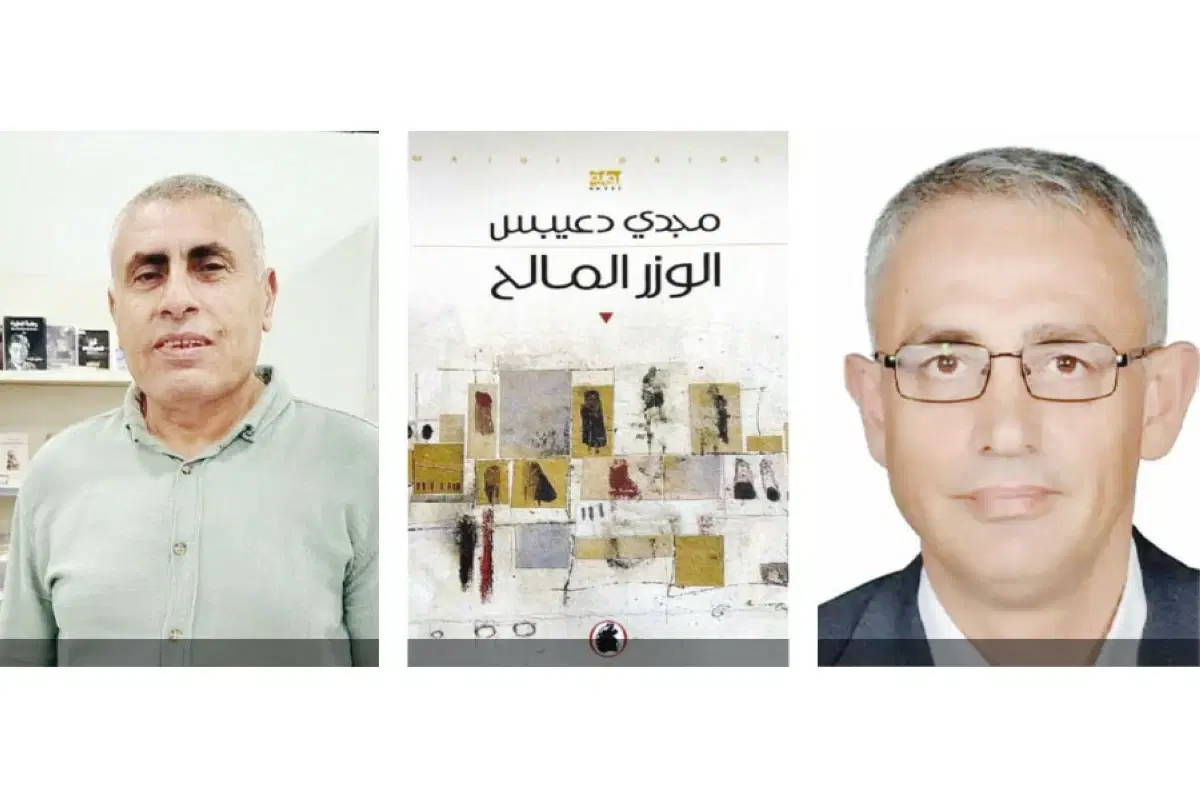
A reading of the novel "Al-Wizr Al-Malih" by Majdi Daibis
From its very threshold, Majdi Daibis's novel "Al-Wizr Al-Malih" declares itself to be "a novel about love and war." At first glance, the phrase seems to define the subject of the novel, but it quickly transforms into a key to reading it; love and war do not appear within it as adjacent subjects, but rather as contending forces: a war that forcefully enters people's lives and reshapes their destinies, and a love that tries to preserve something of humanity for man in a time of death.
The title itself is laden with this meaning; "Al-Wizr" is what a person bears of consequence or burden, while "Al-Malih" (the salty) evokes tears, sweat, and bitterness. As if the novel, right from its title, points to a history that does not pass without leaving a trace, and to the burdens borne by individuals and groups after the events that created them have ended.
The novel is based on a historical backdrop represented by the First World War, the collapse of the Ottoman Empire, and the Ottoman-British conflict in the Levant and Palestine, but it does not make history its primary goal. General Allenby appears from a position of military power, condensing in his voice one aspect of imperial history; he sees the war from the vantage point of a commander who wants to make Jerusalem a "Christmas gift" for the British Empire. In contrast, Salim Akrat's voice reveals the other side of the conflict; he is an Ottoman officer who realizes that the war is bigger than just a battle, saying: "This is the first war of its kind. The winner will dictate his terms and the loser will lose everything."
Between Allenby and Salim, the distance widens between the history made by armies and the history lived by people. If the general sees the war from the perspective of leadership and empire, Fadda sees it from the perspective of a mother waiting for her sons, and Yahya sees it as a direct threat to his life, while Maryam finds herself forced to pay its price in her private life.
Here, the novel succeeds in moving history from the level of military event to the level of human experience. War appears not only on fronts and in battles, but in the home, the village, marriage, hunger, and waiting. Therefore, Ghazi's absence from his mother Fadda is not a marginal family detail, but the human face of a history that books of war do not record. Behind every soldier in the military record is a waiting mother, a frightened family, and a home anticipating a return that may not happen.
From this angle, Maryam assumes a position of utmost importance in the narrative structure. She does not stand outside of history; rather, history falls directly upon her. Saving her brother Yahya from conscription becomes linked to her marriage to Salim, thrusting her into a relationship that did not begin with free emotional choice, but arose from the pressure of war and the authority of the military.
However, the novel does not make Salim a one-dimensional character; the man who enters Maryam's life from a position of military authority is gradually revealed to be a sensitive and complex character. He says in a moment of his early reflection: "I can hardly believe it. These gloomy-faced peasants give birth to such a delicate face," referring to his first sight of Maryam. From this moment, the character's internal transformation begins; the man who came to the village as an Ottoman officer finds himself a prisoner of love. This love becomes a line parallel to war, but standing on the opposite side: there is violence and subjugation, and here is affection, intimacy, and kindness. Daibis himself pointed out that what Salim feels toward Maryam is infatuation before it is desire, and that Salim sacrifices for the sake of this love.
Hence, love in the novel becomes more than an emotional theme; it is a test of humanity. The harsher the cruelty of history becomes, the greater the need for a relationship that restores to man his individuality and his right to feeling and choice.
If the novel recovers history through human experience, it does so primarily through polyphony. Almost every chapter gives voice to a different character: Salim, Mustafa, Anwar, Fadda, Maryam, Yahya, Awda, Warda, and others. Thus, there is no single narrator who monopolizes the truth; every character sees the world from their own position, presents a part of the story, and may reveal during their narration what another character hides.
This technique acquires special importance in the historical novel because history itself becomes multiple with the multiplicity of those who lived it. Anwar, the Mukhtar, looks at events from the perspective of a man trying to manage the village amid changes greater than himself; Mustafa sees the war from the perspective of a soldier living its daily details, while Fadda views it from within the experience of motherhood. As for Maryam, she presents history from the perspective of a woman whose private life has turned into one of its arenas.
Thus, characters are no longer mere tools for moving the plot, but transform into bearers of memory. Each character carries their own history, and when they speak, they add a layer of personal experience to the general history.
This multiplicity reaches its peak when the novel itself becomes aware of the process of storytelling. In the tale of "Departure," narratives multiply, with some narrators adding to the event and others deleting from it, so that the question is no longer just about what happened, but about how what happened reached us. Here the meta-fictional dimension appears in the novel: the story tells itself, and at the same time reveals the mechanisms of its formation and transition from one person to another.
Hence the question arises: Who owns the truth? Is it the narrative of the one who witnessed the event? Or the narrative of the one who preserved it in memory? Or the narrative passed down by people until it became part of collective memory?
This issue makes the relationship between history and memory central to the novel. Official history preserves the names of leaders, battles, victories, and defeats, while memory preserves more fragile details that are more attached to man: a mother's face, a son's absence, an unfulfilled love, fear of conscription, or a home awaiting its owner's return.
Therefore, the novel does not rewrite history from above, but writes it from within; from inside homes, the village, and human relationships. Through these details, the historical event transforms from a piece of information into an experience.
Connected to this is the narrative time, which does not move in a straight line. Characters recall their past, returning to childhood, relationships, and the time before the war, and then return to the present. The event acquires a new meaning every time it passes through another character's memory. The past here is not a finished time, but a continuous present within the characters.
This technique seems necessary because the novel does not deal with history as a sequence of events, but as memory. Memory by its nature does not follow a regular chronological order; it summons the past according to what the present evokes.
Time is inseparable from place. The village, homes, fields, pond, and cave are not just places where events take place, but turn into storehouses of memory. When Salim, Fadda, or Anwar recall the details of a place, they are not recalling neutral geography, but an entire life associated with that place.
Hence, a group of themes intertwine in the novel: war, love, loss, motherhood, hunger, poverty, marriage, and identity. Yet all these themes return to a single question: What does history do to man?
For Allenby, war is a military and imperial project; for Salim, it is a military duty that gradually turns into a human dilemma; for Fadda, it is absence, loss, and waiting; for Maryam, it is a force that interferes with love, marriage, and choice; and for Yahya, it is a danger directly threatening his life. The event is one, but its meaning changes with the changing position of the one who lives it.
From here too, the blending of traditional and modern narrative in the novel can be understood. It retains the story, characters, place, and historical reference, but reconstructs these elements through polyphony, changing viewpoints, breaking chronological sequence, flashbacks, and awareness of the act of storytelling. It does not abandon the story, but reshapes it.
Therefore, it is difficult to speak of a single hero in "Al-Wizr Al-Malih." Heroism is distributed among Salim, Maryam, Awda, Yahya, Fadda, Anwar, Mustafa, Allenby, and others, so that the community itself appears as a composite hero. Each character adds a part to the picture that is only completed by the gathering of voices.
In this lies one of the novel's strengths: it does not present history as a final truth, but as material that renews itself every time it is retold. The fact becomes memory, memory becomes a story, and the story becomes a site for disagreement and interpretation.
In this sense, "Al-Wizr Al-Malih" is not a novel about war alone, nor about love alone, but about the human being who carries the mark of history in his memory. Therefore, its deepest question is not: What happened in that war? Rather: What remained of it in those who lived it?
Between Allenby and Salim, Fadda, Maryam, Awda, and Yahya, the images of history multiply, and the truth ceases to be a single voice. Official history says one thing, personal memory says another, while the novel gathers these voices and leaves the reader the task of reconstructing the past.
Here the significance of "Al-Wizr Al-Malih" is defined: it is not the burden of war alone, but the burden of what remains of it; memory, loss, love, regret, and stories that do not end with the end of their owners.
Thus the novel transforms from a retrieval of the past into a questioning of the method of its retrieval, and from a historical novel to a novel about history when it crosses from document to memory, and from memory to imagination.