The Novel and Questions of Contemporary Man: Protecting Memory and Confronting the Transformations of the Digital Age
Amman6 min read
Share
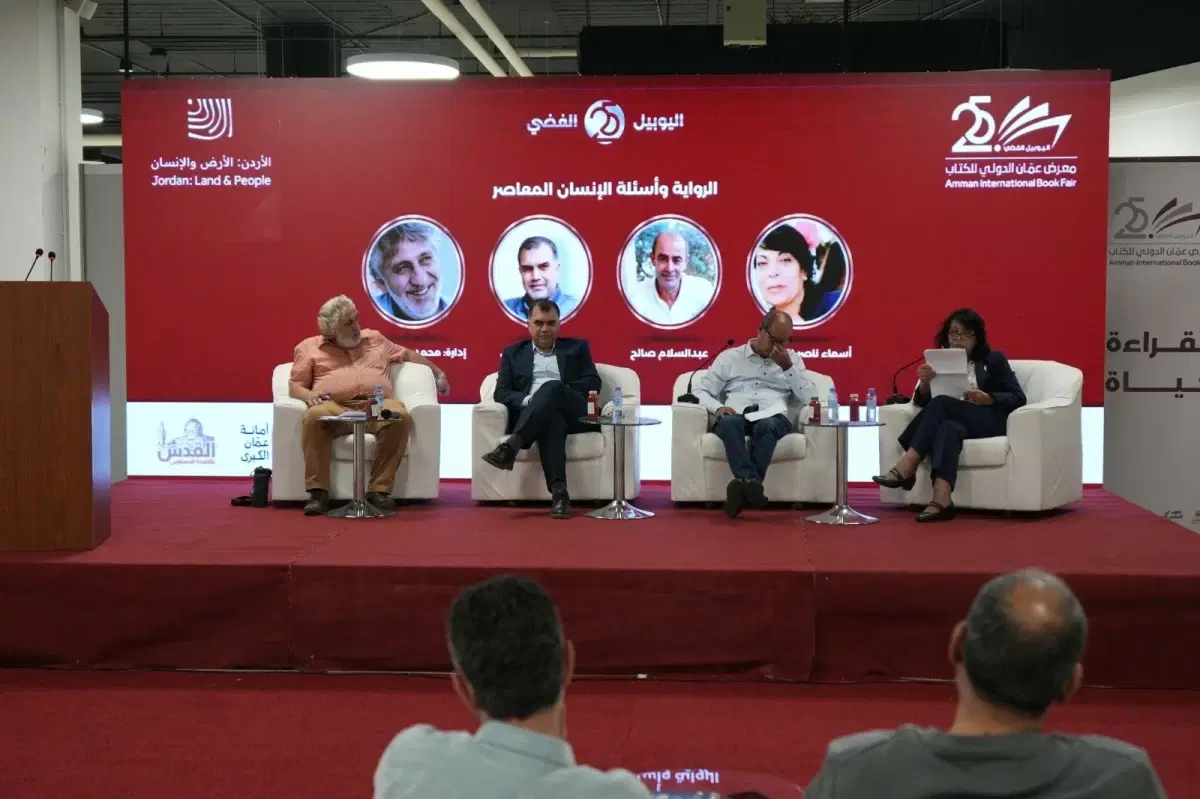
The seminar 'The Novel and Questions of Contemporary Man' held last Friday as part of the cultural program of the Amman International Book Fair 2026 discussed the existential, social, and philosophical transformations facing contemporary man and the ability of the novel to formulate his questions and resist the erasure of memory in light of the rapid transformations imposed by the digital age.
The seminar featured Palestinian novelist Asma'a Nasser, novelist and researcher Samer Haider Majali, and novelist Abdul Salam Saleh, while it was moderated by journalist Muhammad Jameel Khadir.
Palestinian novelist Asma'a Nasser emphasized that talking about narrative, characters, and literary aesthetics in today's world is not an intellectual luxury or the creation of illusion, but represents the 'last act of resistance' against nihilism, in a world that seeks to strip man of his meaning and turn him into a number or an algorithm.
She criticized the tendency of some Arabic literature to import ready-made concepts and anxiety from Parisian salons or Berlin cafes and project them onto societies that do not suffer from the'saturation of existence' that generates philosophical emptiness, but from the 'crushing of existence' that produces fear, the search for salvation, and freedom amidst oppression and defeats.
Nasser explained that the true novel delves into its own soil, moving from the ready-made documentary question 'Who are we?' to the question 'How do we know ourselves in a changing world?', citing manifestations of identity and the loss of geography, and addressing the place as a psychological and philosophical space in the works of Ghassan Kanafani, such as 'What Remains to You', and Bassem Khandakji in 'A Mask the Color of the Sky', Ibrahim Nasrallah in 'The Time of White Horses', and Hussein Barghouti in 'The Blue Light'.
She added that Palestinian narrative presents existence as an act of resistance, unraveling existential crisis, as seen in Kanafani's cry in 'Men in the Sun' to expose collective silence, and in 'Returning to Haifa', alongside the works of Emile Habibi, including 'The Pessimist'.
She also reviewed the specificity of Jordanian fiction in its approach to the anxiety of transformation and alienation within the city, the generational conflict, and the entanglement of identity, starting with Tayseer Sboul in 'You Since Today', and Munees Al-Razzaz in 'Living in the Dead Sea', up to the works of Jamal Naji and Samiha Khrais.
Nasser believed that the novel plays an important role in deconstructing media discourse, explaining that the media may be content with transmitting abstract digital news, such as the mention of the killing of twenty people, while the novel follows the life of an individual, their daily details, morning coffee, and disappointments, turning the number into an existence and restoring to man his lost humanity.
Majali: Four Revolutions and the Questions of Man
For his part, novelist and researcher Samer Haider Majali provided a deconstructive reading of the seminar's title, affirming that addressing the questions of contemporary man requires defining his essence through four pivotal milestones witnessed by humanity.
He explained that the first industrial revolution, in the mid-eighteenth century, raised questions about man's identity and future, and whether he would become a higher being after understanding the physical laws, while the second industrial revolution in the nineteenth century posed questions of power in its various forms, and the question of freedom in its consumer and spiritual dimensions.
He added that the third industrial revolution, in the mid-twentieth century, raised questions about the dominance of capital and multinational corporations and their hegemony over the state and man, leading to the digital revolution, social media, and artificial intelligence, which generated questions of postmodernism, fundamentalism, grand narratives, and the blurring of boundaries between reality and the virtual, and between truth and artificial falsehood.
Majali reviewed how world literature employs these questions, citing fictional and intellectual works that addressed existential dimensions, the creation of virtual worlds, memory erasure, authority surveillance, false consumer happiness, and victims of bureaucracy.
On the Arabic and local novel front, he pointed to Amin Maalouf's treatment of the identity crisis in 'Rock of Tanios', and Samiha Khrais's exploration of the disintegration of family ties and terrorism in 'Blind Spot', pausing at his own novel 'The Moabite', in which he questions history and objectively projects it onto the present, alongside the novel 'The Engineer', which addresses the problems of Arab youth and the dominance of the language of money and corporations behind politics.
Saleh: Freedom is the Root of Creativity
In turn, novelist Abdul Salam Saleh began his speech by asserting that the only constant in this existence is continuous change, explaining that the novel has, throughout its history, kept pace with civilizational development and its transformations, from classicism, romanticism, and realism to modernity and experimentation.
He clarified that questions of existence and meaning remain at the forefront of the concerns of the novel and the contemporary Arab man, who suffers from the burden of dispersion, loss, and the fall of grand ideas, citing Milan Kundera's quote on the role of the novel in revealing that life does not proceed as simply as we imagine.
Saleh questioned the ability of the Arab novelist to answer the questions of the age, shackled by the 'triangle of taboos' and besieged by circumstances of censorship and others, affirming that freedom is the root of creativity and its essential soil, and that the text cannot touch the reader's mind and spirit without it.
Saleh revealed his literary vision in light of this 'dilemmatic' reality, referring to a passage from his upcoming novel that addresses the distribution of absurdity and nothingness among people equally, as poverty was distributed, pointing out that he had turned in his new novel to the formulation of his 'own delusion', drawing on the Sufi enlightenment of Abu Hayyan Al-Tawhidi that wonder lies in 'biting on understanding with delusion'.
At the conclusion of the seminar, the President of the Jordanian Publishers' Union and Director of the Amman International Book Fair, Jibr Abu Fares, honored the seminar participants in appreciation of their contributions to enriching the dialogue on the novel and the questions of contemporary man.