The Jordanian National Identity: Place, Language, and Memory
Amman10 min read
Share
One of the most important and effective factors in forming the national identity of any nation is the creation of a national cultural specificity; national personality is not entrenched merely within the political or geographical framework of the state, but is also formed spiritually and emotionally through a series of cultural processes that work to outline the distinctive features of a national identity that finds its way into the collective consciousness of the citizens. It is an identity capable of arousing emotions and feelings associated with the homeland as a place, and with all the aspects of life, language, customs, and social and cultural characteristics connected to it, which make those who share it feel a sense of belonging to the place, defining it, and recognizing it.
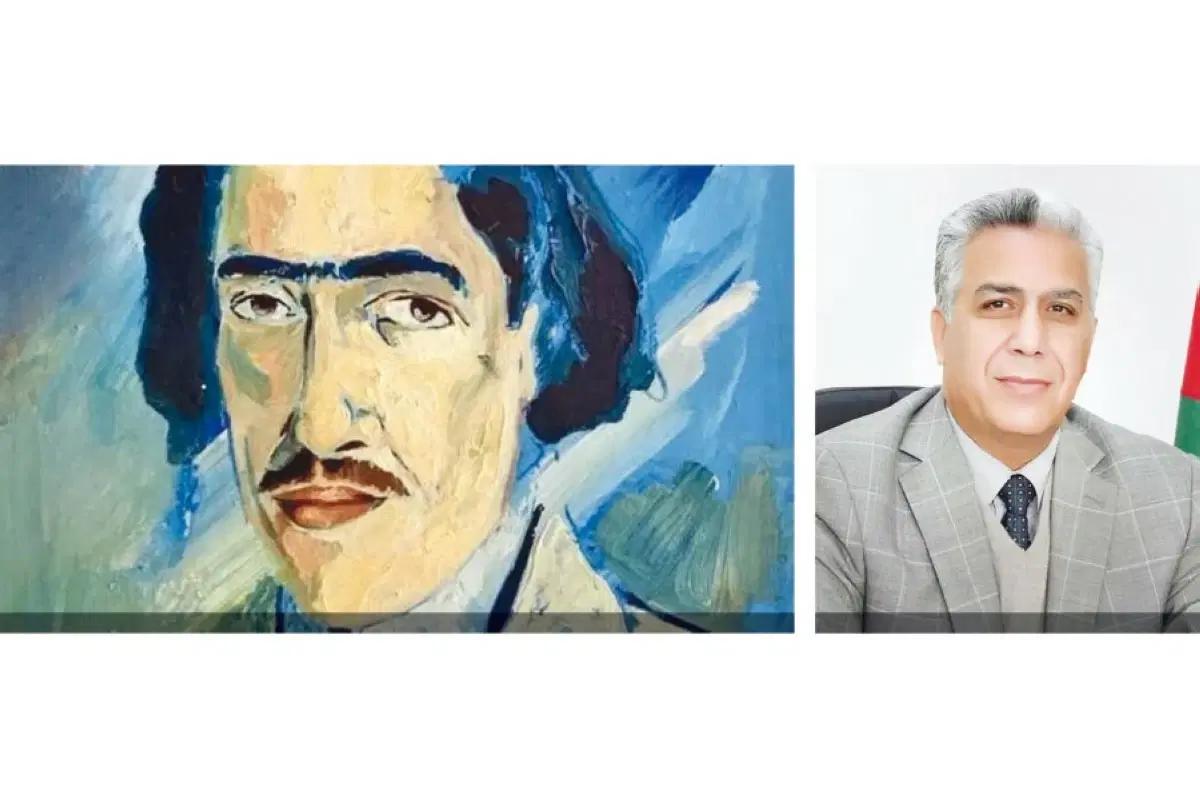
If we start from this perspective to examine the role played by Jordanian intellectuals, foremost among them Arar, we find ourselves before a deeply influential national cultural act, especially since this act came during the founding stage of the Jordanian state, after the collapse and disintegration of the Ottoman Empire. At that time, the new state was laying its foundations, and the features of national identity were in the process of formation and reorganization of the elements of local, social, and cultural belonging within its new framework.
From here, the close relationship between Arar and the Jordanian national identity can be understood; he made Jordan, both as a place and a human being, a fundamental axis in his poetry and writings, transforming the details of life within it into poetic and cultural material. The homeland for him was not an abstract political concept, but rather a living place with its terrain, names, people, language, customs, and memory. Through all of this, his poetry contributed to transforming geography into memory, memory into emotion, and emotion into one of the components of national identity.
This is what makes Arar's experience a phenomenon worthy of contemplation in the history of the Jordanian cultural movement; he was first a poet, and second a national politician, who tried to bear the burden of expressing a national and political discourse and forming it within emotional contexts inseparable from the broader pan-Arab framework, while at the same time working to deepen the sense of place and people, and to express the spirit of the society in which he lived.
The most important issue in this context lies in the formation of a collective national conscience through a poetic discourse saturated with emotional traits associated with Jordan, both as a place and a human being. Perhaps this is what granted Arar a continuous presence in the collective consciousness; his poetry expressed the yearnings, customs, images of life, issues, and rights of the people, until his diwan became, in a sense, a popular diwan memorized by people regardless of their differing levels of culture and knowledge. Perhaps the striking thing about this phenomenon is that many illiterate people used to memorize his poetry and repeat it, which reveals that his poetry reached the oral and social memory, not just the cultural elite.
If Arar's continuity in the popular consciousness requires an explanation, then one of the most important keys to this explanation is the presence of the Jordanian place in his poetry. Places for him are not fleeting geographical names, but rather bearers of memory and emotion. He says:
"O Jordanian women, if I perish in exile,"
"weave my shrouds, may my father be your ransom."
"And tell my friends to lay some of my bones to rest"
"in the hill of Irbid or on the slope of Shihand."
And he says:
"I swear by Mahis and Al-Fuheis, and by Al-Tafilah and Al-Thaniyah,
and the lofty vineyards of Gilead, and the fertile soil of the Ghor,
none other than you has the heart fluttered, nor stirred, O maiden."
And he says:
"O gazelles of Wadi as-Sir, has the brown gazelle
fled from your herd?
For she is the one whose fingertips traced
a dazzling verse in the book of my love."
These texts combine the Jordanian place and the discourse of women emotionally linked to the speaking self, so that the places become part of the emotional experience itself. Irbid, Shihand, Mahis, Al-Fuheis, Al-Tafilah, the Ghor, Jerash, and Wadi as-Sir are not merely places mentioned in the poem, but are transformed into cultural and emotional markers that evoke the homeland in its tangible image, close to the people's lives and memory.
Here, the importance of place in Arar's poetry becomes evident; he does not describe Jordan from the outside, but rather speaks to it and from within it. Place for him is inhabited by people, memories, love, and death, and therefore it transforms from geography into a recognized identity. Perhaps this explains part of the ability of his poetry to endure; places are present in memory, and the discourse of women is an attractive element in Arabic poetry, adding a-emotional and human dimension to this geography. Ibn Qutaybah pointed out in the third Hijri century that opening the pre-Islamic poem with the mention of the beloved and departure represents a discourse that lures listeners and captures their attention.
In "Ashiyyat Wadi al-Yabis" there are a large number of texts that represent this presence of place and people, and reveal Arar's awareness of the relationship between poetry and society. However, it is noticeable that Arar was not content with evoking the Jordanian place, but was also aware of the importance of language in building a local cultural specificity; therefore, he consciously and intentionally used the spoken language in his poetry, and this appeared in the vocabulary, expressions, and linguistic formulations that belong to the daily life of Jordanians.
The matter was not limited to vocabulary, but extended to proverbs, popular expressions, and images of social life in its various aspects. We find references to certain agricultural rituals, social relationships, and folk games specific to children and elders alike. He says:
"The wind blew and grieved you that its breeze"
on the bank of the Jordan is a poisonous wind
The wind blew, and you and I care about
receiving our wage on its known day."
And the phrase "The wind blew" itself is the opening of a song chanted by the peasants threshing on the grain threshing floors, thus entering the poem laden with a complete social memory, a memory associated with a ritual expressive of fertility and joint social labor.
We also read expressions such as: "May their father's cock burn", "Pave the sea", "He raises my resurrection", "By your head's life", "White wild artichoke", "Sahahir", and "Al-Shamalikh". These expressions or vocabulary are not merely colloquial phrases with which the poet decorated his poem, but are part of a linguistic and social fabric connected to the lives of Jordanians and their popular memory. Many of these formulations are still present in the contexts of daily life, especially in rural environments.
This is what made Arar's poetry close to the language of the people, neither detached nor distant from it; which contributed to its transition from writing to memory, and from the poetic text to oral circulation. When people hear words they know, places they lived in or knew, and customs that represent part of their lives, the text no longer feels alien to them, but rather becomes part of their own experience.
If we move beyond poetry to his prose writings, both political and social, we find the same trend toward entrenching Jordanian specificity. When he wanted to publish a collection of stories, he named it, as stated in his papers, "First Dancing is Limping", presenting it as a collection of Jordanian stories. This orientation also appeared in his interest in Bedouin poetry and the linguistic and semantic elements connected to it, which he saw as inseparable from the structure of eloquent language, affirming that his cultural project sprang from the social and linguistic environment in which it was formed.
If these elements contribute to drawing the cultural features of the Jordanian national identity, the complementing aspect of it is represented in defending the land as the incubator of human existence. Land and human are vitally linked in Arar's work; each derives its value from the other, and separation between them becomes a form of losing existence itself.
One of Arar's most important texts expressing this idea is his narrative dialogue text "Sodom", published by the Haifa-based newspaper "Al-Carmel" on June 20, 1934. In this text, Arar reveals a deep conception of the relationship between man and his land, making place a condition for active human existence.
The story relied on the well-known religious tale about the Prophet Lot and his people, when the wrath of God befell them and Sodom's fate became destruction. The two angels come to take Lot out of it, but he argues with them, revealing to them that he cannot live anywhere else but Sodom; it is the place that gives his life meaning, and the place associated with his memory and existence. He elaborates on its beauty and working to adorn it, forgetting that it is facing destruction and will turn to fire and ashes.
Addressing the two angels, he says: "Had you both lain upon the soil of Sodom as I have lain upon it, and had its sweet water quenched your thirst as it has quenched mine, and had its clear sky shaded you as it has shaded me, you would have had a different opinion of Sodom than the one you hold now."
Then he says: "Where else in Sodom shall I find cherished graves upon which I shed my hot tears, whenever the desire to weep besets me, and my eyes thirst to shed tears?"
This discourse presents a profound image of the vital rootedness between man and his place. Place here is not merely land inhabited by man, but a universe storing experiences, memories, and human relationships. Perhaps the impossibility of moving graves reveals the deepest images of attachment to place; man is not attached to the land merely because it is the site of his life, but also because it encompasses his dead, his loved ones, and his memories.
Therefore, "Sodom" in Arar's reading appears as more than a story about a city doomed to destruction; it is an expression of the idea of the homeland as an extension of human existence. Lot does not want to leave the place where he lived, even when departure becomes a means of salvation. The land for him is not something that can be replaced by another land; because it holds his past, embraces his memory, and grants him the meaning of his existence.
From here, one of the deepest connotations in Arar's experience can be understood: the homeland is not merely political boundaries, but the place when it transforms into memory and emotion, and memory when it becomes part of human identity and existence; therefore, uprooting a person from their land does not merely mean moving them from place to place, but means severing the connection between them and a part of their history, memory, and emotion.
In this way, the elements of place, language, human, and memory intertwine in Arar's experience; place grants poetry its names and images, language grants it its popular voice, the human grants it his living experience, and memory grants it the ability to endure. Through these combined elements, Arar contributed to transforming Jordan from a geography to be seen into a homeland to be felt, remembered, and narrated.
Perhaps this is the secret behind Arar's enduring presence in the Jordanian consciousness long decades after his departure; he did not write about an abstract homeland, but rather about a homeland with its own places, language, people, customs, songs, sorrows, and the graves of its loved ones. Therefore, his poetry did not remain on paper alone, but passed into the popular memory, where the homeland continued to be present, alive through the word, the poem, and the story.