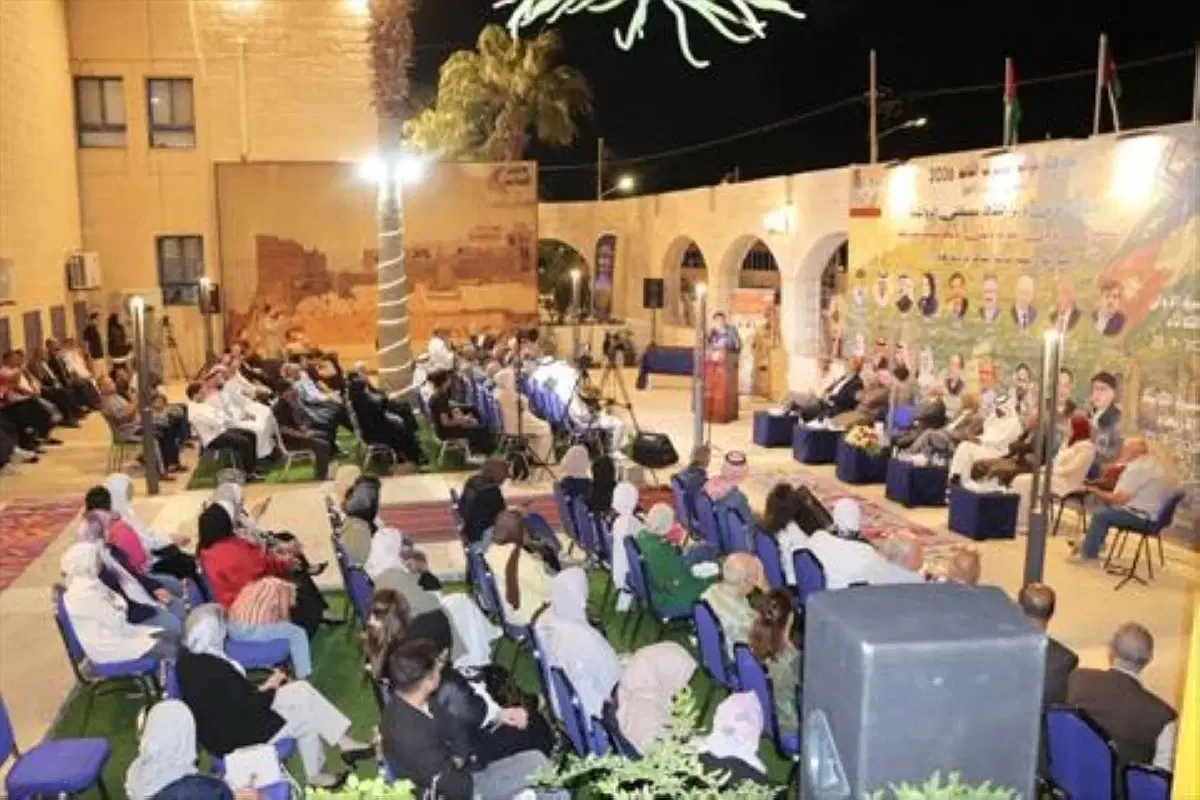
Al-Shama'ilah said in her speech, "The Ma'in Al-Sharee Festival has established its presence year after year, becoming a space where poets and intellectuals meet, where voices and experiences coexist, celebrating the word as a bearer of memory and an expression of man and nation.
She added, "We meet this session in the embrace of Al-Qasr District, the Jordanian City of Culture for 2026, where cultural events continue to affirm that culture is not a passing occasion, but a continuous act, a space for dialogue, and a bridge connecting the past with the present, opening the way for new generations of creators, believing that the beautiful word is capable of preserving the story, and that culture is capable of bringing us together around what is most beautiful and enduring.
She pointed out that the launch of the festival this year under the slogan "Independence tells a national story, and poetry seeks its narrative" carries national and cultural connotations, where the homeland meets poetry, and the memory of the place meets the narrative of man, to retrieve through the word the stories of a nation that built its independence, preserved its identity, and where poetry remained a present voice in its joys, challenges, and transformations.
She continued, "From Karak, this land that carries in its memory deep pages of Jordan's history, we celebrate poets and give the word a new space to be said, heard, and reach people; because poetry, in its essence, is not just a text to be recited, but a human experience that preserves memory, illuminates questions, and gives us a greater ability to see the place, man, and nation.
She explained that the continuity of the festival, reaching its eighth session, confirms the importance of the cultural act when it finds those who believe in it and work to develop and sustain it, and also confirms the role played by the Ministry of Culture in nurturing creativity and opening platforms for poets and creators.
Al-Shama'ilah praised the poets participating in this session and all the poetic voices that came to Karak to add to the Jordanian cultural scene their experiences and visions, and to make this meeting an occasion for dialogue, communication, and celebration of the beauty of the word.
She commended the efforts of the Festival's Higher Committee and all those who contributed to the preparation and organization of its events, thanked the partners, sponsors, and media, which continue to play their role in conveying the cultural act, and thanked the audience, which gives cultural events their true meaning through their attendance and interaction, confirming in every occasion that culture is an integral part of the life and memory of this place.
In turn, Dr. Hussein Mahadeen said in a speech on behalf of the Festival's Higher Committee, Ma'in is the south of the dear homeland, the opener of language, poems and laments, joy and bias, Ma'in is the sails of the two Nuns of Jordan and Palestine towards the broader Saad of the nation, reaching the broader humanity of man.
He added, "In Karak, the beginnings of history, the capital of the Moabites, a fortress that all civilizations of the earth have fallen upon, Ma'in is the first victory and the broader message, a homeland illuminated by the lights of our martyrs on the path of right, and Karak has been and remains the twin of Jerusalem, the capital of Palestine and its crown, from which it has been liberated twice, and they are two basins in one heart, confirming their ancient relationship rooted in presence, blood, and noble meanings.
In Karak, education began, as it had the first Shafi'i school, and the first school established in the Kingdom in the new era was Karak Secondary School, which was built with the cooperation of its people, Muslims and Christians, and it is also a haven for poetry and poets and has always been biased towards the truth and the homeland.
Dr. Mahadeen concluded his speech by praising the efforts of the Ministry of Culture, the Directorate of Culture of the Governorate, and all those who contributed to the success of the festival and its establishment as an annual cultural phenomenon.
The participating poets in the first evening, which was moderated by a member of the Festival's Higher Committee, Siyam Al-Mawajdeh, and accompanied by a performance on the oud by the artist Jarir Al-Helsa, soared in the space of poetry with what they presented of diverse texts and poems that carried beautiful meanings and national and Arab values, and overflowed with meanings of longing, feelings, and human experiences, adding with their high language, artistic images, and high poetic music beautiful shades that touched the aesthetic taste of the audience present.
Poet Dr. Rashid Issa presented a selection of his poems in which he expressed his longing for love and beauty and raised questions of existence, where he read the poem "Mother of Mothers," in which he addressed the Arabic language, while in the poem "Breaths from Karak," he highlighted the aesthetic, human, and national distance of Karak, and in the poems "You Picked Me, Women," and "In the Ten Years," he talked about age as a time and deep human meanings.
Followed by poet Dr. Muhammad Muqaddami, who sang the most beautiful words for Karak, the south, and Jordan, and read a poem entitled "The Dirt," in which he mourned the reality crowded with sadness and pain, searching for what erases the painful past.
Syrian poet Anas Al-Dagheem, who combines classical originality with contemporary human and national concerns and is famous for recalling the stories of the prophets and the Quranic stories, sang the most beautiful poems for Sham and Jordan, affirming that Jordan and Syria are a bird flying with them to the horizons, and he also read the poem "The Girls' Ghazal," in which he addressed the story of a poet who grew up poor but was dear, imposing injustice and seeking freedom as his parents raised him, and he also read "Abu Al-Sa'alik," which talked about the journey of Arabic poetry and the poet's message in his nation, as well as "Ibrahim" and "Al-Judayy"
Southern pain accompanied by poet Muhammad Al-Sharoosh, who read a poem for the south entitled "Southern Anguish," through which he expressed with honesty the pulse of the south and its pains, the beauty of its nature, and the seasons of joy and sadness in it, as well as the poem "O Jerusalem," highlighting its status, its pains, and the steadfastness and bravery of its people.
Poet Musa Hawamdeh read a poem for the south entitled "Towards the South," alongside poems for Arabism and exile
And freedom, titled "Strange to Me, Aleppo" and "Broken Sleeper in Silence"
Then poet Areej Mahmoud read some of her emotional poems and presented a poem for Karak and another poetic text, entitled "A Woman in the Robe of Christ," which dealt with the issues of early marriage.
Poet Falah Al-Jubour sang for Karak and Al-Wat, including the poem "Land of Dignity" and "Jordan," and some poems of chaste love.
Poet Suleiman Al-Asifi concluded the readings with poems that sang for the homeland and Karak and highlighted the importance of the Ma'in Festival
The festival's launch program included various cultural, artistic, and heritage activities, including interactive heritage exhibitions that presented models and elements of Jordanian heritage, alongside an exhibition of visual arts, while diverse musical performances by the Public Security Band added distinctive artistic atmospheres to the festival's events, and the program also included a folklore performance by the Jordanian Al-Mahabis Band, which embodied a part of the Jordanian folk heritage and its authentic artistic colors.