From the beginning, we see an elderly couple—the two main characters in the play. We never learn the man’s name, though we do learn the woman’s name is Semiramis, as her husband repeatedly calls her by it. From his conversation with her, we only understand the phrase: "Drink tea," and we see her drinking tea with a loud "click," as if life’s journey consists of nothing but the click of empty words and the click of tea drinking. Gradually, unknown characters multiply around them. The most prominent is a speaker whose name we do not know, nor do we know who sent him or why he, rather than someone else, stands at the podium. This mirrors how we constantly elevate certain individuals, turning them into the nation’s thinker or genius of the age, focusing all media attention on them, while ignoring an opposing figure who urges awakening and awareness of disaster—because they do not want change. We see this "thinker" attempting to deliver a speech, only to discover he is mute or forbidden from speaking. From the absurd dialogue between the couple, we understand they live on this distant island, as if in isolation, suggesting that despite eight billion people around him, man remains "isolated, isolated, isooolated, my son"—apologies to Nizar Qabbani. We hear them converse and realize from their meaningless dialogue that they are alone, speaking to each other in dull, random repetition, with confused recollections of memories. He asks her: "Do you remember?" What does she remember? She remembers nothing, yet tells him: "Yes, I remember." Despite this intellectual and cognitive confusion, the husband feels he has an "important message" he wants to deliver to the world, a message for humanity, yet he is unable to express it in comprehensible intellectual terms. Even if he could, his message is blocked or prevented from reaching others by some powerful force. The wife appears to understand her husband’s meaning and supports his attempts to deliver his message, yet she too lives in a state of inability to express what she wants.
We notice the couple prepares for a non-existent audience, feeling their happiness has arrived after preparing everything, although we see nothing. "The aim is to highlight a life built on emptiness, despite being full of movement and noise."
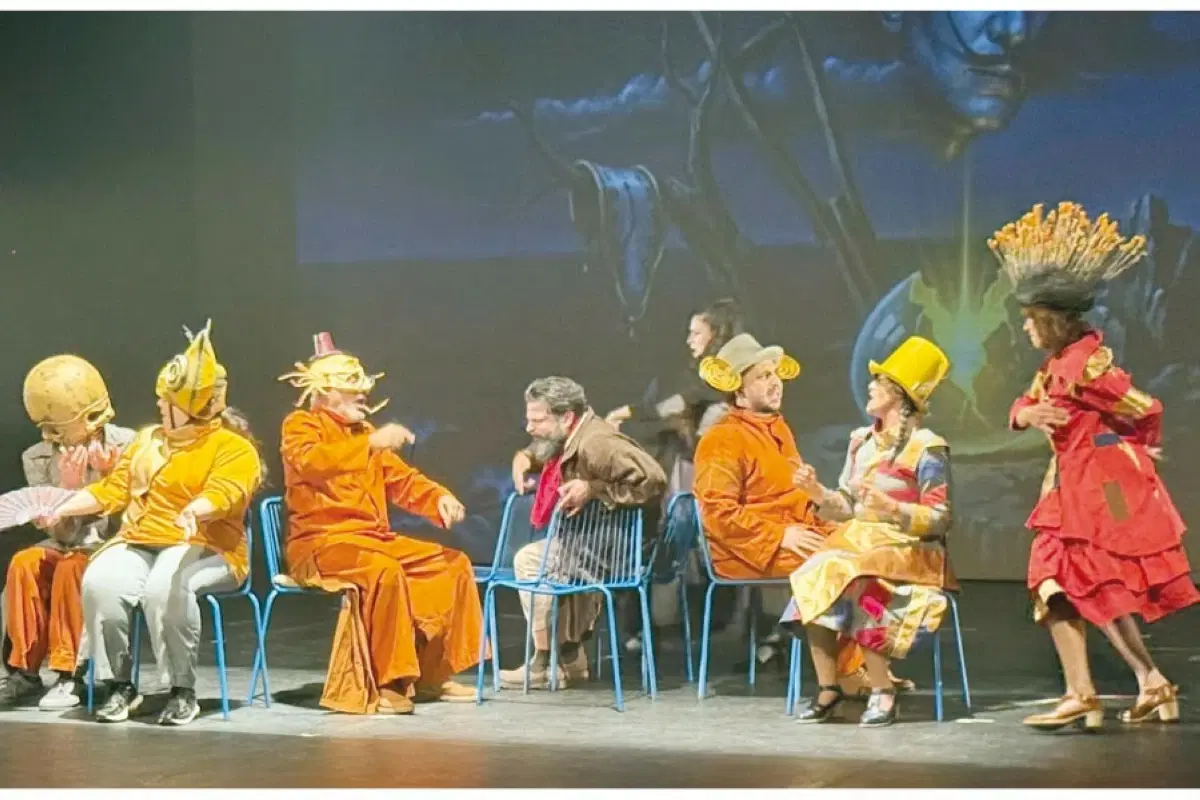
As numerous guests arrive, we understand the multiplication of people in society—the "crowded" figures in the old couple’s imagination, according to Ionesco, whom the director made strikingly present through beautiful, ornate, bright, contrasting, eye-catching costumes, and joyful, bouncy, energetic movements here and there, suggesting people appear happy and content with their circumstances. Chairs multiply to accommodate the arriving people, making the stage completely crowded with chairs. Instead of the new generation sitting on them, we see the speaker climb atop them and trample them without care, as if stepping arrogantly and haughtily on the heads of citizens, raising his head, believing himself the distinguished genius of his age. The empty chairs, devoid of occupants, symbolize the speaker’s control over the seats, despite his muteness, representing the false presence of the citizen.
While diverse dialogue and chaotic interaction unfold among society’s members, the speaker attempts to deliver his lecture—the summary of experiences the elderly couple wished to present to society. We realize this speaker is incapable of communicating or connecting with them. Here, the director adds some Jordanian folk songs, making us feel the local relevance of a play whose events concern us directly. We see people living, speaking, interacting, loving, hating, and some even committing what we call marital betrayal, actively engaging around the mentioned characters, while this society waits to hear the "speaker’s" speech, chosen to deliver that message.
We observe that as the number of chairs increases, so does isolation among people—a truth today. All modern means of communication—mobile phones, the internet, satellite television, and excessive terrestrial and space transportation—have made the transmission of knowledge and messages between people far less effective than before, with communication nearly severed. Even your friend contacts you only through brief text messages, if he replies at all. For example, as links of union among European countries grow stronger, we find each nation’s people still speak only their native language, and while communication exists, mutual understanding among peoples remains nearly nonexistent. Hence, wars increase and escalate. As Saad Zaghloul said, "It’s useless." This is the play’s idea: no matter how hard we try to write, compose ideas, anthems, and great works, or send our spacecraft to distant galaxies, we regress in understanding, harmony, and love—to the point we hire robots and artificial intelligence to perform the task.
Although events unfold on earth, the setting is distant, on an island surrounded by sea waves, symbolizing man’s strangeness in a crowded world of people living without understanding or communication, and without happiness. Despite instant translation being available everywhere, this ease has failed to convey understanding through language capable of expressing purpose.
While the original play ends with a curtain closing on a "non-existent" audience, the director wanted it to be present, even though it is lost and does not understand how its members communicate with others. We thus understand from her that life continues eating and drinking in absurd, irrational ways, living in emptiness despite existing presence.
To convey the play’s idea, Ionesco’s language is broken, repetitive, illogical, with disjointed dialogues full of contradiction, repetition, futility, and obscure messages—confirming the absurdity of meaning, that no truth can be conveyed, and even if it exists, it cannot reach the other, making us feel this entire universe, so full, is emptiness within emptiness.
This play aligns with nihilistic and absurdist philosophy, as seen in the works of Danish philosopher Søren Kierkegaard (1813–1855), known as the "father of existential philosophy," whose writings emphasized individual subjective experience, feelings of anxiety and alienation, as well as the writings of Albert Camus and Sartre from existential philosophy, portraying man in a meaningless world, forcing him to fill his void with illusion, art, or speeches no one cares about.
We notice all our writings revolve around a single orbit, never exceeding the ideas of the Epic of Gilgamesh, the seven Canaanite commandments, the Iliad and the Odyssey, the data of One Thousand and One Nights, and other books across the ages—all of which failed to stop fighting and wars among people. Despite everything having been said, it is as if nothing was ever said. The conflict between Cain and his brother Abel repeats today between savage capitalism and nature-rich peoples, as we see today in the West’s aggression against the East.
The play reveals man’s fragility before cosmic silence, as we see today in our war-stricken lands. As if saying: "In a world where we supposedly know everything, the 'reader and the ignorant are one'—with due respect."
After the stage filled with empty chairs and the world’s inhabitants, the mute speaker appeared, and the entire structure collapsed. The couple committed suicide by jumping into the sea, despairing of their inability to deliver their message to people. It is the absurdity of life through death.
Thus, we see that "The Chairs" presents a mental and philosophical idea: we live absurdity and meaninglessness in all its dimensions. Man, no matter how hard he tries to do something beneficial for humanity, loses his ability to convey his ideas or influence society’s development. He lives trying, yet fails, while life continues—but he loses faith in the existence of any meaning or truth that can be transferred.
Here, we find Eugène Ionesco using theatre itself as a tool to expose human life’s inability to move forward, exposing pretense and false claims in a world that pretends to "know and be able," yet knows and can do nothing. We see everything built to deliver a "useful message," yet it reaches no one; and if it does, no one expresses it. Man thus tries to fill his life with empty speeches, communication messages, and work—but all of it is absurd, yielding nothing.
The purpose of the play "The Chairs" is to instill in the reader or viewer a sense of absurdity, solitude, failed communication, and human disillusionment in the face of the universe, as if whispering softly: "Nothing matters."
It remains to be said that Eugène Ionesco (1909–1994) was a French-Romanian writer and playwright, and one of the leading figures of the Theatre of the Absurd, which emerged in the mid-twentieth century after World War II as a reaction to the devastation of the two world wars. He belongs to the circle of absurdist playwrights including the Irishman Samuel Beckett, the Frenchman Albert Camus, the Briton Harold Pinter, the Spaniard Fernando Arrabal, the French-Russian Arthur Adamov, and others.
Novelist, short story writer, and playwright.