The play is part of the 2026 Jordanian Theater Season, organized by the Ministry of Culture in cooperation with the Jordanian Artists Association, which hosts various theatrical performances on the stage of the Royal Cultural Center.
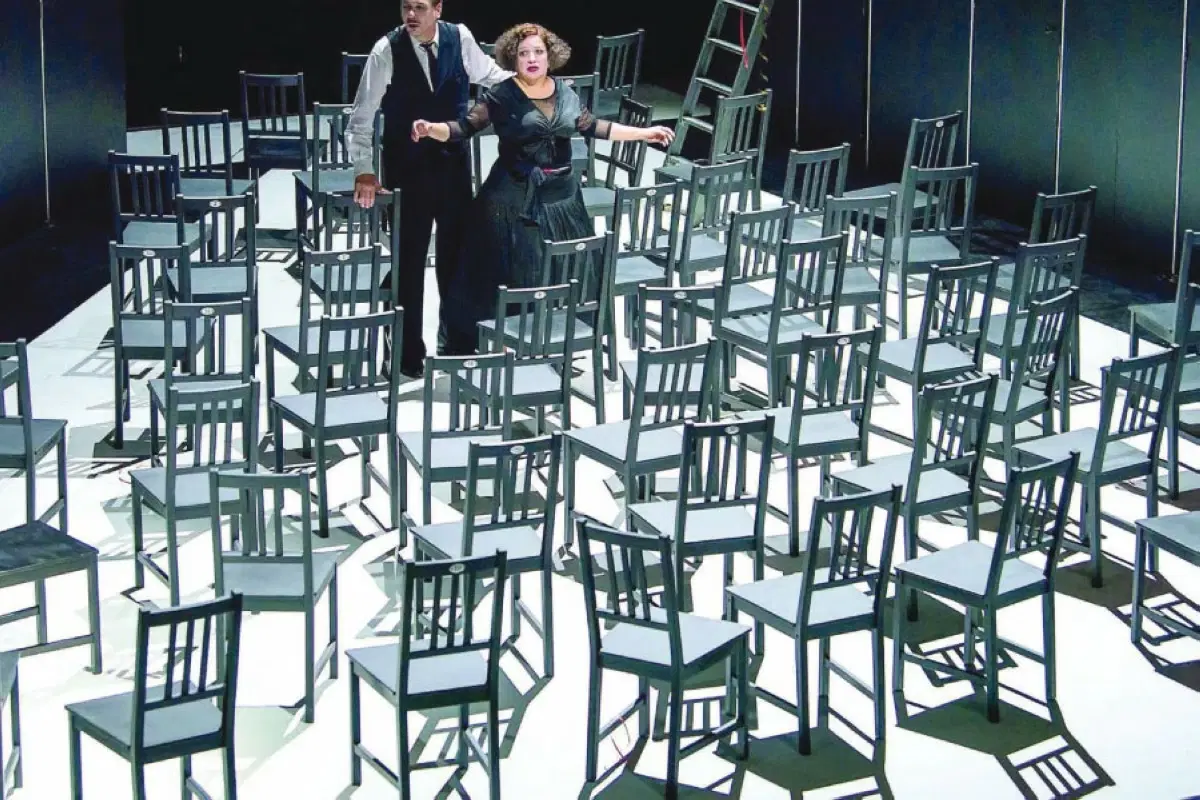
The events of the text revolve around an elderly couple living in an isolated place, recalling their memories while the husband waits to deliver a message he believes is of importance to humanity. With the arrival of invisible guests, the couple becomes busy preparing chairs for them, the number of which increases in the space, in a scene that combines irony and waiting, gradually revealing the distance between the desire for communication and the possibility of achieving it.
In the text, the chairs take on a significance that transcends their material function, as they appear as signs of absence and imagined presence, while the waiting for guests turns into an image of the ambiguous relationship between the human being and others. As for the message the husband seeks to deliver, it opens a door to reflection on the ability of language to convey ideas, and on the human need to be heard, understood, and acknowledged by others.
In the end, the play takes a tragic turn, as the orator summoned to deliver the husband's message is unable to convey it in understandable speech, leaving the chairs and the incomplete message as witnesses to the failure of communication. Through this ending, the text poses a question about the utility of possessing an idea or message if it cannot be conveyed to others, revealing the fragility of the relationship between the desire for expression and the possibility of understanding.
"The Chairs" belongs to Ionesco's experience in the Theater of the Absurd, which moves away from traditional dramatic structure and employs irony and unusual situations to reveal the contradictions and crises of human existence. This style gives the recipient space for interpretation; the significance of the events is not limited to the story of the couple, but extends to questions of loneliness, memory, language, and the limits of communication.
Al-Qassas handles the scenography and direction, in addition to the design of costumes, masks, accessories, film material, and lighting. Participating in the work are Murad Damirjian in musical composition and synthesis, Talal Saeed as decor consultant, Fikriya Abu Khait in costume execution, Moataz Karama in mask execution and decor theatricalization, Omran Ali in music and film material execution, and Kifah Qabaja in lighting execution.
The acting team includes Munther Khalil Mustafa, Mais Al-Zoubi, Mousa Al-Satari, Maria Khoury, Nadin Khoury, Mohammed Al-Batoush, Aya Khalifat, Hamza Fahmi, and Karim Hamdan. Ani Karalian, Nizar Oweis, and Majd Al-Qassas handle the choreography, while the Modern Theater Troupe handles makeup, Qais Al-Shamaila manages the stage, and Nizar Oweis assists in directing.
The play comes as part of the 2026 Jordanian Theater Season, within the framework of efforts aimed at supporting professional theater, providing an opportunity for artistic experiences to connect with the public, and enhancing the presence of theater as a space for creative expression and the discussion of intellectual and human questions.