"Exercises in Freedom": A Theatrical Language That Shifted from Absurdist to Realist Space
Amman4 min read
Share
The second event of the Jordanian professional theater season, "Exercise in Freedom," was presented. Conceived by Firas Zaqout, written by Hani Al-Khalidi, and directed and scenographed by Firas Al-Masri.
The season's events, held from the 19th to the 26th of this month at the Hani Sanobar and Mahmoud Abu Ghreibe theaters in the Royal Cultural Center, were suspended for three days in mourning for the victims of the terrorist incident in Al-Hamoud village in Karak.
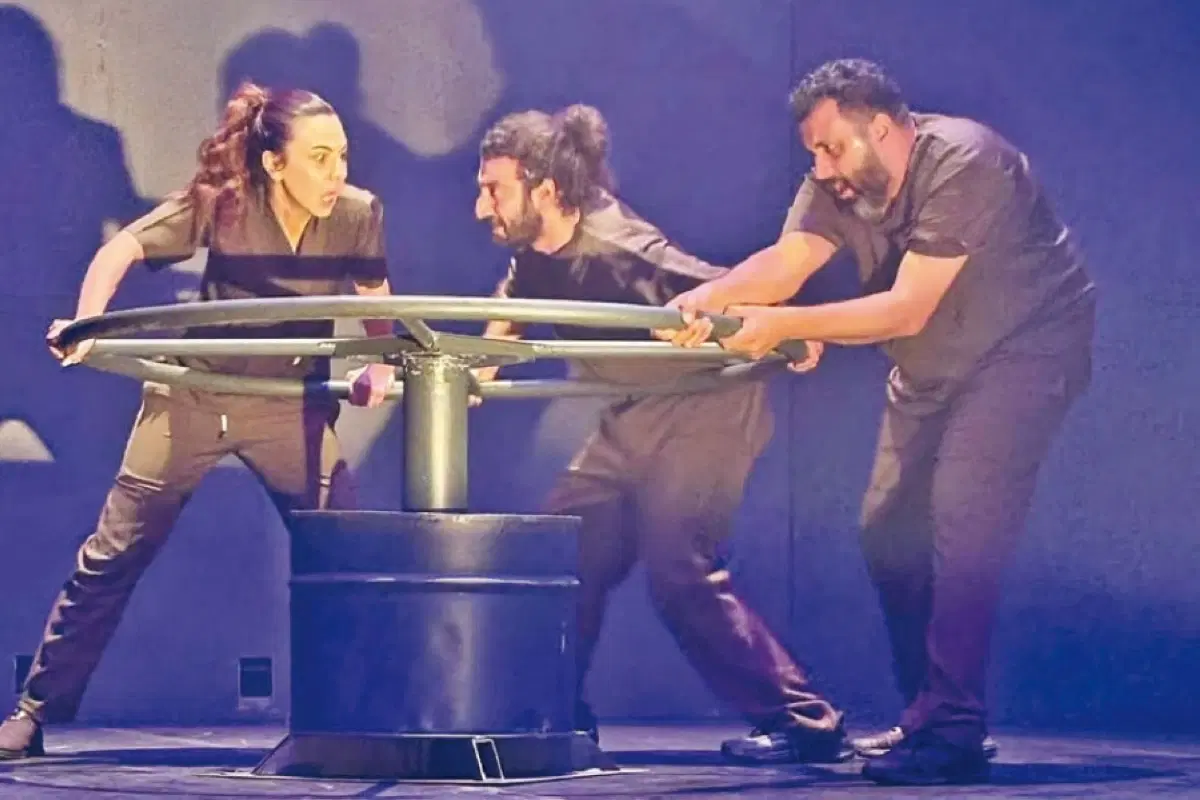
The play's events, with music and compositions by Abdulrazzaq Matryeh, began as the stage revealed four characters who found themselves trapped in a confined space. The roles were portrayed by Ahmed Al-Jizawi, Tariq Al-Tamimi, Salsabeel, and Nada Batarseh. These characters express astonishment and shock at their current reality, questioning themselves and each other about how they arrived at this place and why they are imprisoned in a narrow, enclosed space from which they cannot escape. They are forced, in order to stay alive, to keep rotating a large metal disc fixed at the center of the stage, as the disc's rotation ensures a continuous flow of oxygen into the confined space. Ceasing to turn it would result in their suffocation due to oxygen deprivation.
In subsequent scenes, answers to the questions posed by the four characters begin to emerge, revealing an unknown authority behind their captivity. This authority then attempts to subdue and tame them. In the end, three of the characters surrender to the demands of this unseen authority, hoping to escape their predicament and ensure their personal safety, having agreed to alter their natures, relinquish their freedoms, and expose their private lives under the pressure of coercive and manipulative tactics. The fourth character, however, chooses freedom—even if it costs her life—over submission to the authority's demands.
In the early scenes, the theatrical space closely resembled an absurdist setting, particularly through the emergence of a sense of helplessness in comprehending their surroundings, culminating in the characters' feeling—and eventually certainty—that they would remain imprisoned in this space, with no prospect of escape from the predicament they found themselves in.
The presence of the large metal disc, and the actors' interaction with its symbolic meaning, contributed to imbuing the disc's movement and function with semantic significance—its rotation becomes the sole means of preventing the characters' suffocation. This established a semiotic framework within the theatrical space, transforming the physical object into a signifier that transcends its material existence, becoming intrinsically linked to the characters' survival.
This deepened the absurdist nature of the space, in which the characters' power diminishes and becomes feeble in the face of the disc's symbolic weight—their salvation lies within it. Their sole concern becomes keeping it in motion, clinging to it desperately.
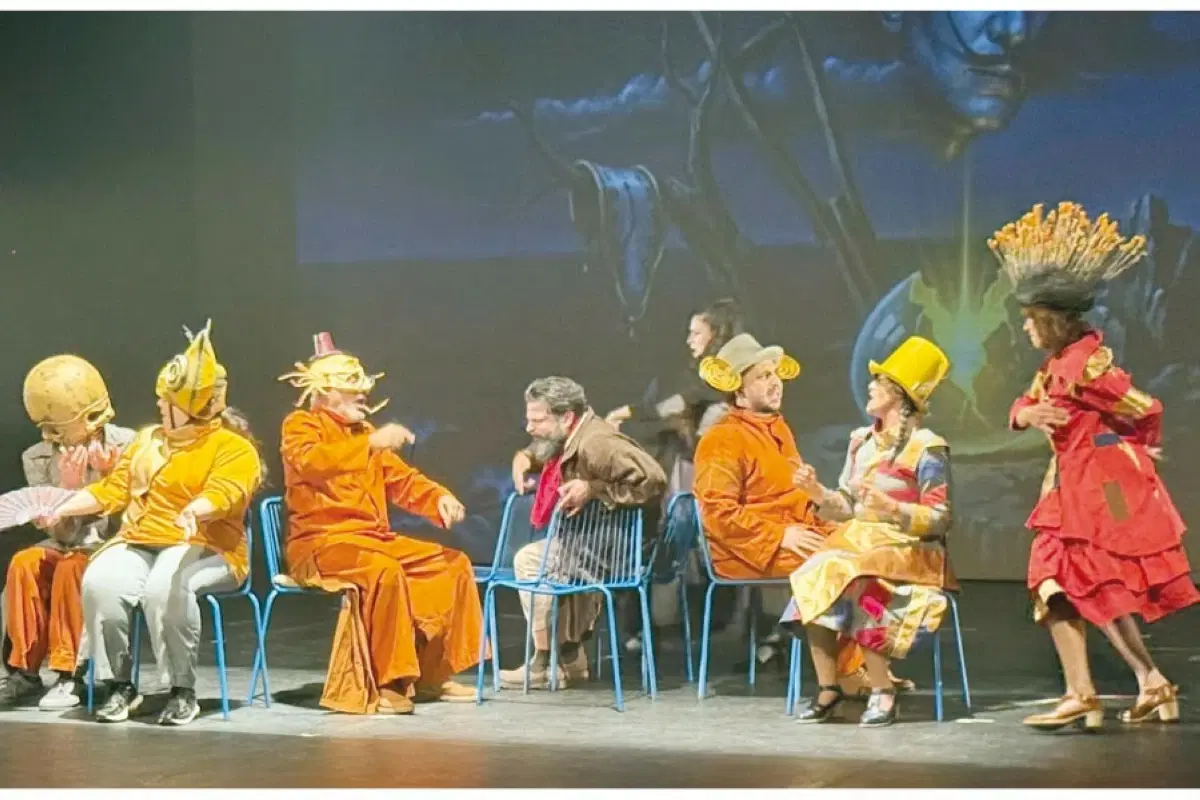
Yet this semiotic structure, which initially reinforced the absurdist space, gradually shifted as an external authority emerged, controlling the characters and giving way to a different space—one that manifests as a realistic, social environment, where the characters begin pursuing their personal interests, much like in lived reality.
Thus, we can argue that this performance serves as a reaction against the dominance of values associated with ugliness in capitalist consumer patterns, which dominate the social and cultural lives of broad classes and groups in most cities worldwide—not only in our societies. However, this social, cultural, and economic submission is no longer imposed, as it once was, through coercive force, whether by threats of war or economic sanctions.
Instead, it is now achieved through "soft power," by reshaping school and academic curricula, in addition to the immense pressure exerted by globalized digital media platforms, which have brought about significant transformations in the narratives of Global South societies—transformations that ultimately serve the narratives of the Global North.
Following the performance, director Firas Al-Masri, during a post-show discussion, spoke about the meaning of the authority that confined the characters, stating: "In reality, they know everything about us. Our personal privacy is no longer immune to intrusion through information technology. Their influence even extends, as he pointed out, to the types of food we consume—indeed, they feed us unhealthy food products."
"Moreover, the artificial intelligence we have begun to rely on in our daily lives to the point of addiction is merely an outdated version of the technologies they possess, while they reserve for themselves more advanced and intelligent technologies. Therefore, we must become more aware and conscious of what surrounds us."