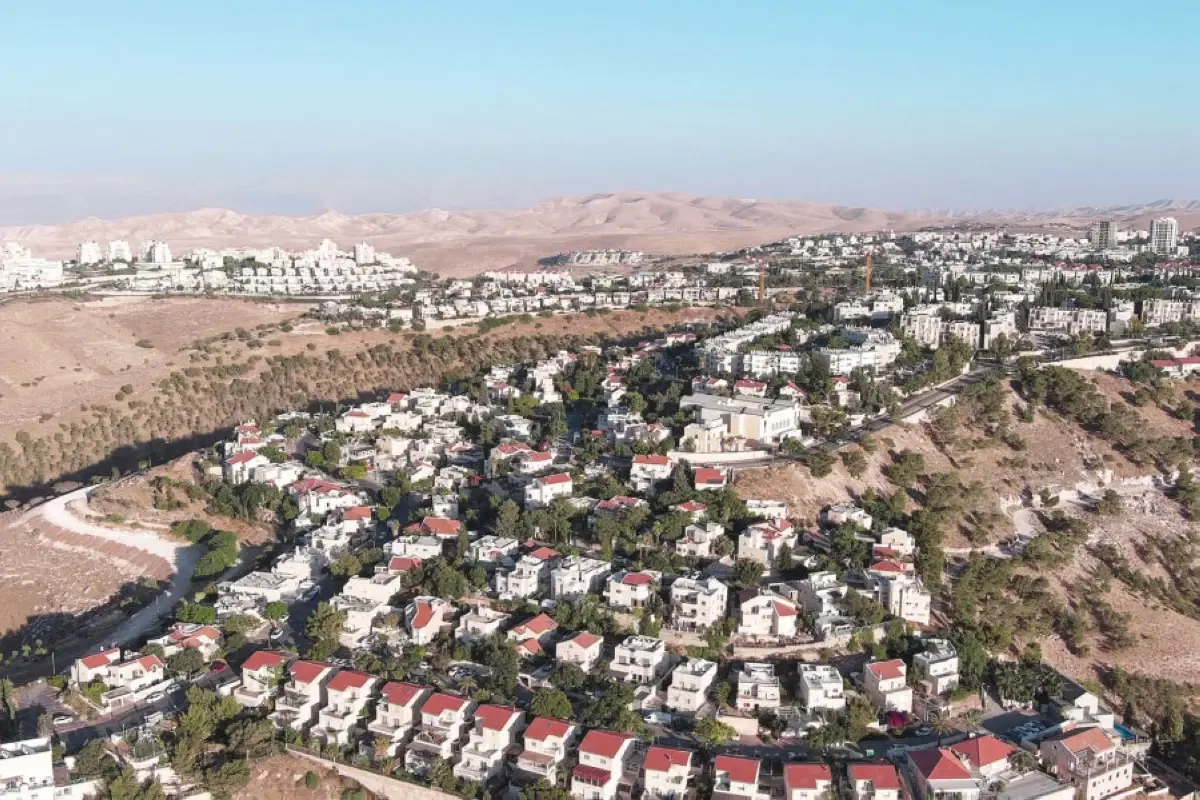
Settlement expansion reaches deep into the West Bank
Isolating Palestinian towns from their lands
Amman7 min read
Share
Israeli human rights organizations warn of geographic and demographic changes in the Palestinian territories
A joint report issued by three Israeli human rights organizations opposed to settlements—Yesh Din, Bimkom - Planners for Planning Rights, and HaMoked - Center for the Defence of the Individual—has revealed an acceleration in Israeli policies aimed at seizing vast areas of Palestinian land and shrinking the space available to Palestinians. The report warns that these policies are transforming into a de facto annexation process, expanding from isolated areas in Area C to towns and populated regions located deep within the occupied West Bank.
The report, titled "Maximum Land, Minimum Population," explained that Israeli measures are no longer limited to small, remote Palestinian communities but now include large towns and areas theoretically under the control of the Palestinian Authority. This is being achieved through an integrated system involving settlement expansion, pastoral outposts, settler violence, land seizure, and the imposition of restrictions on movement and access to agricultural land. The report documents four cases that the organizations consider indicative of this trajectory, ranging from denying Palestinian farmers access to their lands in the "seam zone," to surrounding a Palestinian community with outposts, isolating a Palestinian town from its agricultural lands, and the return of settlement activity in the northern West Bank.
The report notes that the restrictions imposed by Israel on Palestinian farmers in the "seam zone" following October 7, 2023, under the pretext of emergency and temporary security measures, have gradually turned into a permanent reality that denies landowners regular access to their property.
The report cites the case of farmer Adnan Qabha, who was prevented from reaching the olive trees he used to cultivate during the 2023 and 2024 harvest seasons, while in 2025, he was allowed access to his land for only two days. Human rights organizations believe that the continuation of this pattern of restrictions on movement and land access transforms measures initially presented as temporary security precautions into a sustainable policy that effectively displaces Palestinian farmers from their lands and threatens their ability to invest in and maintain them.
In the Jericho area, the report documents the case of the Rummana community, whose homes are located within the area classified as "Area A," which is officially under Palestinian civil and security control. However, according to the report, it has become completely surrounded by pastoral settlement outposts.
The report states that the community's residents are repeatedly subjected to attacks and harassment by settlers, alongside increasing restrictions on their movement and ability to enter and exit the community. It considers what is happening in Rummana to be a reflection of the expansion of policies to seize land and push Palestinians away from it, extending beyond the borders of Area C, as settlement outposts now encircle population centers that were previously far from the circle of direct settlement expansion.
In the town of Sinjil, located in Area B, the report monitors the impact of settlement outposts, fences, closures, and settler violence in gradually isolating residents from their agricultural lands and reducing the space available to them.
According to the report, the pastoral outposts established north of the town have created settlement contiguity between the settlements of Shilo, Eli, and Ma'ale Levona. This has contributed to isolating Sinjil from its natural Palestinian extension toward the north and east, while settlers have seized vast areas of land located south of the town.
The report also documents widespread destruction of Palestinian agricultural property, noting the uprooting of more than 200 trees during the construction of a fence around Sinjil, including 135 ancient olive trees, in addition to the leveling of vast areas of agricultural land.
Furthermore, the proliferation of settlement outposts and repeated settler attacks on farmers have made access to large parts of the land surrounding the town extremely dangerous, and in some areas almost impossible. This effectively pushes residents to retreat into built-up areas and isolates them from the agricultural lands that constitute a primary source of their livelihood.
In the northern West Bank, the report documents the return of Israeli settlement to the four settlements evacuated under the 2005 "Disengagement Plan": Homesh, Sa-Nur, Ganim, and Kadim, in the area between Nablus and Jenin.
According to the report, Israel began in 2023 to remove the restrictions that had prevented settlers from returning to these areas. Settlement has effectively been re-established in Homesh, while practical steps have been taken to re-establish the Sa-Nur settlement, alongside similar moves regarding Ganim and Kadim.
This is accompanied by extensive changes in infrastructure and a heavy military presence in the area. In December 2025, a military order was issued to seize approximately 500 dunams of private Palestinian agricultural land for the purpose of constructing a road over six kilometers long to connect the settlements of Homesh and Sa-Nur.
In this context, Israeli Finance Minister and head of the so-called "Settlement Administration" in the Ministry of Defense, Bezalel Smotrich, announced that Israel is working during the summer of 2026 to establish 11 new settlements and begin populating them in the northern West Bank. He stated that the number of settlements in the area will rise from four to 18, including 11 immediately, encompassing Homesh, Sa-Nur, Ganim, and Kadim, adding that "more is coming."
Smotrich linked these steps directly to his political project aimed at preventing the establishment of a Palestinian state, saying: "We are strengthening the security belt, killing the idea of a Palestinian state, and making it clear that the Land of Israel is ours forever and ever."
The report links the four cases it documented to the political vision announced by Smotrich under the slogan "Maximum Land, Minimum Population." According to human rights organizations, this vision is based on imposing Israeli control over the largest possible area of the West Bank while keeping the smallest possible number of Palestinians within that area, through land seizure, isolating towns from their agricultural surroundings, and severing Palestinian geographic contiguity.
Smotrich had revealed details of this vision during a press conference held in September 2025, where he presented maps prepared by the Settlement Directorate of the Israeli Ministry of Defense. These maps, according to his announcement, aim to apply Israeli law to approximately 82% of the West Bank's land.
Smotrich explained at the time that the principle upon which the plan is based is "maximum possible land, minimum population," adding: "We do not want to apply our sovereignty over a population that seeks to destroy us... We must fight our enemies and prevent them from living a comfortable life."
The three human rights organizations considered that the seizure of Palestinian land, the isolation of towns from their agricultural lands, and the severing of geographic contiguity between Palestinian communities collectively constitute components of a de facto annexation process that is gradually being entrenched on the ground. They warned that settlements, outposts, settler and military violence, and movement restrictions are not separate files, but rather interconnected tools working in one direction.
In a joint statement, the organizations said that the West Bank is witnessing "an accelerated process of annexation, land seizure, and the displacement of Palestinians," confirming that what is happening "is not a series of isolated local events, but a policy aimed at controlling the largest possible area of land and confining Palestinians to the smallest possible area."
They added that what has been applied for years against small Palestinian communities in Area C is now extending to entire towns and regions deep within the West Bank, noting that the Israeli government no longer hides its goal of "annexing the largest possible area of land with the fewest possible Palestinians."
The organizations warned that transforming annexation and forced displacement from a declared political project into a field reality being imposed gradually will lead to profound geographic and demographic changes in the West Bank, calling on the international community to intervene to stop these policies before they lead to a reality that is difficult to reverse.