Seminar in Irbid on the Jordanian Narrative between the State's Inception and Prosperity
Amman6 min read
Share
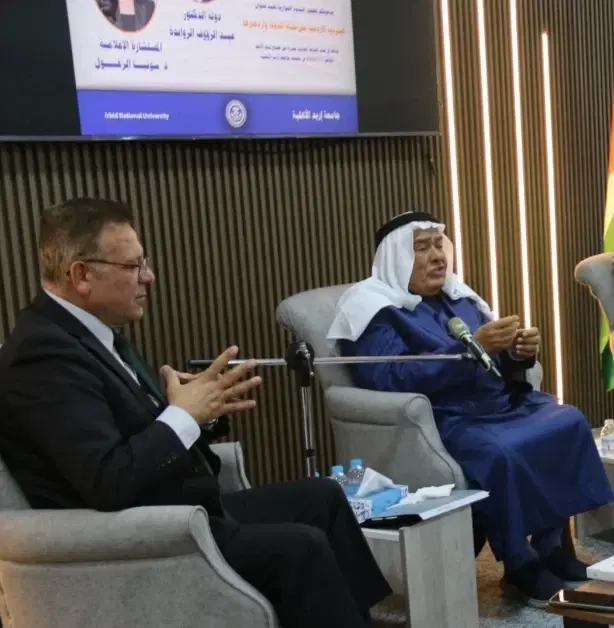
Former Prime Minister Dr. Abdur-Raouf Al-Rawabdeh stated that the inception of the Jordanian state is linked to deep-rooted national and Arabist roots, and that the Great Arab Revolt and the establishment of the Emirate of Transjordan formed pivotal milestones in building the modern state, within the context of the transformations the region witnessed with the issuance of the Sykes-Picot Agreement and the Balfour Declaration.
During a national dialogue seminar at Irbid National University this Sunday, titled "The Jordanian Narrative between the State's Inception and Prosperity," Al-Rawabdeh emphasized that from its beginnings, Jordan has carried a clear Arab message, remained present in the issues of its nation, and served as a haven for Arab brethren, all while maintaining the specificity of its national identity.
Al-Rawabdeh provided an in-depth historical and political reading of the Jordanian narrative, stressing that it is not merely a fleeting political discourse, but a cumulative path formed through successive historical milestones, built upon by the will of the Hashemite leadership and the sacrifices, awareness, and ability of Jordanians to protect the state and safeguard its achievements.
He explained that the state's journey has contributed to building a modern political entity and national institutions that have evolved through successive stages, noting the importance of continuing scientific efforts to document Jordanian history and present it in an integrated and simplified form that allows citizens, especially the youth, to understand its milestones and implications.
He addressed the geographical and civilizational dimension of Jordan as a crossroads for routes and civilizations, noting that the strength of a state is not measured by its natural resources or geographical area alone, but by the awareness, cohesion, and ability of its people to coexist, and by the wisdom of its leadership in dealing with regional challenges to preserve stability and enhance national immunity.
He stressed that Jordan's Arabism is not a political slogan, but an authentic approach that accompanied the state's inception and was reflected in its positions and relationships with its Arab surroundings, affirming that solidarity with and openness to brethren enhance Jordan's status and do not conflict with the specificity of its national identity.
He affirmed that the Jordanian identity is based on citizenship, belonging, respect for the law, equality, and non-discrimination, and that safeguarding the national fabric and strengthening trust between the citizen and state institutions represent the foundation for continued stability and progress.
Speaking about Jordanian-Palestinian relations, he highlighted the historical and humanitarian ties between the two peoples, asserting that the relationship transcends geographical proximity to a partnership in history and destiny, reflecting the steadfastness of the Jordanian stance toward the Palestinian cause and the support for the legitimate rights of the Palestinian people.
He reviewed the achievements made by the state in the health, education, public services, infrastructure, and economic project sectors, noting that Jordan, despite its limited natural resources and the challenges it faced, was able to build solid institutions and achieve progress in multiple fields.
He also indicated that the modernization of political, economic, and administrative systems represents an extension of the continuous development process, enhances institutional efficiency, and benefits from national competencies. He pointed to the importance of transforming the Jordanian narrative into a renewed national project that strengthens youth confidence in the state's future, in light of the modernization efforts led by His Majesty King Abdullah II and the follow-up of His Royal Highness Crown Prince Al Hussein bin Abdullah II on the development tracks.
He called on students and youth to read Jordanian history objectively, to distinguish between facts, rumors, and misleading information, and to rely on reliable sources, emphasizing that understanding history is a necessity for comprehending the present, anticipating the future, and participating consciously in public life.
For her part, media consultant Dr. Sonia Al-Zaghoul spoke about the role of media in building the Jordanian narrative and presenting it to the public, explaining that the task is not limited to reporting or retelling events, but requires professional processing that links facts to their historical contexts, highlights their national and human implications, and turns documents and information into clear and attractive knowledge content.
She noted that media professionals face a challenge in linking documented Jordanian history with contemporary media narratives, in light of the speed of information circulation, the spread of digital platforms, and the multiplicity of content sources. She emphasized the necessity of strengthening cooperation between media professionals, historians, and researchers to ensure the presentation of narratives based on historical documents and evidence that maintain the accuracy of information and the integrity of its context.
She stated that historical documents require conscious media processing to move them from mere information to a coherent narrative that helps the public understand events, their implications, and their impact on the state's journey, while utilizing modern storytelling tools without compromising content or credibility.
Al-Zaghoul stressed the importance of diversifying the methods of presenting the Jordanian narrative to suit the interests of new generations and their ways of interacting with content through digital platforms, multimedia, human stories, and interactive content.
She called for enhancing media initiatives in documenting national milestones and publishing reliable information in a timely manner, rather than just reacting to circulating content after it has spread, noting the importance of the media's role in countering disinformation and protecting national memory from distortion or fragmentation.
Al-Zaghoul also affirmed that building the Jordanian narrative is a shared national responsibility in which the efforts of the historian, researcher, media professional, and educational institution are integrated to ensure the documentation of the state's history and achievements, and to present it to new generations in a way that fosters knowledge and belonging and keeps pace with contemporary media transformations.
In turn, the university president, Dr. Majed Abu Zureiq, in the presence of the Chairman of the Board of Directors Dr. Ahmad Al-Atoum and the university vice president Dr. Mohammad Al-Muqablah, affirmed that the Jordanian narrative represents a fundamental pillar in building awareness and consolidating national identity, pointing to the importance of documenting the state's history, its pivotal milestones, and its achievements, and presenting them to the young generation in a clear scientific language based on facts and documents.
He noted that universities fulfill a role that goes beyond academic education to developing critical thinking and responsible dialogue, fostering values of citizenship and belonging, and preparing generations capable of understanding their present and participating in building their nation's future.
The seminar featured an intellectual discussion that addressed the history of the Jordanian state and its national identity, the relationship between Arabism and citizenship, the importance of Arab unity, regional challenges, and future prospects, in addition to the role of academic and media institutions in consolidating national awareness.