He pointed out that the archaeological and historical evidence spread across the north and south of the Kingdom, in the desert and the Jordan Valley, confirms the civilizational importance of Jordan and the succession of civilizations witnessed on its land.
Al-Rawashdeh explained that work on the project relies on a team of specialists and researchers, distributed among committees specialized in history, archaeology, anthropology, sociology, and other fields, who are responsible for documenting and verifying historical and cognitive material in preparation for presenting it in engaging narrative styles that address the mind and conscience.
He noted that the Ministry of Culture is working to provide the Jordanian community with the opportunity to participate in documenting the national narrative through platforms that receive documents, stories, tales, songs, folk chants, and other materials that form part of the national memory.
He emphasized that the project is open and ongoing and will not end with the completion of the documentation phase, but will rather form a reference for researchers, those interested, and future generations, stressing the importance of presenting the national narrative in a way that strengthens Jordanians' confidence in their country and future, and highlights the bright milestones in Jordan's history and its cultural and civilizational heritage.
Al-Rawashdeh indicated that the Jordanian identity is based on integrated national, Arab, and human dimensions, and that the comprehensive narrative reflects what humans have achieved on this land, far from regional or sectarian considerations. He also pointed out that the cultural and social diversity in Jordan, and its experience in coexistence and social cohesion, form part of the components of the national narrative that should be documented and highlighted for future generations.
In a related context, he emphasized the importance of keeping pace with digital transformations and employing artificial intelligence technologies in cultural and media work, noting that the Ministry has established a directorate specialized in this field to keep up with technological developments, while stressing the necessity of verifying and maintaining values, constants, and historical and national foundations when producing content using these technologies.
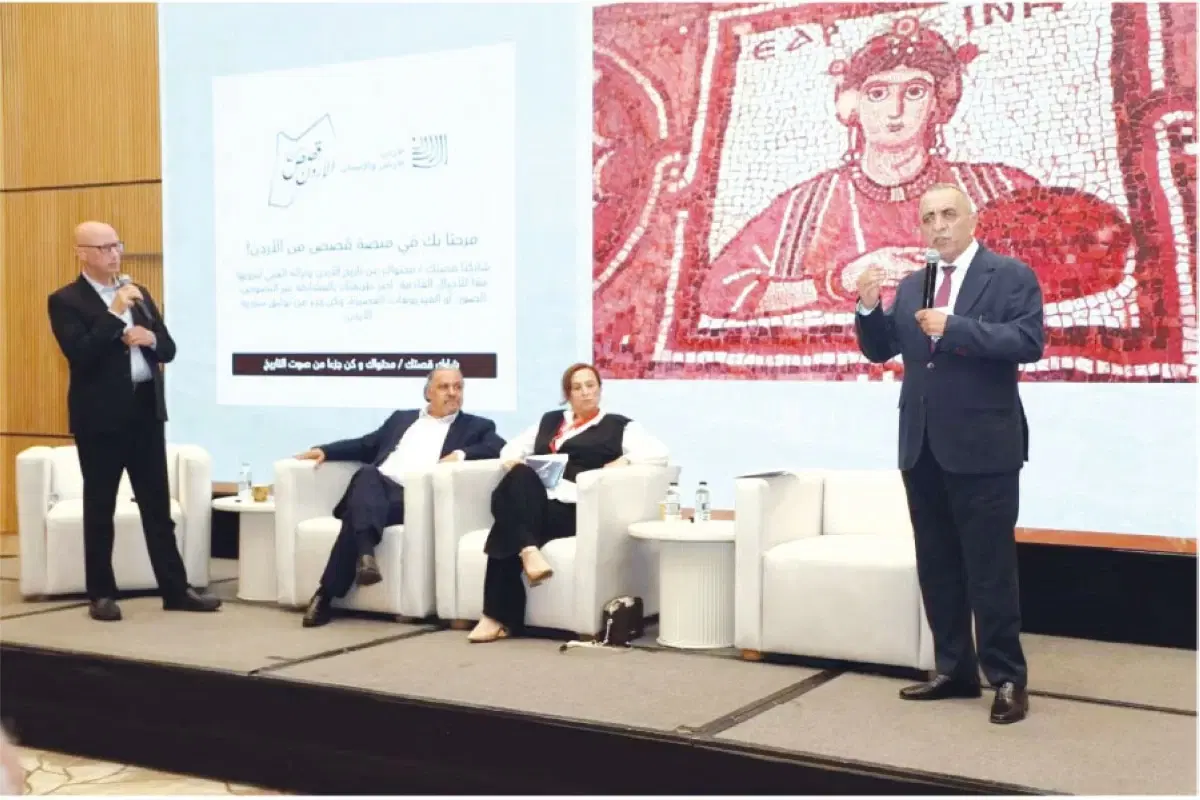
The session, moderated by Hossam Gharaibeh, witnessed the participation of writer, journalist, and former Minister of Culture Basma Al-Nsour, and writer, researcher, and journalist Mefleh Al-Adwan. The participants discussed the concept of the Jordanian national narrative, ways to document and present it in the media, and the role of the media in conveying history and national memory to the public using professional and contemporary methods.