Culture Minister: Jordan's history is not reduced to the twenties and it is our right to document our narrative
Amman3 min read
Share
Minister of Culture, Mustafa Rawashdeh, said on Sunday that the Jordanian narrative is the state's project that tells the story of the land and the human being, adding that Jordan is a great land and an archaeological treasure, as several civilizations have passed through it.
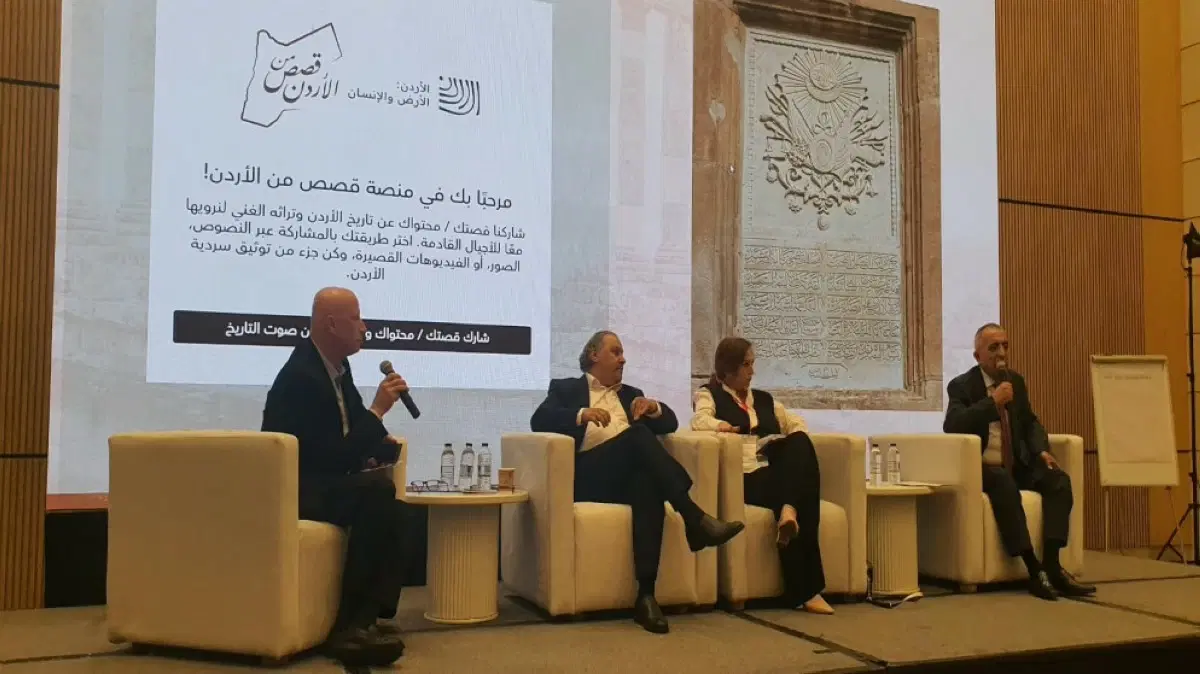
During a session entitled "The Jordanian National Narrative: How did the media understand and present it?", within the Future of Media and Communication Forum held in Amman, he explained that the narrative does not recount historical events, because history is found in books, but rather enjoys a specificity represented in evoking bright points that do not touch anyone.
He pointed out that the narrative will not end with the conclusion of its documentation project.
"The Jordanian narrative is one, like the flag," according to Rawashdeh, who stressed that the time has come to document the narrative, and that it is Jordan's right to document its narrative.
He explained that the narrative project began a year ago, and that there are platforms available for citizens to document the narrative objectively, stressing that there is no fear in raising questions related to the narrative, but rather all questions must be raised.
The minister stressed that Jordan's history is not reduced to the twenties, but extends to two and a half million years before that.
Rawashdeh affirmed that any citizen, young or old, can enter the platform and document the stories, tales, and documents they have, emphasizing the importance of the submitted materials being reliable, and stressing that the Jordanian identity has national, Arab, and human dimensions.
When asked about Israeli ambitions in the region, he stressed that Jordan has nothing to fear with the presence of its leadership and its people, affirming that the Israeli occupation of Palestine is transient, and whoever reads history realizes that, pointing out that land cannot be occupied by force.
Regarding the employment of artificial intelligence in the Ministry of Culture, Rawashdeh said that a specialized department for artificial intelligence has been established in the ministry, which must be dealt with while subjecting its outputs to scrutiny.
Former Minister of Culture Basma Al-Nsour also said that the Jordanian narrative must steer clear of emotions and slogans and recount facts, pointing out that the narrative documentation project is also related to the inception of the state, starting from the Great Arab Revolt.
Al-Nsour stressed the importance of the role of media, art, and drama in documenting the Jordanian national narrative, and highlighting the history of the Jordanian state and its political, social, and economic development.
For his part, researcher Mufleh Al-Adwan said that the narrative came to answer the question: "Who are we?", pointing out the existence of previous projects that documented Jordanian villages, the Badia, and others.
Al-Adwan touched upon previous efforts to document Jordanian villages and the Badia, as part of the national memory, and what they contain of political, social, and economic history, alongside popular stories and inherited narratives that contribute to preserving the cultural identity of Jordanian society.
Al-Adwan pointed to the experience of documenting Jordanian villages which began in 2005, and reached the documentation of a number of villages, within the framework of efforts to monitor the history of local communities and their social, economic, and political structure.
Al-Adwan sees the importance of presenting the narrative through the media and publishing it.