Princess Sumaya: The future of artificial intelligence is not measured by the speed of its adoption, but by its ability to create real change in people's lives.
Her Highness calls for Jordan and the region to transition from consuming technology to participating in its innovation.
Amman6 min read
Share
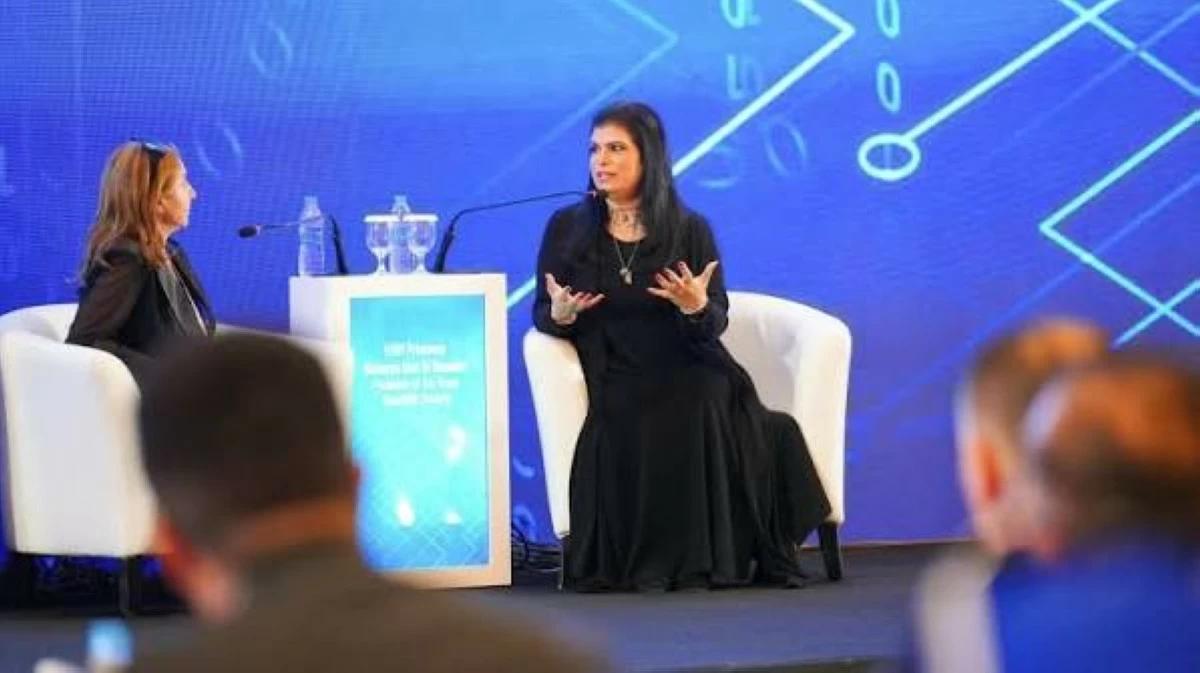
Her Highness Princess Sumaya bint El Hassan, President of the Royal Scientific Society, inaugurated today, Sunday, the proceedings of the "Artificial Intelligence: From Adoption to Impact" forum, organized by the Information and Communications Technology Association of Jordan (int@j).
During a panel discussion moderated by JoPACC CEO Maha Al-Bahou, Her Highness stated that the question facing nations and institutions is no longer how quickly they can adopt AI technologies, but what these technologies can effectively change in people's lives, economic productivity, institutional competitiveness, and the quality of services.
Her Highness emphasized that success in digital transformation is not measured by the number of technologies institutions introduce, but by the value they generate and their ability to address challenges, create new opportunities, and improve quality of life. She called for moving beyond limited experiments and demonstrations toward practical, scalable solutions that yield tangible economic and social results.
In presenting the future of AI in Jordan and the region, Her Highness stressed that digital sovereignty does not simply mean owning or using technology, but possessing the capability to shape, govern, and direct its future to serve national priorities.
She stated that the requirement is to shift from being a consumer of technology to becoming an innovator and an active contributor to its development, ensuring that digital transformation does not deepen existing gaps, but rather expands opportunities for participation and growth for everyone.
Her Highness cited international experiences that offer practical lessons in this field, including Estonia in developing digital governance and enhancing transparency and public service efficiency, and India in utilizing digital infrastructure to expand access to services and economic opportunities.
She also pointed to the Finnish experience in education, Morocco in renewable energy, and Costa Rica in balancing environmental protection with economic growth, emphasizing that benefiting from these models requires adapting them to national needs and priorities.
At the heart of this transformation, Her Highness placed humanity, education, and skills, asserting that investment in human capital is the foundation for any successful technological future. Artificial intelligence, according to Her Highness, requires not only technical expertise but also critical thinking, creativity, adaptability, and continuous learning.
She stressed the necessity for skill development programs to encompass various segments of the workforce, not just technology specialists, and for future generations to be prepared to work alongside smart systems and leverage their potential.
Her Highness also called for directing innovation and artificial intelligence toward the most urgent developmental challenges, primarily education, healthcare, energy security, and climate change, while ensuring the development of responsible applications that respect ethics, governance, data protection, and environmental and social impact.
Her Highness pointed out that technology alone does not create transformation; its success requires leadership with a long-term vision, institutions capable of keeping pace with change, evidence-based policies, flexible regulatory and legislative frameworks, and a genuine partnership between the public and private sectors.
She affirmed that building public trust in technology begins by ensuring citizens understand the systems that affect their lives, trust them, and feel their direct benefits.
Her Highness stated that the future of AI will not be determined by those who adopt this technology the fastest, but by those who possess the vision, institutions, skills, and courage to employ it in the most meaningful and impactful way, emphasizing that adoption is the starting point, while creating impact remains the true ambition, with the human being at the center of both.
In a related context, calls emerged during the forum to invest in Jordanian talent to build a national AI industry capable of serving Arab markets, and to leverage local expertise in the Arabic language, its dialects, and the needs of institutions in the region.
Fadi Qutaishat, Chairman of the int@j board of directors, said that the opportunity lies in developing specialized Arab solutions atop available global models, including speech recognition in various dialects, adapting language models, and text-to-speech conversion, rather than bearing the cost of building massive models from scratch.
He emphasized that this opportunity is not limited to developing models but extends to their governance, security, data protection, integration with institutional systems, operation, and updating. These are areas that allow for the employment of Jordanian expertise and the opening of new regional markets, calling for strengthening the role of government institutions in adopting solutions developed by local companies, which helps them prove their capabilities, expand, and provide high-quality opportunities for youth in various governorates.
For his part, the CEO of int@j, Eng. Nidal Bitar, indicated that the primary challenge facing institutions is demonstrating what AI has actually achieved in terms of productivity and competitiveness, and the extent to which its benefits are reflected across all segments of society, stressing that the forum focuses on three interconnected pillars: digital sovereignty, skills, and inclusive digital growth.
Bitar highlighted the importance of expanding women's participation in innovation and leadership within the technology sector, noting the role of Her Highness in supporting the Women in Tech (SHETECHS) unit since its launch in 2018.
Within the framework of the new generation entering the field of innovation, the participation of university students in an AI-based video competition reflected the breadth of interest in these technologies beyond traditional technological disciplines. The competition saw the participation of 73 male and female students from 17 Jordanian universities, who submitted 64 works, of which 11 distinguished clips were displayed under the title: "A Leap Towards 2033."
The entries included students from diverse disciplines, including nursing, pharmacy, business administration, media, cinema, applied arts, and education, signaling the widening scope of AI application and the importance of involving various disciplines in shaping the digital future.
In turn, the German Ambassador to the Kingdom, Dr. Bertram von Moltke, pointed to the importance of measuring the impact of AI on corporate competitiveness and employment opportunities, citing data indicating that more than 60 percent of ICT companies in Jordan incorporate these technologies into their products and services, confirming that the benefits extend to industry, trade, and other sectors by improving product quality, reducing waste, and developing inventory management and demand forecasting.
The forum, which was attended by officials, business leaders, investors, experts, and representatives of the technology sector and academic institutions, addressed a number of issues related to the transition from adopting AI to achieving actual returns, including AI investments, infrastructure and digital sovereignty, future skills, productivity, and technology applications in Jordanian institutions.
The forum was organized through the SHETECHS unit at int@j, with support from the second phase of the Innovative Private Sector Development project, implemented by GIZ and funded by the German Federal Ministry for Economic Cooperation and Development, and in cooperation with the Ministry of Industry, Trade and Supply.