Princess Sumaya emphasizes Jordan's role as an equal partner with the European Union in research and innovation
Amman6 min read
Share
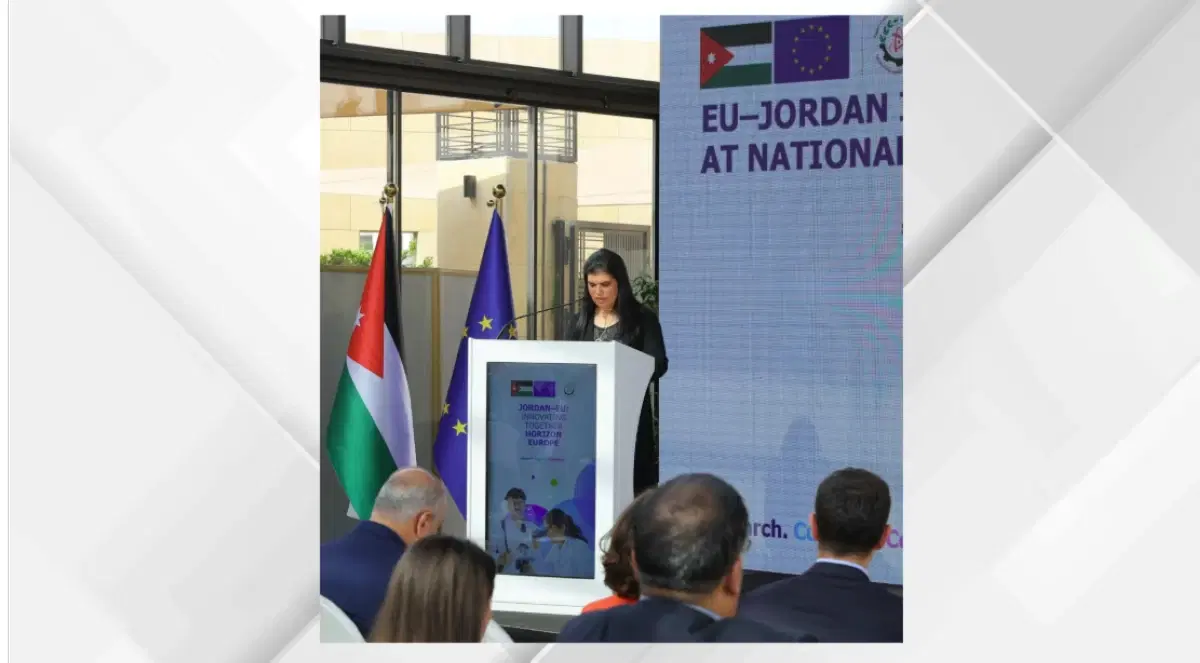
Her Royal Highness Princess Sumaya bint El Hassan, President of the Royal Scientific Society (RSS) and UNESCO Goodwill Ambassador for Science for Peace, emphasized on Thursday the importance of strengthening cooperation between Jordan and the European Union in the fields of scientific research and innovation. She stressed that Jordan possesses the scientific capabilities and expertise that qualify it to contribute to global scientific progress through partnerships based on equality, the exchange of expertise, and the achievement of mutual benefit.
This came during the keynote speech delivered by Her Royal Highness at the "Jordan and the European Union: Innovating Together" event, organized by the European Union Delegation to Jordan at the Fairmont Amman Hotel. The event was attended by government officials, university leaders, researchers, innovators, representatives of the private sector, and members of the diplomatic corps, to discuss opportunities for enhancing cooperation under the "Horizon Europe" program and other European research and innovation programs.
The event opened with welcoming remarks by the EU Ambassador to Jordan, Pierre-Christophe Chatzisavas, followed by speeches by the Minister of Education and Minister of Development of Human Resources, Dr. Azmi Mahafzah, and Maria Cristina Russo, Deputy Director-General for Research and Innovation at the European Commission.
In her speech, entitled "Science Without Borders: Jordan and Europe Innovating for a Common Future," the Princess highlighted the depth of relations between Jordan and the European Union, which were further solidified by the signing of a comprehensive and strategic partnership between the two sides in January 2025.
Her Royal Highness affirmed that scientific excellence is only complete when it has the capacity to create a tangible impact on people's lives, improve their standard of living, expand their opportunities, and transform knowledge into practical solutions for the challenges facing communities. She stressed that Jordan is not merely a beneficiary of European research programs, but an active partner possessing scientific expertise and capabilities that contribute to knowledge production and the development of innovative solutions to shared challenges.
Her Royal Highness highlighted the opportunities provided by the "Horizon Europe" and "Partnership for Research and Innovation in the Mediterranean Area" (PRIMA) programs, the "Digital Europe" program, and the international dimension of the "Erasmus+" program in enhancing research capacities, connecting scientific communities, and expanding cooperation opportunities for Jordanian researchers.
She also emphasized the importance of empowering young scientists to work within international teams, benefit from advanced research infrastructure, and participate in multidisciplinary projects, thereby contributing to the building of sustainable national capacities.
The Princess touched upon the national role of the Royal Scientific Society in developing the research and innovation ecosystem in Jordan since its establishment in 1970, linking scientific knowledge with national development priorities and community needs. She explained that the Society undertakes the responsibility of networking with all Jordanian universities, enhancing integration among universities, research centers, laboratories, researchers, and innovators, and connecting national scientific capabilities with international opportunities and partnerships.
Her Royal Highness affirmed that scientific cooperation goes beyond the exchange of knowledge and expertise to form an effective tool for science diplomacy, contributing to trust-building, the continuity of dialogue, and the enhancement of mutual understanding—particularly in light of the conflicts and challenges witnessing the region. She pointed out that cooperation between scientists and scientific institutions across borders can preserve communication channels, strengthen relations between communities, and support efforts to build a safer, more peaceful, and prosperous future.
For his part, Dr. Mohafzah affirmed that the "Horizon Europe" program provides an important platform that offers Jordanian universities and researchers broader opportunities to build international partnerships, participate in joint research projects, benefit from advanced research expertise and infrastructure, and enhance their presence in international research and innovation networks.
He added that enhancing research cooperation with the European Union contributes to developing the scientific research system in Jordan, empowering national competencies to keep pace with scientific and technological developments, and utilizing the outcomes of research and innovation to find solutions to developmental challenges, thereby supporting the building of a knowledge-based economy and enhancing opportunities for sustainable development.
For his part, Ambassador Chatzisavvas affirmed that Jordan's true wealth lies in its human resources, talents, universities, and laboratories, pointing out that thousands of young Jordanians have studied in Europe through "Erasmus+", the flagship European program in higher education.
He explained that "Horizon Europe" represents another European success story, affirming the European Union's aspiration to enhance Jordan's benefit from the opportunities provided by the program, enabling Jordanian researchers and universities to work with their European counterparts and participate in joint research projects.
He explained that "Horizon Europe" represents another European success story, affirming the European Union's eagerness to enhance Jordan's utilization of the opportunities provided by the program, enabling Jordanian researchers and universities to work with their European counterparts and participate in joint research projects.
He added that challenges related to clean energy, water, climate, food, health, and digital technology represent vast areas for cooperation, stressing the importance of unifying the efforts of Jordanian and European universities, researchers, and companies, and putting forward joint projects to benefit from the program's support.
The keynote speech was followed by a dialogue session entitled "Jordan and the EU: Innovating Together under Horizon Europe," moderated by Tina Swiss, founder and director of "42" and educational technology consultant. The session featured Dr. Tariq Maqdah, Director of the Scientific Research and Innovation Support Fund at the Higher Council for Science and Technology, and Heba Gaber, Regional Research and Innovation Officer at the European Union Delegation to Egypt.
During the dialogue and the question-and-answer session, participants discussed opportunities to enhance the participation of Jordanian institutions and researchers in European research and innovation initiatives, as well as mechanisms for developing research partnerships between the two sides.
The event concluded with a networking and idea-exchange reception, giving participants the opportunity to explore areas of cooperation and build new partnerships among universities, research institutions, government entities, and the private sector.
Scientific and research cooperation between Jordan and the European Union is based on a long trajectory of partnership, most notably the agreement signed in 2009, which was followed by enhanced cooperation in 2025 through the comprehensive and strategic partnership between the two sides, encompassing increased Jordanian participation in EU research and innovation programs. Furthermore, Jordan has been participating in the "PRIMA" program since 2017, which supports research cooperation and innovation in the Mediterranean region.