Princess Sumaya Sponsors the German Institute of Archaeology's 50th Anniversary Celebration in Amman
Amman8 min read
Share
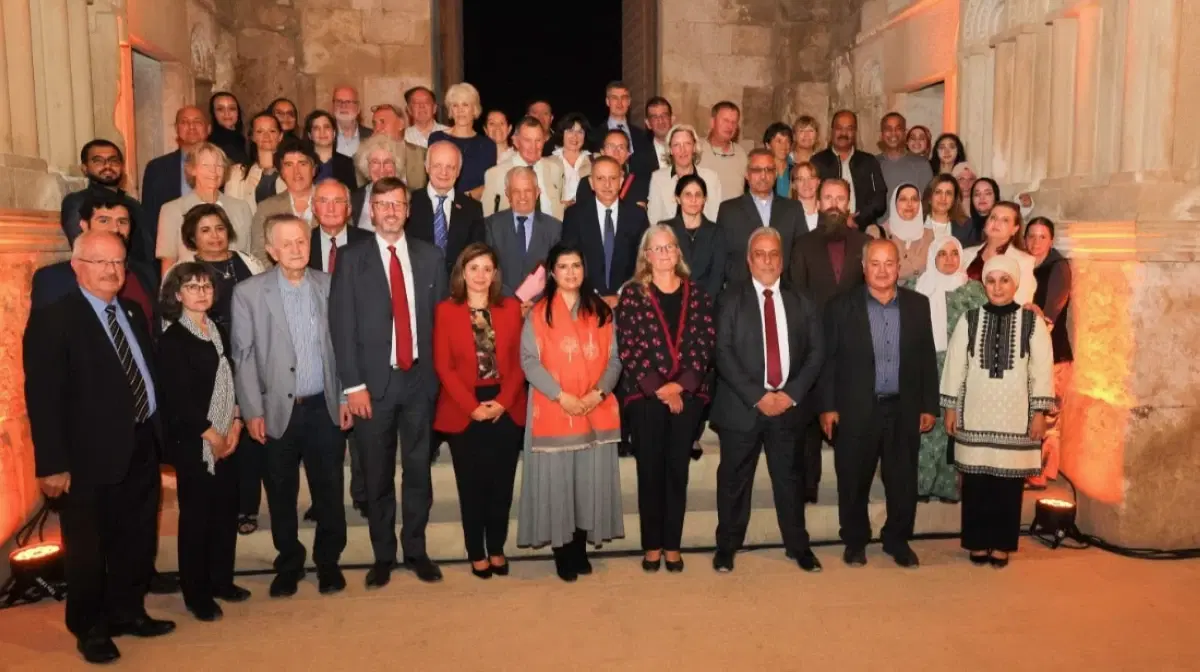
Her Royal Highness Princess Sumaya Bint Al-Hassan, Vice President of the Board of Trustees of the Jordan Museum, sponsored the 50th anniversary celebration of the German Institute of Archaeology in Amman at the Umayyad Palace on Jabal Al-Qal'a on Monday.
The ceremony was attended by HRH Princess Dana Firas, President of the National Commission for Heritage and President of ICOMOS-Jordan, the German Ambassador to Jordan Dr. Bertram von Moltke, the Director General of the Department of Antiquities Dr. Fawzi Abu Dhne, the Director General of the German Institute of Archaeology in Jerusalem and Amman Dr. Dieter Vieweger, the Director of the German Institute of Archaeology Dr. Britta Jansen, and the founding member of the German Protestant Archaeological Association Dr. von Dubschitz.
In her speech, HRH Princess Sumaya said that the passage of fifty years since the establishment of the Institute represents an important milestone, documenting not only the journey of scientific work and archaeological discoveries, but also embodying the depth of trust, friendship, and long-term partnership between Jordan and Germany.
Her Royal Highness pointed out that over fifty years, the German Institute of Archaeology in Amman has contributed to the study of this land and to strengthening the relationships that make serious scientific research possible. Its legacy is not limited to research and discovery, but extends to the sustainability of intellectual ties between Jordan and Germany. HRH Princess Sumaya emphasized that the responsibility towards heritage is not limited to protecting the past and preserving its monuments, but also extends to preserving archaeological evidence and historical knowledge and making them available to future generations, enabling them to discover and understand their history themselves, and enhancing their connection to their cultural heritage and identity. Her Royal Highness explained that archaeological evidence represents irreplaceable testimonies of the history of human civilizations, and the loss of any archaeological site or its historical context means the loss of a part of knowledge that cannot be fully restored, no matter how advanced modern technologies become, making the protection of archaeological sites and the preservation of their historical contexts a fundamental responsibility for preserving the cultural heritage and passing it on to future generations.
HRH Princess Sumaya pointed out that the preservation of heritage is not limited to the protection and preservation of archaeological sites, but also requires interpreting their meanings and making the knowledge associated with them available to the public, enhancing people's understanding of their historical and cultural value, and enabling them to interact with them and realize their connection to our common human story, considering heritage as a living legacy through which generations communicate and learn about their roots and the experiences of civilizations that have contributed to shaping our world.
Her Royal Highness pointed out that archaeological cooperation between Jordan and Germany is based on the exchange of knowledge and expertise in a balanced manner, reflecting the importance of scientific partnerships based on mutual respect and the utilization of shared expertise. HRH Princess Sumaya emphasized the pivotal role of Jordanian institutions and researchers in studying, understanding, and protecting the national heritage, affirming that these efforts form the basis of any effective and sustainable cooperation, and contribute to the development of archaeological knowledge and the enhancement of national capabilities and the transfer of expertise to future generations.
Her Royal Highness affirmed that scientific and archaeological cooperation between Jordan and Germany goes beyond the production of knowledge and the discovery of historical evidence, to form a long-term investment in building national research capabilities and qualifying a new generation of researchers capable of continuing the study, preservation, and development of documentation methods for Jordanian heritage.
HRH Princess Sumaya pointed out that this cooperation embodies the concept of science diplomacy, through the use of knowledge to enhance understanding, exchange expertise, and build bridges of communication between institutions and researchers, ensuring the continuity of Jordanian-German partnership and solidifying its impact on future generations.
Her Royal Highness concluded her speech by emphasizing that the preservation of heritage is a shared responsibility that transcends time, saying: "The past was not made by us, but preserving it has become, to some extent, our responsibility," stressing the importance of preserving the cultural heritage, protecting its archaeological evidence, and preserving the associated knowledge, and passing it on to future generations as part of the shared human memory.
For her part, HRH Princess Dana said that over 50 years, the Institute has made a valuable contribution to deepening our understanding of the exceptional archaeological and cultural heritage of Jordan through its research, excavations, documentation and restoration work, and the training of specialists. The Institute has contributed to shedding light on the multiple layers of history that have shaped the features of this land.
Her Royal Highness added that over thousands of years, Jordan has been a meeting place for civilizations, religions, and cultures, and the importance of its archaeological heritage is not limited to telling the story of ancient cities and landmarks, but extends to telling the stories of the peoples who lived on its land, the ideas they exchanged, the societies they built, and the beliefs that shaped their lives, noting that the work of the Institute has enriched the understanding of this history and Jordan's place in the broader story of human civilization.
HRH Princess Sumaya pointed out that the contributions of the Institute are not limited to archaeological discoveries, as its fifty-year journey in Jordan reflects the value of international cooperation, the exchange of knowledge, and the bonds based on a shared commitment to our archaeological human heritage, affirming that this partnership between German scientific research and Jordanian expertise is a model to be emulated.
For her part, the Director of the German Institute of Archaeology, Dr. Britta Jansen, confirmed that the Institute has conducted many archaeological researches in several archaeological sites in the Kingdom, from "Umm Qais" in the north to "Baq'a" in the south, passing through the capital Amman and other sites that have contributed to the protection of cultural heritage and the management of archaeological sites, in addition to the exchange and dissemination of knowledge through lectures, field trips, conferences, exhibitions, publications, and editions.
She praised the "International Conference on the History and Archaeology of Jordan," which is held every three years under the patronage of HRH Prince Hassan bin Talal, which represents a landmark in the journey of academic dialogue thanks to its contributions, and expressed the Institute's readiness to assist the Department of Antiquities in the scientific committee of this conference.
Jansen pointed to the close cooperation between the Institute and the Department of Antiquities, Jordanian government institutions, and Jordanian universities, in addition to the Institute hosting and supporting archaeological missions.
The German Ambassador welcomed the attendees and participants in the celebration, expressing his pride in the depth of Jordanian-German relations, and the close cooperation between the two countries in the field of archaeology and the protection of cultural heritage. Dr. Abu Dhne emphasized the importance of Jordanian-German cooperation in the field of archaeology, and its role in developing archaeological research and enhancing knowledge of Jordan's history and successive civilizations, noting that the partnership with the German Institute of Archaeology has contributed to the implementation of scientific research and studies in a number of Jordanian archaeological sites, and the exchange of expertise between Jordanian and German researchers, and the use of modern scientific methods in excavation, documentation, and preservation work. He pointed to the Department's keenness to continue strengthening cooperation with international research institutions and universities, to contribute to the protection of archaeological sites and the preservation of the national cultural heritage, and the development of its management methods and promotion, emphasizing the importance of building the capacities of Jordanian cadres and qualifying young researchers, to ensure the sustainability of efforts aimed at preserving Jordanian cultural heritage and delivering it to future generations.
Jordanian and German academics and researchers, during their welcoming speeches and lectures at the celebration, emphasized the importance of strengthening cooperation to exchange expertise in the field of archaeology, and benefiting from methodological and technical developments in the study, documentation, and preservation of archaeological sites. They pointed out that the Jordanian-German experience provides a model for the integration of research institutions, universities, and archaeological missions, emphasizing the importance of involving young students and researchers in field projects, expanding training opportunities, and organizing specialized lectures and seminars that contribute to the transfer of knowledge and enhancing awareness of the value of Jordanian and global cultural heritage.
It should be noted that the Jordan Museum houses archaeological discoveries from the excavations of the German Institute of Archaeology at various sites, including Tell Zar'a, and provides logistical support for researchers in the study of its archaeological collections.