((Ishtar and Esther)).. The tale of dolls that encapsulates the conflicts of history and humanity
Amman4 min read
Share
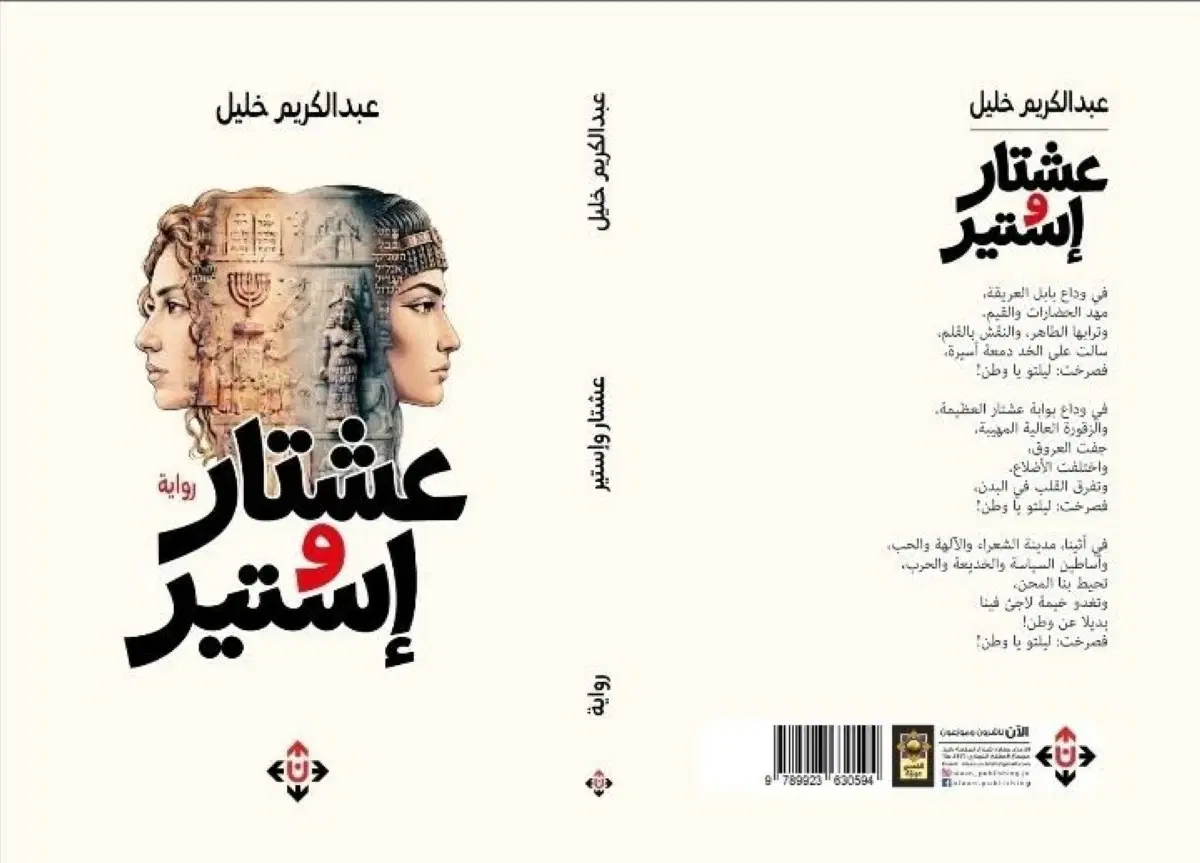
In his new novel "Ishtar and Esther," recently published by "Al-Aan Publishers and Distributors" in Jordan in 2026, Jordanian novelist Abdelkarim Khalil recreates historical worlds stretching from Babylon and Athens to Egypt and Jerusalem, in a narrative where tale intertwines with history, and questions of poverty and wealth, freedom and tyranny, identity and intolerance, and love and betrayal collide.
The novel spans about 592 pages, and its events begin in Athens in 333 BC, during the era of Alexander the Great, before its paths branch out across multiple places and characters, based on a historical background within which the author allows room for narrative imagination to build relationships, conflicts, and the development of events.
The story revolves around two female characters of different origins and social status; Ishtar, the poor Babylonian, and Esther, who belongs to a wealthy family, making the relationship between them an entry point to explore class disparity, intolerance, and belonging, and the effects these factors leave on the destinies of individuals and their relationships.
Ishtar begins her life in one of the poor neighborhoods of Athens, where she lives with her grandmother, Liltu, and they work making wax dolls and selling them in the markets. The function of the dolls is not limited to being a source of livelihood, as Ishtar imbues them with stories through which she evokes the contradictions of society and expresses her vision of poverty, discrimination, and exploitation.
Upon moving to the wealthy Hebrew family's home, she meets Esther, and a tense relationship develops between them that transcends personal disagreement to broader questions related to class, identity, and social and cultural legacies. Through the development of the two characters, internal contradictions and human trials that transcend the boundaries of time and place are revealed.
The novel's world expands to include Egypt, where the stories of multiple characters intersect, including Samara, daughter of Meriton, and her son Apis, the Greek physician Adonis, and Hebat-El-Shams, alongside Malika the Canaanite, who confronts pirates in an attempt to protect captive women. These tales intertwine with themes of slavery, captivity, love, and loss, while the intervention of the Egyptian merchant Horus to save Ishtar from slavery marks a turning point in her life's path.
Events later return to Athens, where political and emotional conflicts intertwine, and Odysseus bin Tsipras emerges as a character combining revolutionary ambition with weakness and contradiction, while Ishtar's adventures lead to stations of imprisonment, escape, and travel across the sea.
In the final path, the novel moves to Jerusalem in 285 BC, where Ishtar and Horus settle on the Mount of Olives, before Rachel, Esther's granddaughter, appears selling dolls, in a return to the symbol from which the story began, suggesting the continuity of memory and the transmission of human questions from one generation to another.
At the level of artistic structure, the novel adopts a multiplicity of tales, characters, and points of view, with stories spawning within a narrative structure that evokes some traditions of the ancient Arabic tale, particularly "One Thousand and One Nights." The wax doll tales play a role that goes beyond digression, becoming a means to reveal social contradictions and express the characters' positions on the world surrounding them.
Intellectual and political dialogues are also present as part of the dramatic structure, addressing issues of religion, power, identity, belief, and human behavior, while the author relies on historical and religious references, including texts from the books of the Bible, to repurpose them within a narrative context that allows for questioning the relationship between heritage and practice.
Symbolic functions abound in the work; the doll bag refers to memory and heritage, while the dolls represent miniature images of society's classes and characters, and the sea becomes a space for freedom, the unknown, and danger, in harmony with the movement of characters between places, identities, and destinies.
The novel is interspersed with poems, songs, and chants that contribute to expressing the characters' feelings and describing places and events, alongside a language characterized by lexical richness and the use of simile, metaphor, and metonymy, giving the narrative a poetic character that suits its multiple narrative levels.
Through this complex world, Khalil employs history as material to re-pose questions of humanity, freedom, justice, and belonging, in a novel where times and places change, while human conflicts remain capable of recreating themselves in different forms.