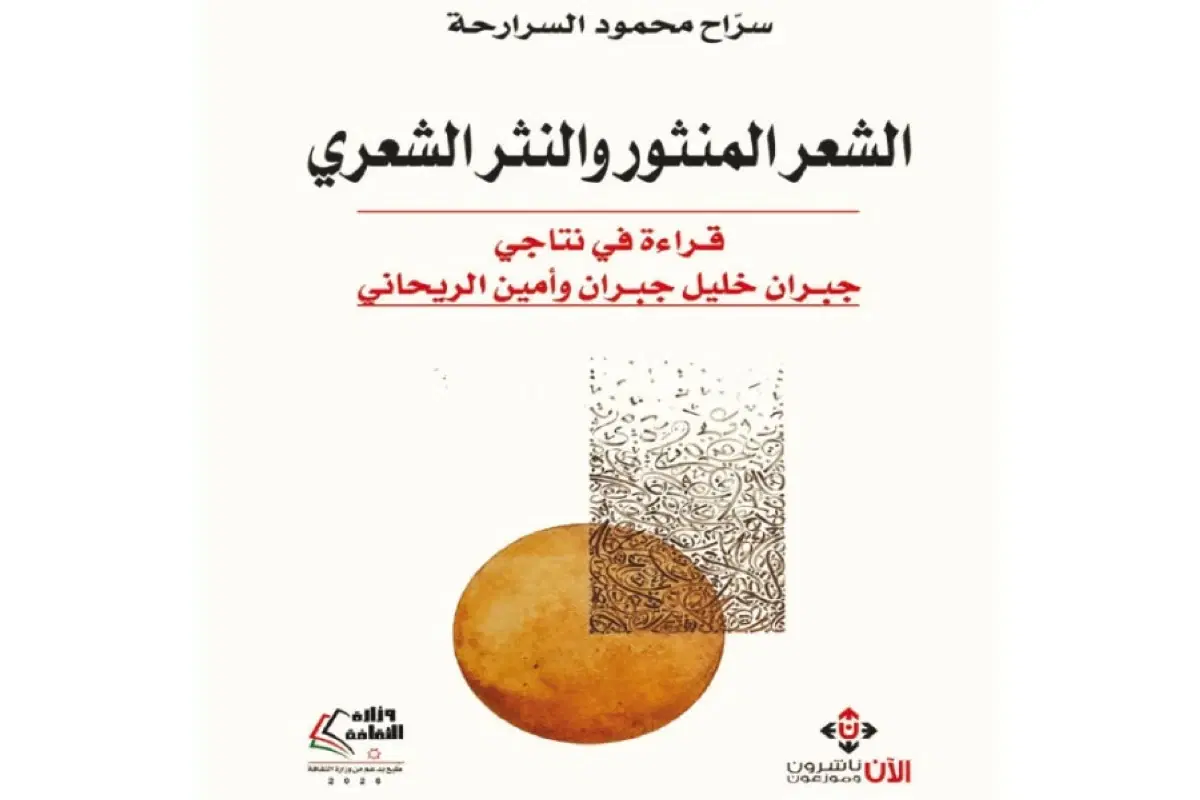
In his introduction to the book, Prof. Dr. Abdul Rahim Azzam Marashdeh, Dean of the Faculty of Arts and Languages at Jadara University, believes that the researcher chose a different critical path; he did not side with the classical poem, nor did he stop at the boundaries of what is known as the prose poem, but rather sought to answer a fundamental question: "What makes speech poetry?"
Marashdeh points out that this question opens horizons for thinking about the structure of the literary text and its components, and about the relationship between language, its choices, and the methods through which the identity of the text and its literary genre are formed. He also recalls previous critical questions, including Jean-Paul Sartre's question in his book "What is Literature?", and Youssef Al-Khal's (Anse Al-Hajj's) question in the introduction to his poetry collection "Lan" (Never): "Can a poem emerge from prose?", placing the study within a broader context of thinking about the nature of literariness, poeticity, and genre boundaries.
The book re-reads the experience of Gibran and Rihani in light of the cultural and intellectual circumstances surrounding the emergence of prose poetry and poetic prose, and the opportunities for experimentation and transcending inherited patterns provided by the migration movement and interaction with other cultures. The diaspora writers carried with them the questions of the Renaissance, the concerns of humanity, the homeland, and alienation, and their experiences contributed to opening new paths for Arabic writing, despite the critical objections that the attempts at renewal faced.
The study is distributed into an introduction and four chapters. The introduction provides an overview of Kahlil Gibran and Ameen Rihani, while the first chapter examines the concepts of prose poetry and poetic prose and their origins, the linguistic and terminological connotations associated with them, and the problem of their classification, alongside the early precursors and most prominent figures.
The second chapter monitors the formative influences of prose poetry and poetic prose by studying Arab and Western influences, and the impact of the "Shi'r" (Poetry) group on the development of these two forms. As for the third chapter, it addresses the intellectual manifestations in the output of Gibran and Rihani through four main trends: nationalist, meditative, humanitarian, and philosophical.
The fourth chapter is dedicated to technical issues, stopping at the structure of poetic language, the poeticity of the artistic image, stylistic phenomena, and typographical layout in prose poetry and poetic prose, allowing for a reading of the characteristics that contributed to distinguishing this writing and shaping its aesthetic features.
The study concludes that the early calls to renew Arabic poetry were not isolated from the transformations of the cultural and social environment, nor from the movement of interaction with other civilizations. It also highlights the role of diaspora poets, foremost among them Gibran and Rihani, in formulating new perceptions of poetic writing, and affirms that their experiences represented one of the important stations in the path of modernizing Arabic poetry and the emergence of expressive patterns that transcended the prevailing forms in the Renaissance era.
In conclusion, the book presents a critical reading of two experiences that contributed to expanding the horizon of modern Arabic poetry, and re-presents the question of poeticity as an open question to experimentation and transformation, and to the renewed relationship between language, form, and intellectual vision.