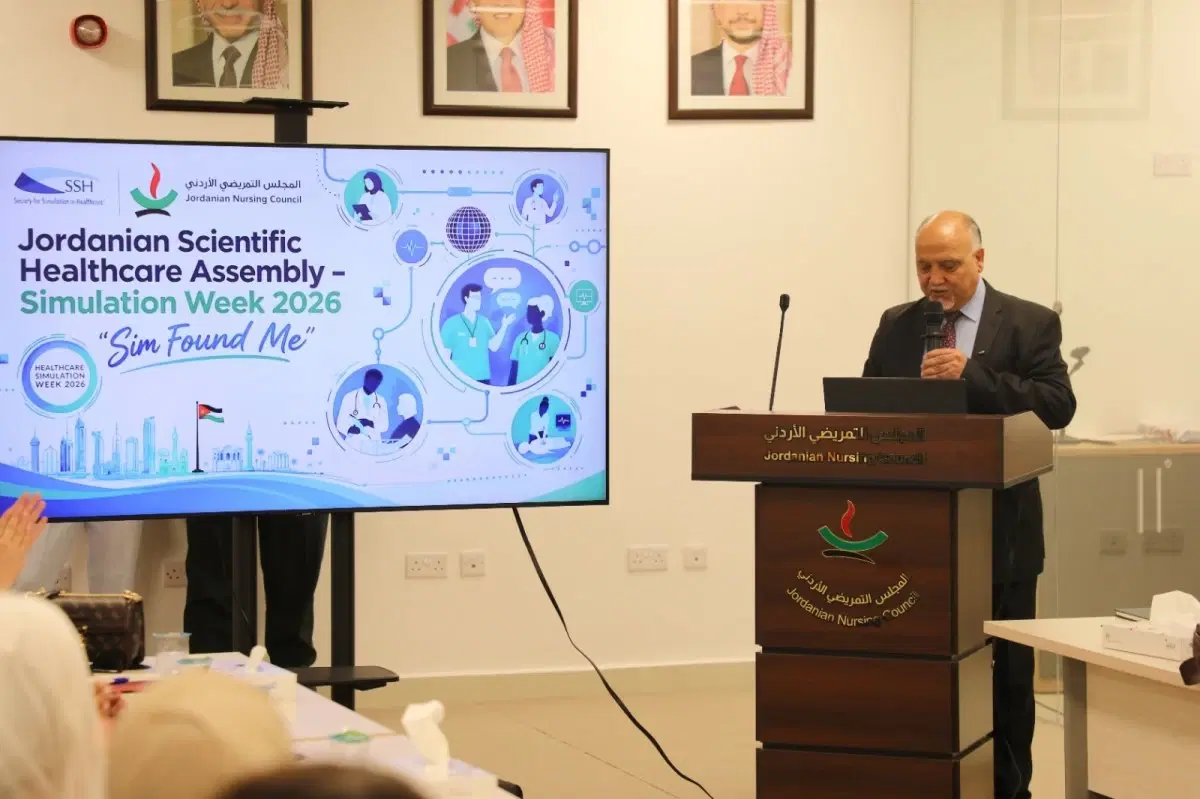
The Secretary-General of the Council, Professor Hani Al-Nawafla, said that simulation creates readiness and change turns it into a clear impact, explaining that investment in this field starts with preparing the human capable of dealing with clinical situations efficiently within the medical team.
Al-Nawafla pointed out that the inauguration by Her Highness Princess Muna Al-Hussein, President of the Jordanian Nursing Council, of the Clinical Skills and Simulation Center in 2022, laid a major milestone for the development of nursing and midwifery professions.
He reviewed the Council's most prominent achievements, including the benefit of about 800 trainees in the last three months of its programs, the launch of the «Simulation Knights» initiative, working on international accreditation of the center, and employing artificial intelligence and simulation to consolidate safe nursing practice.
Regarding the Council's commitment on Change Day, Al-Nawafla confirmed the Council's commitment to continuing to institutionalize the specialty, build specialized nursing competencies and develop qualitative programs, in addition to employing modern training methods, artificial intelligence, and clinical simulation, in line with the transformations in health care and consolidating a safer nursing practice.
For his part, the Dean of the Faculty of Nursing at Amman Arab University, Professor Dr. Khalid Hamdan, reviewed the specialization axis in health simulation, stressing the importance of building specialized competencies to lead this field and design educational scenarios and measure the impact of training, which contributes to raising the quality of medical education and linking it to the clinical reality.
In turn, the President of the Jordanian Association for Ambulance, Dr. Yalal Al-Ajlouni, addressed the role of the Arab Simulation Committee in health care in enhancing the exchange of regional expertise, praising the Jordanian presence in its leadership through the assumption of Tahani Khalil from the Council's cadres of the position of Vice President of the Committee. For her part, the trainer at the Council's Simulation Center, Tahani Khalil, confirmed that simulation contributes to enhancing patient safety by linking training to real-life situations and raising the readiness of health practitioners.
Participants stressed the importance of investing in the expertise and infrastructure that Jordan possesses, and moving from training individuals to enhancing the performance of integrated health teams.