- Opening and developing Princess Basma Hospital with a capacity of 504 beds.
- Completion of the first phase of the expansion and modernization of Princess Iman Governmental Hospital within 7 months.
Follow Al Rai

- Opening and developing Princess Basma Hospital with a capacity of 504 beds.
- Completion of the first phase of the expansion and modernization of Princess Iman Governmental Hospital within 7 months.
- Commencement of the new Madaba Hospital project after about 10 years of delay.
- Establishment and equipping of an open-heart surgery department at Zarqa Hospital.
- Activation of evening shifts at comprehensive health centers surrounding Al-Bashir, Prince Faisal, and New Zarqa hospitals.
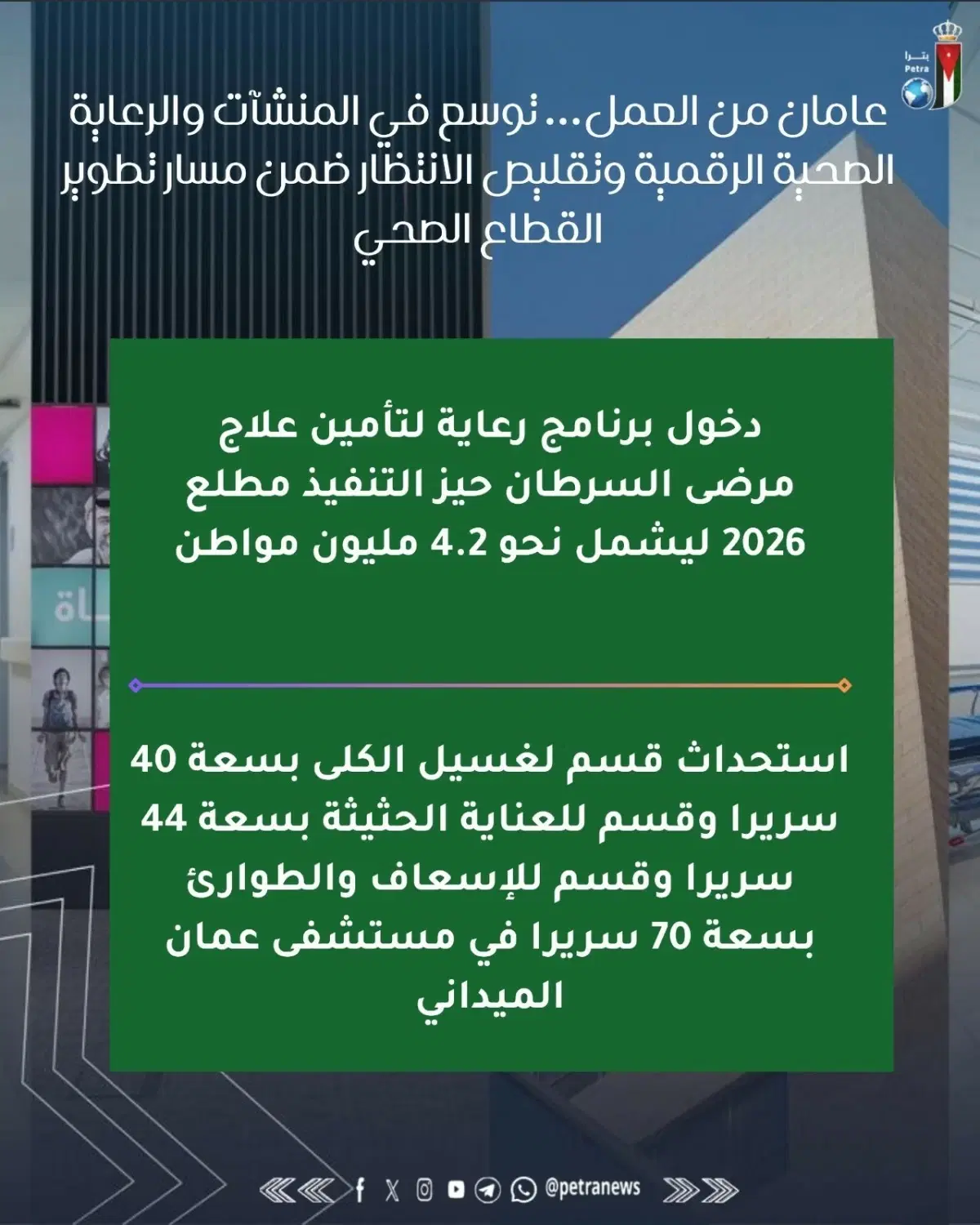
- The "Ri'aya" (Care) program to secure cancer treatment for patients enters into force at the beginning of 2026, covering about 4.2 million citizens.
- Expansion of telemedicine services through the Jordanian Digital Health Center.
- Expansion of the home medication delivery service, with a total of 147,110 parcels delivered.
- Establishment of 14 new health centers, in addition to the rehabilitation and maintenance of 49 health centers across the Kingdom's governorates.
- Establishment of a dialysis department with a capacity of 40 beds, an intensive care unit with 44 beds, and an emergency department with 70 beds at the Amman Field Hospital.
Over the past two years, the health sector has witnessed a series of projects, decisions, and programs aimed at expanding the capacity of hospitals and health centers, bringing specialized services closer to citizens, and reducing waiting periods and the need to travel between regions and governorates, in addition to expanding digital health services, improving the quality of care and infrastructure, and enhancing the capabilities and numbers of health personnel.
Sector data shows that a key aspect of the work focused on developing hospitals and increasing their ability to provide specialized services, in parallel with improving access to healthcare in the governorates and relieving pressure on referral hospitals.
In the north of the Kingdom, Princess Basma Hospital was opened and developed with a capacity of 504 beds, expanding the scope of health and specialized services provided to the region's residents.
In Balqa, the first phase of the expansion and modernization of Princess Iman Governmental Hospital was completed within 7 months, following a 4-year delay. The expansion included outpatient clinics and dialysis, while work continues on the second phase of the expansion and modernization project.
In Madaba, the new Madaba Hospital project entered the implementation phase after about 10 years of delay, with the aim of increasing capacity and bringing healthcare services closer to the governorate's residents.
Within the framework of expanding health protection, the "Ri'aya" program to secure cancer treatment for patients enters into force at the beginning of 2026, to include about 4.2 million citizens from the covered categories, including those under 19 years of age, those over 60, and beneficiaries of the National Aid Fund.
The cost of the program is 132 million dinars, with the government bearing 124 million, while the King Hussein Cancer Foundation bears 8 million dinars.
According to the data, the government has paid two installments of 62 million and 31 million dinars, while the King Hussein Cancer Center has received about 2,000 patients covered by the agreement since it entered into force.
In parallel with the expansion of health facilities, telemedicine services have seen an expansion through the Jordanian Digital Health Center, with the aim of bringing specialized medical consultation closer to the citizen and reducing the need to travel between governorates.
The center provides multiple services ranging from specialized radiology to consultations. Since its operation, the number of beneficiaries of the teleradiology service reached about 49,488 patients as of last August 31, while 2,441 patients benefited from tele-intensive care services, 528 patients from telemedicine services in cardiology, 975 in endocrinology, and 111 in nutrition. Additionally, 625 patients per month benefit from tele-dialysis services as part of efforts to bring specialized services closer to citizens.
At the primary healthcare level, 14 new health centers were established, in addition to the rehabilitation and maintenance of 49 health centers in various governorates of the Kingdom, which expands the scope of service and relieves some of the pressure on hospitals.
In Zarqa, a strategic stockpile warehouse was opened in the governorate, and 13 medical warehouses were established and rehabilitated in various regions, as part of efforts to enhance the readiness of the medical supply chain and inventory.
Infrastructure development projects included the rehabilitation and operation of the Amman Field Hospital, by establishing a dialysis department with a capacity of 40 beds, an intensive care unit with 44 beds, and an emergency department with 70 beds.
An open-heart surgery department was also established and equipped at Zarqa Hospital, while the kidney department at Prince Hussein bin Abdullah II Hospital in Balqa was expanded and operated with a capacity of 18 beds. The foundation stone was laid for a new building at Prince Faisal Hospital in Rusaifa district, which will include emergency, intensive care, cardiac, and surgical services.
Regarding the quality of healthcare and prevention, two new vaccines were introduced to the National Immunization Program: the pneumococcal vaccine and the chickenpox vaccine for children, in addition to launching a unified national protocol for treating cancer patients, a protocol for treating acute heart attacks with catheterization, and implementing unified procedures for treating stroke patients.
In the context of improving the patient experience and reducing waiting times, a new mechanism for organizing appointments for hospital clinic visitors was implemented at Prince Hamzah Hospital and Al-Bashir hospitals.
A national plan was also implemented to improve MRI services, which increased the number of monthly examinations in five major hospitals from about 5,700 to 13,000 examinations per month, with the aim of reducing waiting lists and accelerating patients' access to service.
The measures also included launching a plan to relieve pressure on emergency departments in government hospitals, which began implementation in Al-Bashir, Prince Faisal, and New Zarqa hospitals by activating evening shifts at the comprehensive health centers surrounding them.
In a move to reduce the need for citizens to travel to the capital, the Medical Committees Regulation for 2025 was approved, and judicial medical committees were established in the Kingdom's regions, allowing for the completion of disability assessment procedures in citizens' areas, saving them time, effort, and cost.
Regarding digital transformation, the computerization of 156 additional health facilities was completed, bringing the total number of computerized health facilities to 431, including 31 hospitals, 393 health centers, and 7 laboratories.
The home medication delivery service was also expanded, with the total number of parcels delivered reaching 147,110, reducing the need for patients to visit health facilities to obtain their medications.
Work also included strengthening human resources in the sector by appointing 2,185 employees from various medical, health, and administrative specialties, while 1,400 are still in the appointment process, in addition to accrediting 8 new medical sub-specialties in Ministry of Health hospitals, bringing the total number of new sub-specialties to 20.
Regarding supporting the sustainability and financing of the sector, a financing agreement was signed for the results-oriented program for health sector reform worth $400 million, in addition to paying 40 million dinars to King Abdullah University Hospital and 10 million dinars to Jordan University Hospital, and settling 150 million dinars of arrears to pharmaceutical warehouses.
The results of the work over the two years since September 2024 show that the development of the health sector is proceeding along several parallel paths, including increasing hospital capacity, expanding the network of health centers, bringing specialized services closer, enhancing therapeutic coverage, reducing waiting times, and developing digital health, in addition to supporting infrastructure, personnel, and the pharmaceutical supply chain.
Work continues on a number of these projects, primarily hospital expansions, the new Madaba Hospital project, and the expansion of digital health and specialized care services, as part of a path aimed at improving citizens' access to health services, reducing waiting time and the need to travel between governorates, and relieving pressure on health facilities.
Know more about this story?Send us a tip
Ask about this report — answers stay grounded in its text.