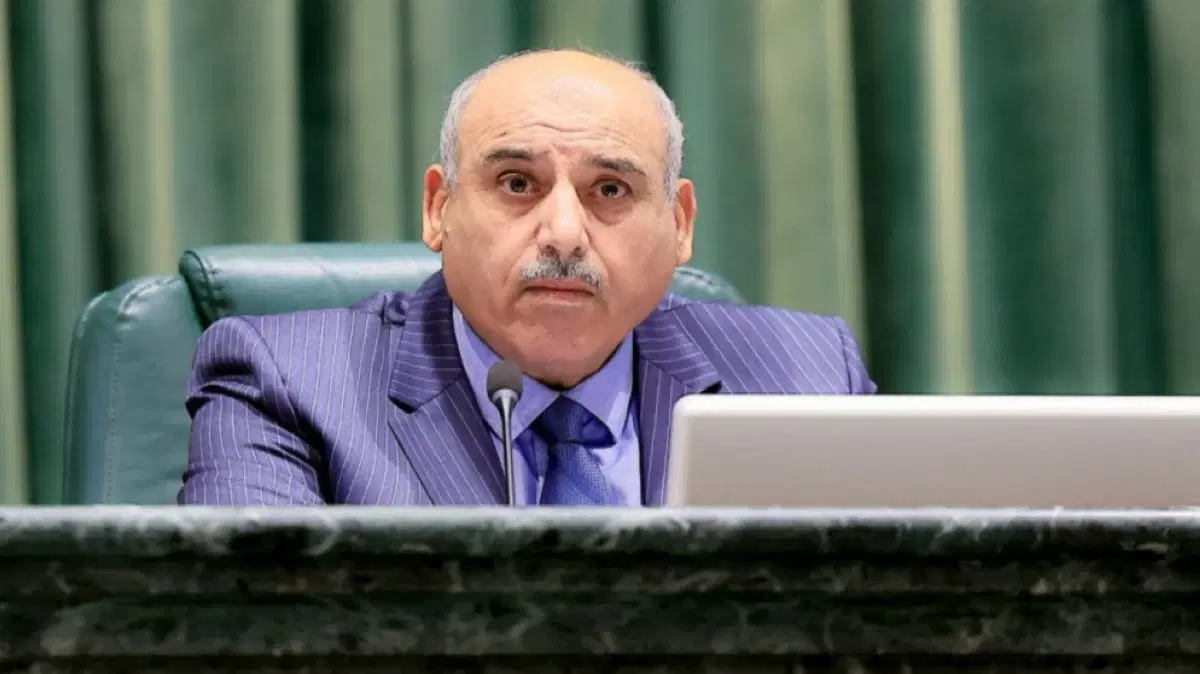
The judge: The King's speech presented a model for the world in steadfastness on principles and strength in protecting national interests
Amman8 min read
Share
The Speaker of the House of Representatives, Mazen Al-Qadi, said that the speech of His Majesty King Abdullah II before the United Nations General Assembly, with its deep strategic vision, put the international community before its legal, moral and political responsibilities, and presented an integrated Jordanian vision for dealing with the crises of the region, foremost of which is the Palestinian issue.
Al-Qadi added, in a statement issued by the House of Representatives, that the royal speech represents a clear roadmap towards a just peace, based on the two-state solution, ending the occupation and realizing the independent Palestinian state on its national soil.
He said that His Majesty the King spoke with the confidence of a state that knows its interests and is aware of the magnitude of the challenges surrounding it, when he affirmed that Jordan will not turn away from any threat to its national security, and that the security of borders, water and Jordanian interests are clear lines that do not accept compromise, stressing that the House of Representatives stands behind His Majesty the King, the army and the security agencies, in protecting Jordan's security, stability, sovereignty and the interests of its people.
He continued that His Majesty the King's talk about the growing threats in the region, especially those related to southern Syria, reflects an accurate Jordanian reading of the sources of danger, and confirms that Jordan is dealing with its national security as a responsibility that cannot be postponed, and that any threat to the northern borders or Jordanian water security is a direct threat to national security that Jordan will deal with firmly and strongly.
He added that Jordan, at the same time, proves that protecting national security does not conflict with openness to dialogue, diplomacy and performing duties towards the international community, as the Kingdom continues to play its role in combating terrorism, drug smuggling and contributing to the protection of regional security, while seeking to enhance its position as a center for trade, industry and technology, and a bridge linking the countries of the region and their economic and humanitarian interests.
Al-Qadi said that His Majesty the King's speech addressed the international community in the language of international law and legitimacy, and put the Israeli occupation government before the reality of its practices on the ground, away from attempts to redefine the facts or circumvent their reality, affirming that His Majesty the King provided in his speech evidence and evidence that what is happening in the Palestinian territories is no longer acceptable to be silent about in any way.
He continued that His Majesty the King clearly exposed the occupation state, and the danger of its continuation in settlement policies, land confiscation and displacement in the West Bank, and also put the international community before the reality of what is happening in the Gaza Strip of destruction of civilian infrastructure, targeting civilians and tightening the siege on the Palestinians, affirming that naming acts by their legal and political names represents a fundamental step in confronting the occupation's attempts aimed at entrenching the matter by force.
Al-Qadi pointed out that His Majesty the King's talk about Gaza and the West Bank carried a very important message, which is that the international community should not be content with managing the conflict, or dealing with its crises on the basis of containing the explosion at one time and postponing it at another, because managing the conflict instead of solving it has contributed over decades to producing a more complex reality that serves the occupation state and its illegitimate procedures.
Al-Qadi affirmed that His Majesty the King's speech put the world before the fundamental question related to the credibility of international law, as if occupation and continuous violations can continue for decades without effective accountability, then the entire international legitimacy system is facing a real test, pointing out that Jordan, under the leadership of His Majesty the King, will continue to affirm that international law is indivisible, and its application should not be subject to double standards.
Al-Qadi said that His Majesty the King also revealed the seriousness of what is happening in the West Bank of settlement expansion, violence, displacement and seizure of land, and placed these practices within their legal and political framework, warning that their continuation directly undermines the possibility of establishing a viable Palestinian state, threatens the basis on which the two-state solution is based, and makes just peace more difficult the longer the international community delays in taking action.
He added that His Majesty the King's talk about rejecting the reduction of the conflict to a religious framework was very important, as he affirmed that the issue is not a conflict between religions, but an issue of rights, dignity, justice and the right of a people to self-determination, indicating that this position reflects the Jordanian role in defending the true image of Islam, protecting Christianity and its heritage and communities in its historical homeland, and consolidating the values of coexistence, moderation and respect for others.
Al-Qadi affirmed that Jordan, under the leadership of His Majesty the King, continues to play its historical role in protecting Christianity, its communities and its civilizational heritage in its original and historical homeland, in parallel with defending the true image of Islam, based on moderation, tolerance and mercy, in the face of hate speech, extremism and attempts to tarnish the image of the pure religion.
He stressed that Jordan will not retreat from supporting the steadfastness of the Palestinian people, supporting the United Nations Relief and Works Agency for Palestine Refugees in the Near East (UNRWA), and will continue to carry the Hashemite custodianship of the Islamic and Christian holy sites in Jerusalem, and to preserve the historical and legal status quo in them, considering this an integral part of the historical Jordanian role and responsibility that Jordan undertakes.
He pointed out that His Majesty the King did not talk about the Palestinian issue in isolation from its regional and international surroundings, but placed it in a broader context of the crises that are sweeping the region and the world, from Lebanon, Syria, Yemen, Sudan, to Ukraine and other conflict zones, warning that prolonged wars do not remain confined to their geographical borders, but rather reflect on food security, energy, trade, investment and the lives of peoples in different parts of the world.
Al-Qadi affirmed that the royal message also emphasized that Jordan is a country on which the world can rely, as a country that adheres to its principles, committed to its positions, open to dialogue, and ready to work with everyone who seeks peace, stressing that adherence to diplomacy and dialogue should not be understood in any way as weakness, but rather as an expression of the state's confidence in itself, its position and its ability to protect its interests.
Al-Qadi said that one of the most prominent contents of the royal speech was the emphasis that military force alone cannot produce peace or address the roots of crises, and that ending wars requires legitimate institutions, trust between countries, respect for agreements and laws, and a political will capable of transforming international decisions from written texts into effective procedures on the ground, indicating that the collapse of trust in international law opens the door to more chaos and instability.
He pointed out that His Majesty the King put the international community before the responsibility of not allowing the focus on crises to turn into a temporary focus linked to the size of media coverage, affirming that the peoples living in war and displacement should not become the hostages of the world's interest or its retreat, and it is not permissible for principles to change with the change in the level of international attention to the crisis.
Al-Qadi said that the House of Representatives sees in the royal speech a great expression of the constants of the Jordanian state and its national interests, and its responsibility towards the issues of its nation, foremost of which is the Palestinian issue, affirming that the Council will continue to play its role in supporting the Jordanian position led by His Majesty the King, and in defending Jordan's interests, security and stability, and the right of the Palestinian people to freedom, independence and the establishment of their independent state.
Al-Qadi concluded by saying that His Majesty the King's speech presented a Jordanian model to the world based on steadfastness in principle, openness in means, and clarity in protecting interests, affirming that Jordan will remain committed to just peace, international law, and the right of peoples to security, dignity and independence, and that the Kingdom, under the leadership of His Majesty the King, will continue to work for a more secure and stable region, and for a future in which crises are not managed indefinitely, but their roots are resolved according to justice, legitimacy and law.