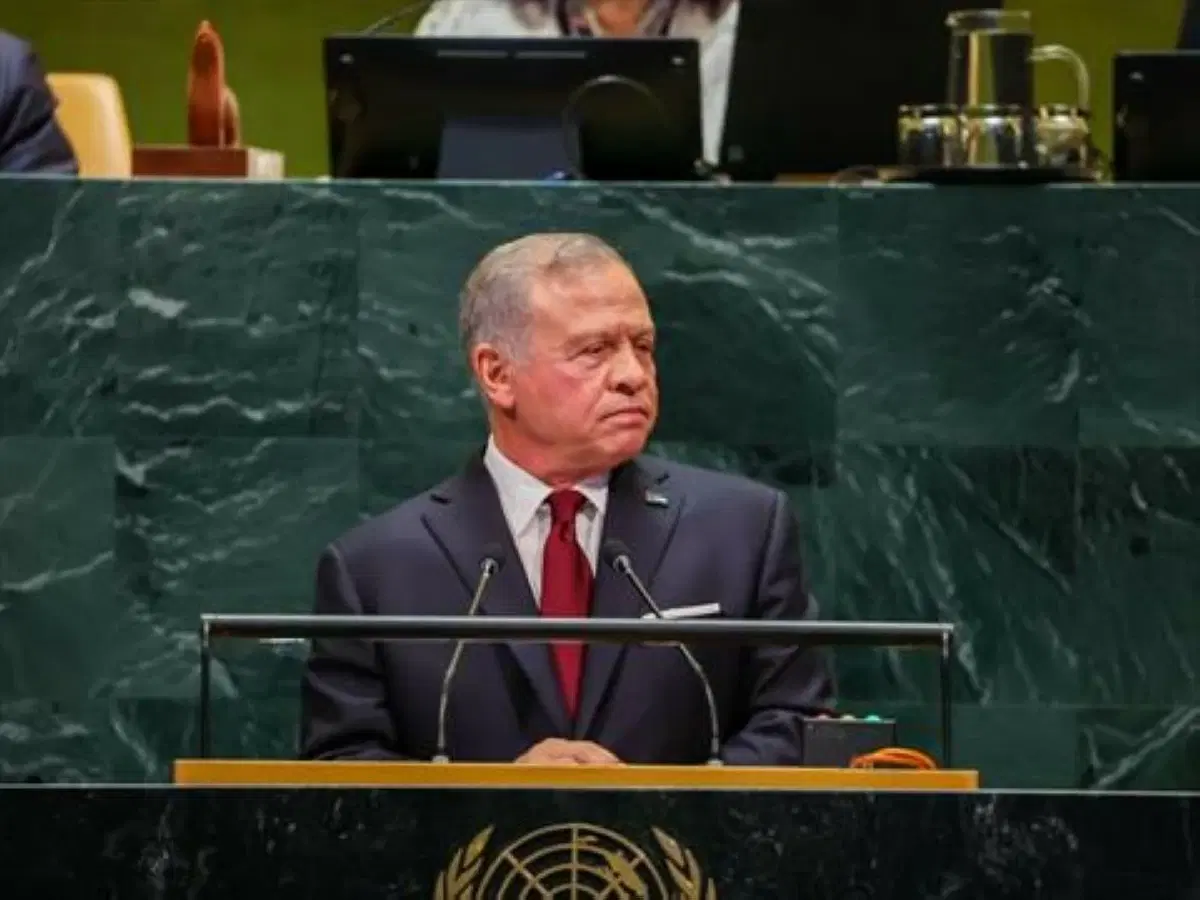
Speaker of the House of Representatives: The King's speech is a message of confidence and steadfastness
The Speaker of the House of Representatives, Mazen Qazaq, said that the speech of His Majesty King Abdullah II before the United Nations General Assembly, with its deep strategic vision, put the international community before its legal, moral, and political responsibilities, and presented an integrated Jordanian vision for dealing with the region's crises, foremost of which is the Palestinian issue, affirming that the royal speech represents a clear roadmap towards a just peace, based on the two-state solution, ending the occupation, and realizing the independent Palestinian state on its national soil.
Qazaq added that His Majesty the King spoke with the confidence of a state that knows its interests and is aware of the challenges surrounding it, when he affirmed that Jordan will not turn away from any threat to its national security, and that the security of borders, water, and Jordanian interests are clear lines that do not accept compromise, stressing that the House of Representatives stands behind His Majesty the King, the army, and the security agencies in protecting Jordan's security, stability, sovereignty, and the interests of its people.
Qazaq said that His Majesty the King's talk about the growing threats in the region, especially those related to southern Syria, reflects an accurate Jordanian reading of the sources of danger, and confirms that Jordan deals with its national security as a responsibility that cannot be postponed, and that any threat to the northern borders or Jordanian water security is a direct threat to national security that Jordan will deal with firmly and strongly.
He added that Jordan, at the same time, proves that protecting national security does not conflict with openness to dialogue, diplomacy, and performing duties towards the international community, as the Kingdom continues to play its role in combating terrorism and drug smuggling and contributing to protecting the security of the region, while seeking to enhance its position as a center for trade, industry, and technology, and a bridge linking the countries of the region and their economic and humanitarian interests.
Qazaq said that His Majesty the King's speech addressed the international community in the language of international law and legitimacy, and put the Israeli occupation government in front of the reality of its practices on the ground, away from attempts to redefine the facts or circumvent their reality, affirming that His Majesty the King provided in his speech evidence and witnesses that what is happening in the Palestinian territories is no longer acceptable to be silent about in any way.
Qazaq said that His Majesty the King clearly exposed the state of occupation, the danger of its continuation in settlement policies, land confiscation, and displacement in the West Bank, and put the international community in front of the reality of what is happening in the Gaza Strip of destruction of civilian infrastructure, targeting civilians, and tightening the noose on Palestinians, affirming that naming acts by their legal and political names represents a fundamental step in confronting the occupation's attempts aimed at entrenching the matter by force.
Qazaq pointed out that His Majesty the King's talk about Gaza and the West Bank carried a very important message, which is that the international community should not be content with managing the conflict, or dealing with its crises on the basis of containing the explosion sometimes and postponing it at other times, because managing the conflict instead of resolving it has contributed over decades to producing a more complex reality that serves the state of occupation and its illegitimate procedures.
Qazaq affirmed that the Hashemite custodianship of the Islamic and Christian holy sites in Jerusalem represents a deep-rooted historical responsibility and a steadfast Jordanian commitment that is not subject to political circumstances or balances of power, stressing that Jordan, under the leadership of His Majesty the King, will continue to protect the Arab, Islamic, and Christian identity of Jerusalem, preserve its holy sites, and maintain the historical and legal status quo in it, and confront any attempts to change this status or impose new facts on the ground.
Qazaq affirmed that His Majesty the King's talk put the world in front of the fundamental question related to the credibility of international law, as if occupation and continuous violations can continue for decades without effective accountability, then that puts the entire international legitimacy system in front of a real test, pointing out that Jordan, under the leadership of His Majesty the King, will continue to affirm that international law is indivisible, and its application should not be subject to double standards.
Qazaq said that His Majesty the King also revealed the danger of what is happening in the West Bank of settlement expansion, violence, displacement, and land seizure, and placed these practices within their legal and political framework, warning that their continuation directly undermines the possibility of establishing a viable Palestinian state, threatens the basis on which the two-state solution is based, and makes fair peace more difficult the longer the international community delays in taking action.
Qazaq added that His Majesty the King's talk about rejecting the reduction of the conflict to a religious framework was of great importance, as he affirmed that the issue is not a conflict between religions, but an issue of rights, dignity, justice, and the right of a people to self-determination, pointing out that this position reflects the Jordanian role in defending the true image of Islam, protecting Christianity and its heritage and communities in its historical homeland, and consolidating the values of coexistence, moderation, and respect for the other.
Qazaq affirmed that Jordan, under the leadership of His Majesty the King, continues to play its historical role in protecting Christianity, its communities, and its civilizational heritage in its original and historical homeland, in parallel with its defense of the true image of Islam, based on moderation, tolerance, and mercy, in the face of the discourse of hatred, extremism, and attempts to tarnish the image of the pure religion.
Qazaq affirmed that Jordan will not retreat from supporting the steadfastness of the Palestinian people, supporting the United Nations Relief and Works Agency for Palestine Refugees in the Near East (UNRWA), and continuing to carry the responsibility of the Hashemite custodianship of the Islamic and Christian holy sites in Jerusalem, and preserving the historical and legal status quo in them, considering this an integral part of the historical Jordanian role and responsibility that Jordan undertakes.
He pointed out that His Majesty the King did not talk about the Palestinian issue in isolation from its regional and international environment, but placed it in a broader context of the crises affecting the region and the world, from Lebanon, Syria, Yemen, and Sudan, to Ukraine and other conflict zones, warning that prolonged wars are not confined to their geographical boundaries, but reflect on food security, energy, trade, investment, and the lives of peoples in different parts of the world.
Qazaq affirmed that the royal message also emphasized that Jordan is a country on which the world can rely, as a country that adheres to its principles, committed to its positions, open to dialogue, and ready to work with everyone who seeks peace, stressing that adherence to diplomacy and dialogue should not be understood in any way as weakness, but rather as an expression of the state's confidence in itself, its position, and its ability to protect its interests.
Qazaq said that one of the most prominent contents of the royal speech was the emphasis that military force alone cannot produce peace or address the roots of crises, and that ending wars requires legitimate institutions, trust between countries, respect for agreements and laws, and a political will capable of transforming international decisions from written texts into effective procedures on the ground, pointing out that the collapse of trust in international law opens the door to more chaos and instability.
He pointed out that His Majesty the King put the international community in front of the responsibility of not allowing the focus on crises to become a temporary focus linked to the size of media coverage, affirming that the peoples living in war and displacement should not become their suffering hostage to the world's attention or retreat, and that principles should not change with the level of international attention to the crisis.
Qazaq said that the House of Representatives sees in the royal speech a great expression of the constants of the Jordanian state and its national interests, and its responsibility towards the issues of its nation, foremost of which is the Palestinian issue, affirming that the Council will continue to play its role in supporting the Jordanian position led by His Majesty the King, and in defending the interests, security, and stability of Jordan, and the right of the Palestinian people to freedom, independence, and the establishment of their independent state.
Qazaq concluded by saying that His Majesty the King's speech presented the world with a Jordanian model based on steadfastness in principle, openness in means, and clarity in protecting interests, affirming that Jordan will remain committed to just peace, international law, and the right of peoples to security, dignity, and independence, and that the Kingdom, under the leadership of His Majesty the King, will continue to work for a more secure and stable region, and for a future in which crises are not managed indefinitely, but their roots are resolved in accordance with justice, legitimacy, and law.
Al-Khasawneh: The steadfastness of the Jordanian position towards regional issues
MP Dr. Mustafa Al-Khasawneh confirmed that the speech of His Majesty King Abdullah II before the 81st session of the United Nations General Assembly clearly reflected the steadfastness of the Jordanian position on regional issues, foremost of which is the Palestinian issue, and placed the international community before its political, humanitarian and legal responsibilities in dealing with crises and conflicts that threaten regional and international security and stability.
Al-Khasawneh said that His Majesty's speech came at a highly sensitive international and regional moment, affirming that the continuation of crises without fair solutions cannot be an acceptable approach, and that managing conflicts and postponing their treatment only deepens and widens their effects, pointing out that Jordan, under the leadership of His Majesty the King, continues to present a clear vision based on just peace, respect for international law, and the protection of the rights of peoples.
He added that the Palestinian issue was present in the royal speech as the core of the conflict and the key to stability in the region, as His Majesty the King affirmed that what is happening in the Gaza Strip and the West Bank cannot be viewed as separate events, in light of the ongoing developments that affect the lives of Palestinians, their land, and their rights, which requires a responsible international stance that goes beyond crisis management to addressing its causes and roots.
Al-Khasawneh pointed out that His Majesty's emphasis on the necessity of ending the Palestinian-Israeli conflict through a fair and comprehensive solution confirms the steadfastness of the Jordanian position calling for enabling the Palestinian people to their legitimate rights and establishing their independent state on their national soil with East Jerusalem as its capital, in accordance with the relevant international references.
He stressed that the royal message to the international community was clear in the need to translate international decisions and positions into practical measures, and not to allow international law and international resolutions to remain unimplemented, pointing out that the continued absence of fair solutions exacerbates crises and threatens the chances of achieving peace and stability in the region.
Al-Khasawneh said that His Majesty's warning of the repercussions of regional developments and the imposition of new facts on the ground reflects a deep awareness of the magnitude of the risks facing the region, affirming that respect for the sovereignty of states and not compromising their security and stability represents an indispensable basis in any political or security approach.
He emphasized that Jordan's national security, borders, waters, and supreme interests are well-established constants, and that the Jordanian state, under the leadership of His Majesty the King, will continue to take what is necessary to protect its national security, in parallel with its ongoing efforts to combat terrorism, drug smuggling, and enhance its defense and security capabilities.
Al-Khasawneh praised His Majesty's affirmation of Jordan's continued support for the steadfastness of the Palestinian people and support for the United Nations Relief and Works Agency for Palestine Refugees in the Near East (UNRWA), affirming that Jordan will continue to play its humanitarian and national role towards the Palestinian brothers, alongside continuing to bear the Hashemite custodianship of Islamic and Christian holy sites in Jerusalem, and preserving the historical and legal status quo there.
He pointed out that the Jordanian position on the Palestinian issue was not linked to a political circumstance or an immediate development, but rather represents a well-established national and pan-Arab constant, confirmed by Jordanian diplomacy in various international forums, pointing out that His Majesty continues to carry this position and defend it with clarity and responsibility.
Al-Khasawneh said that His Majesty's emphasis on just peace is inseparable from the protection of rights and national interests, and that Jordan's adherence to diplomacy and dialogue does not mean complacency in protecting its security and interests, but rather reflects a political approach that combines responsibility and firmness, and between the pursuit of peace and the readiness to protect national constants.
He added that His Majesty's speech reaffirms the active Jordanian presence in regional and international issues, and the role of the Kingdom in defending security and stability, promoting dialogue, and mobilizing international efforts towards just political solutions, in a way that serves the interests of Jordan and the issues of the Arab nation.
Al-Khasawneh concluded by affirming that the royal speech at the United Nations represents a clear and comprehensive Jordanian message, combining the defense of the Palestinian cause, adherence to international legitimacy, the protection of national security, and the call for peace and stability, affirming that Jordan will continue, under the leadership of His Majesty the King, to play its role in defending the issues of the nation, foremost of which is the Palestinian issue, based on its national constants and steadfast positions.
Head of the Union and Reform Parliamentary Bloc: The King's speech is a decisive political stance
For his part, the head of the Union and Reform Parliamentary Bloc, MP Zuhair Muhammad Al-Khashman, confirmed that the speech of His Majesty King Abdullah II before the United Nations General Assembly presented a decisive political stance on the path being pushed for the region, and placed the international community before the reality that continued inaction grants the policies of occupation and expansion the ability to determine the future, while clearly announcing that Jordan will protect its borders, waters, and the interests of its people.
Al-Khashman said that the strength of the speech is evident in its structure; it began with a question of attention, moved to questioning the international will, and culminated in a determination of the requirements of Jordan's national security.
In this progression, His Majesty addressed the world in a language that explains the danger, determines responsibility, and announces the position, combining the clarity of the argument with the firmness of the warning.
He added that His Majesty's reference to the study related to the decline in the duration of individual attention in front of the screen formed a highly significant entry to understanding a broader imbalance in international politics: crises are crowding the world's attention, while the policies that create them and benefit from the decline in attention to them continue.
When His Majesty described attention as a geopolitical resource, he posed a question to the leaders about what they are doing after the headlines have receded and the cameras have turned away; rights remain threatened even when the tragedy stops headlining the news.
He continued: (In our reading of the speech, the world is treating time as an additional space for diplomacy, while the Israeli government is using it to change the land on which the settlement is supposed to be. Herein lies the danger of waiting: that talk of a Palestinian state remains, while its components of life are gradually being taken away from it).
Al-Khashman explained that this implication explains His Majesty's insistence on reading Gaza and the West Bank within a single strategy; the destruction of the components of life in Gaza, the confiscation of land, the expansion of settlements, and the displacement of residents in the West Bank converge in undermining the possibility of a Palestinian state. Therefore, protecting the two-state solution requires confronting the measures that make it impossible and holding those responsible accountable.
He emphasized that naming the acts by their names represents a pivot in the speech; because accepting the description of annexation as a registration of land and displacement as the implementation of the law prepares for accepting their results.
His Majesty put the international community before its responsibility for the language it uses, to the same extent as its responsibility for the actions it takes; when words lighten the gravity of the act, the chances of accountability decrease with them.
Al-Khashman said that the royal tone reached the peak of accountability when His Majesty described inaction as a choice and listed the tools available for influence. This approach eliminates the excuse of lack of means and transfers the discussion to the reasons for its obstruction and selective use, and to what results from it in undermining confidence in international law and the institutions entrusted with it.
He added that the importance of His Majesty's warning against Israeli expansion in southern Syria stems from placing it in the context of accumulated impunity; the absence of deterrence allows for testing new limits of aggression, until its effects extend to the security of the region's countries and their vital resources. From this context came the explicit emphasis on the northern borders of Jordan and its water security, as they are part of the national security of the Kingdom.
Al-Khashman stressed that “the clarity of His Majesty requires a parallel clarity in our national position: protecting Jordan's borders, waters, and the interests of its people is a collective responsibility, supported by a cohesive domestic front, strong institutions, and firm support for our armed forces and security agencies. Everyone must read Jordan's readiness for dialogue coupled with its will to protect its security; Jordanian diplomacy is based on the steadfastness of the position and the ability to defend it.”
He pointed to the link between His Majesty's refusal to portray the conflict as a war of religions and his affirmation of Jordan's role in protecting Christianity and defending the truth of Islam and bearing the Hashemite custodianship.
In this link, Jordan, from a position of practice and historical responsibility, provides an argument that the essence of the issue is human rights and dignity, and that protecting the holy sites and religious pluralism is complementary to defending Palestinian rights.
Al-Khashman affirmed that the parliamentary responsibility requires translating the contents of the speech into action with Arab and international parliaments, presenting them with specific questions about protecting the chances of a Palestinian state, confronting displacement and annexation, supporting UNRWA, and confronting the attacks that threaten the stability of the region.
It also requires supporting Jordan's path in building its economy and developing its capabilities in parallel with facing dangers, so that the decision of the future remains in the hands of Jordanians.
He concluded by saying: (His Majesty the King has announced what Jordan will commit to protecting, and has placed the world before what it is responsible for leaving unprotected.
From our parliamentary position, we affirm that Jordan's steadfastness in just peace is linked to its steadfastness in defending its security and the rights of the Palestinian people; the peace we defend must have land on which it can be established, rights that it protects, and a law that protects everyone).
Al-Hemyasat: The King's speech at the United Nations embodies the constants of the Jordanian position
The head of the parliamentary initiative bloc, MP Ahmed Al-Humeissat, affirmed what was stated in the speech delivered by His Majesty King Abdullah II before the 81st session of the United Nations General Assembly, stressing that it embodied the steadfastness of the Jordanian position towards the issues of the region, foremost of which is the Palestinian issue, and placed the international community before its political, humanitarian, and legal responsibilities.
Al-Humeissat said that His Majesty's emphasis on what the Palestinian people are experiencing in the Gaza Strip and the West Bank, and the necessity of ending the occupation, settlements, and displacement, reflects the steadfast Jordanian position calling for a just and comprehensive solution that guarantees the establishment of an independent Palestinian state on its national soil with East Jerusalem as its capital.
He added that His Majesty's call on the international community to move from positions and decisions to practical steps, and to respect international law and human rights, confirms the importance of addressing the root causes of conflicts and ending double standards.
Al-Humeissat valued His Majesty's affirmation that Jordan's security, sovereignty, borders, waters, and national interests are lines that cannot be crossed, pointing out that Jordanian diplomacy based on dialogue and peace is accompanied by a firm stance in protecting national security.
He praised His Majesty's positions towards the "UNRWA" agency, support for the steadfastness of the Palestinian people, and Jordan's continuation of its role in protecting Islamic and Christian holy sites in Jerusalem within the framework of the Hashemite custodianship.
Al-Humeissat affirmed the support of the initiative bloc for the national positions expressed by His Majesty, and the Jordanian efforts aimed at defending the Palestinian cause, protecting the interests of the Kingdom, and enhancing security and stability in the region.