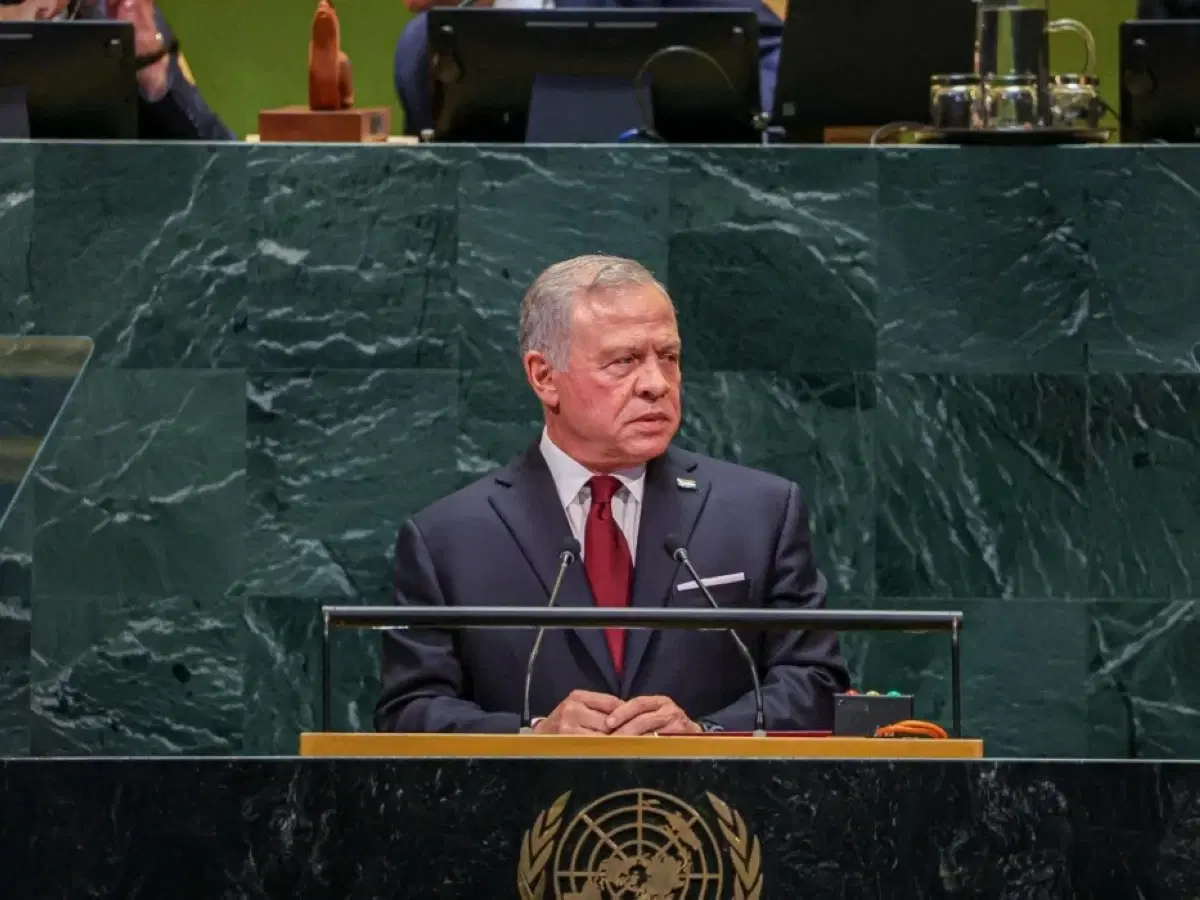
Al-Naimat and Al-Jaafra: The King's Speech Embodies Clarity of Vision and Steadfastness of the Jordanian Position
Amman5 min read
Share
President of Mu'tah University, Dr. Salama Al-Naimat, and Director of Administrative and Financial Affairs at the Directorate of Education for the Southern Mazar Governorate, Dr. Itimad Al-Jaafra, confirmed that King Abdullah II's speech before the United Nations General Assembly reflected the clarity of the Jordanian vision and the steadfastness of the position towards regional issues, foremost among them the Palestinian issue, and placed the international community before its responsibilities in dealing with crises in accordance with the principles of justice and international law.
Naimat said that the King's speech came at a precise time when the region is going through highly complex circumstances, which gave it an importance that goes beyond the occasion itself, to be a clear expression of Jordan's vision towards regional developments and issues that affect the security of the region and the future of its peoples.
He pointed out that the essence of the speech is to emphasize that achieving security and stability cannot be achieved by dealing with the consequences of crises and leaving their causes in place, explaining that the experiences the region has lived through over the past years have proven that crises that do not find real solutions increase in complexity and produce more suffering.
Naimat pointed out that the Palestinian issue was present at the core of the royal speech, affirming the steadfastness of the Jordanian position towards the rights of the Palestinian people, noting that what is happening in Gaza and the West Bank cannot become a usual reality that the international community deals with over time, and that the continuation of suffering, settlement, displacement, and attempts to change the reality on the ground cannot lead to real peace.
He stressed the importance of continuing to deal with the Palestinian issue based on the rights of the Palestinian people to freedom, self-determination, and the establishment of their independent state, explaining that peace that does not address the root of the problem remains a postponed peace, and that stability that is not based on justice cannot be stable in the true sense.
Naimat explained that the royal speech also reflected Jordan's awareness of its national priorities and its keenness to protect its security and interests, explaining that Jordan's national security is not separate from what is happening in the region, and that the developments surrounding Jordan require close and careful monitoring, especially in files related to borders, water, and the security and stability of the state.
He added that Jordan's adherence to dialogue and diplomacy does not mean leniency in protecting its interests, but rather reflects clarity in determining priorities and the ability to express them responsibly, noting that the strength of the diplomatic position stems from the clarity of what the state seeks to preserve.
He also pointed out that the King's talk about international law and the credibility of the international system places the international community before a real responsibility, affirming that laws and agreements are not effective unless they are applied according to a fair and equal criterion, away from differing positions from one issue to another.
Naimat explained that the value of the royal speech also lies in its view of the region's crises as interconnected, as what happens in Palestine, Syria, Lebanon, and others has its repercussions on security, economy, trade movement, energy, water, and people's lives, which makes addressing the roots of crises a necessity to achieve sustainable stability.
For her part, Al-Jaafra said that the King's speech before the United Nations carried a clear message that puts the truth at the forefront of the international scene, confirming that the Jordanian word in international forums is based on a clear position that does not compromise on rights and does not ignore the reality of what is happening in the region.
She added that the King spoke in a clear language that does not beautify reality or hide from naming things by their names, noting that recognizing reality as it is represents a fundamental step towards achieving justice and addressing the crises witnessed by the region.
Al-Jaafra pointed out that the King's speech emphasized the importance of international accountability, and that silence in the face of facts does not create justice, while addressing crises requires courage in facing facts and taking responsibilities, noting that the Jordanian position combines a desire for peace, adherence to rights, openness to dialogue, and protection of national interests.
She stressed that the message carried by the speech reflects a Jordanian approach based on moderation, clarity, and steadfastness in positions, while adhering to political solutions that lead to just and lasting peace.
King Abdullah II had confirmed during his speech before the United Nations General Assembly: “Accountability begins when we call things by their real names... and it is time for the world to face the reality of what is happening,” affirming the need to deal with facts clearly and for the international community to bear its responsibilities towards existing issues and crises.
Naimat and Al-Jaafra pointed out that the royal speech consolidates Jordan's presence in regional and international issues, confirms its keenness on its security and stability, and its adherence to the principles of peace, justice, and political solutions, which preserves the rights of peoples and enhances the chances of stability in the region.