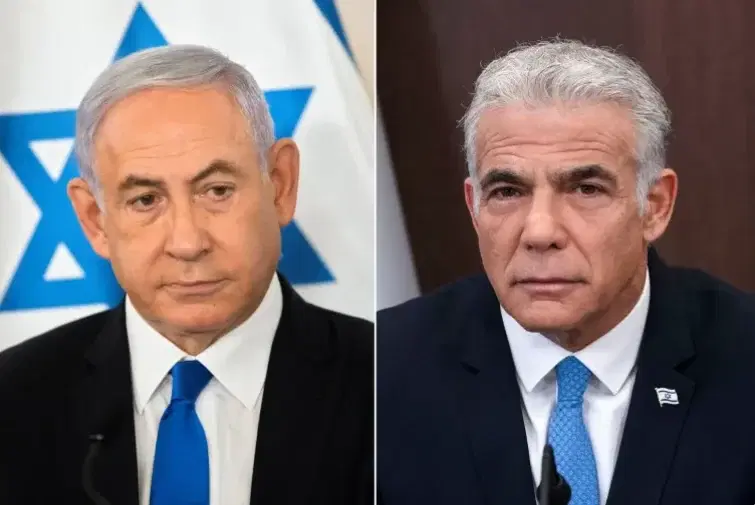
The Israeli opposition seeks to change the Knesset Speaker and pass laws targeting Netanyahu
Amman4 min read
Share
Israeli opposition parties are preparing to move within the Knesset to replace its speaker and pass legislation targeting Prime Minister Benjamin Netanyahu, in an effort to shift the political balance of power, despite neither camp having secured the necessary majority to form the next government.
Preliminary results of the parliamentary elections showed Netanyahu's camp securing 53 out of 120 seats in the Knesset, compared to 48 seats for the opposition parties and 19 seats for the Arab parties, with neither camp reaching the required majority of 61 seats.
Israeli media cited sources stating that opposition leaders have held bilateral meetings and phone conversations, and intend to hold a meeting of the bloc's party leaders at the home of opposition leader Yair Lapid to develop a joint action plan regarding government formation and translating election results into political power within parliament.
The bloc includes the leaders of the "Yesh Atid" party led by Lapid, "Yashar" led by Gadi Eisenkot, "Yisrael Beiteinu" led by Avigdor Liberman, and "The Democrats" led by Yair Golan.
Consultations to determine the person who will be tasked with attempting to form the government are scheduled to begin on Wednesday, November 11, at the residence of Israeli President Isaac Herzog.
The Israeli Broadcasting Authority stated that the Director-General of the Knesset invited the heads of the lists to meet at the presidential residence on the same day.
Sources in the opposition camp reported that Eisenkot has decided to accept the first mandate if he receives it, and work toward forming a government.
Cooperation with Arab parties
As part of the search for an alternative majority, Israeli figures, including former ministers and Knesset members, have called on opposition leaders not to rule out cooperation with Arab parties in order to form an alternative government to Netanyahu's government.
Israeli media reported sources saying that Eisenkot agreed to study a proposal to form a government with external support from the United Arab List and the United Torah Judaism party, through the two parties abstaining from voting in a crucial parliamentary session, allowing the government to take power without them officially joining the coalition.
The plan is based on the cooperation of parties with divergent political orientations to provide the necessary support to change the government.
Changing the Knesset Speaker and passing laws
The opposition intends to replace the current Knesset Speaker, Amir Ohana, a member of the Likud party, which would allow it to manage parliamentary work and attempt to pass legislation during the six weeks leading up to the deadline for forming a government.
Opposition parties are discussing the identity of a consensus candidate for the Knesset Speaker position, while the names of Eisenkot, Lapid, and Oded Forer, from the Yisrael Beiteinu party, are being proposed for the post.
The opposition's legislative agenda includes pushing for the formation of an official commission of inquiry into the events of October 7, 2023, alongside what is known as the "Defendant Law," which aims to prevent anyone facing a criminal indictment from forming a government, even if no conviction has been issued against them, in addition to repealing other judicial laws.
Netanyahu, 76, is being tried on corruption charges including bribery, fraud, and breach of trust, charges that could lead to his imprisonment if convicted.
Opposition understandings determine the chances of action
Leaders in the opposition camp believe that changing the Knesset Speaker could be a step toward changing the political balance of power, even as negotiations over government formation continue; however, implementing the plan requires agreeing on a candidate for the position and mobilizing a parliamentary majority to elect them.
The opposition seeks to separate the move within the Knesset from negotiations on forming a government by trying to take control of the parliament speaker position and pushing its legislative agenda first, before addressing the disputes related to forming the next coalition.
However, the success of these moves depends on the opposition parties' ability to overcome their political differences and reach understandings that allow them to work together.
Since late 2022, Netanyahu has led a government that includes far-right parties, while facing corruption charges before the Israeli judiciary.
The International Criminal Court also issued an arrest warrant for him in 2024 over accusations of committing war crimes and crimes against humanity in the Gaza Strip.