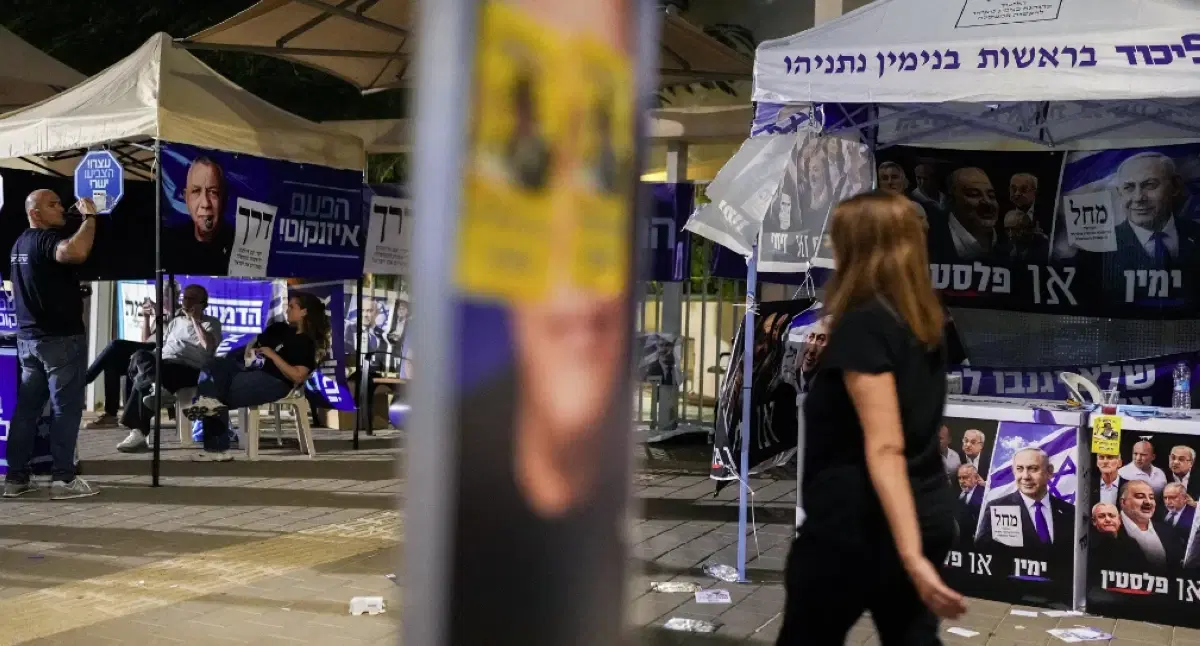
Voters cast their ballots in the Israeli legislative elections on Tuesday, which saw the "highest voter turnout" in decades, reaching 77.7%.
The opposition coalition made slight gains over the coalition led by Benjamin Netanyahu, according to exit polls, but it remains far from the 61-seat majority threshold in parliament, meaning the next government will be formed by whoever succeeds in building a coalition.
Polls predicted that the opposition coalition led by former Chief of Staff Gadi Eizenkot would secure between 52 and 53 seats, compared to 50 seats for Netanyahu's coalition. The two Arab lists achieved strong gains, with polls granting them between 17 and 18 seats.
Below are four potential scenarios:
1. Coalition
Parties immediately begin negotiations in an attempt to reach the 61-seat threshold in the 120-seat Knesset (parliament), but achieving this appears complicated.
President Isaac Herzog will hold consultations with party representatives and designate the candidate most likely to form a government, not necessarily from the party with the most seats, but the one best positioned to secure enough seats in parliament.
Arab parties, especially the United Arab List "Ra'am," expressed openness to working with the Eizenkot coalition, but the latter preferred to keep its distance, considering their support a burden during the election campaign.
As for Netanyahu's coalition, it has no clear options to secure more seats after some small right-wing parties failed to cross the electoral threshold to enter parliament.
These negotiations could be arduous and lengthy, given that parties cling to their narrow interests, which could result in unstable governments.
After the last elections held in November 2022, Benjamin Netanyahu needed 58 days to form his government.
2. Minority government
Unless any bloc succeeds in securing 61 seats, a candidate could attempt to govern without a majority, relying instead on the support of other lawmakers on a case-by-case basis.
In this scenario, deputies from the Arab minority, which makes up 20% of the population, could play a pivotal role.
The United Arab List "Ra'am," led by Mansour Abbas, previously played the role of "kingmaker" after becoming the first Arab party to join an Israeli government within a coalition that held power for a short period between 2021 and 2022, led by Naftali Bennett and Yair Lapid.
"Ra'am" expressed its readiness to work with the Eizenkot bloc, while the Joint List offered to provide a "safety net" for any alliance that removes Netanyahu from power.
Political analyst Tal Ilovits said that the very high turnout among Arabs "indicates a strong desire for partnership."
Eizenkot did not publicly show any willingness to even discuss this possibility, while Netanyahu said during his campaign to Jewish voters that voting for the opposition could bring Arabs into the government.
Ilovits explained, "Ultimately, it seems at the moment that there is a possibility of forming a minority government headed by Eizenkot, but this could change depending on the final results."
3. National unity government
Although the option of forming a national unity government is considered far-fetched given the intense polarization in Israel, it remains theoretically the scenario most capable of forming a less extremist government.
Israeli political analysts have repeatedly discussed the hypothesis of forming a national unity government in which Netanyahu abandons his hard-right allies and ultra-Orthodox religious parties to ally with Eizenkot, who shares the same views on many security issues.
Such a large alliance would exclude Arab parties.
A poll published on October 16 showed that 55% of Israelis prefer a national unity government over holding new elections if the vote does not lead to a clear majority.
This scenario has a recent precedent. In 2020, Netanyahu and Benny Gantz, who like Eizenkot is a retired general appealing to the center, reached a power-sharing agreement after three elections held in less than a year, which stipulated a rotation in the premiership.
However, this partnership collapsed after only one year, leading to new elections.
But this scenario would face strong opposition from both sides, especially the opposition bloc that built its election campaign on ousting Netanyahu and describing him as unfit to lead.
4. Deadlock and new elections
If no candidate succeeds in forming a government, Israel will have to return to elections.
The country held four elections between April 2019 and March 2021 because politicians were unable to form a sustainable coalition.
The candidate chosen by the President would, in principle, have 28 days to form a coalition with the possibility of a 14-day extension, although there are other procedural means to avoid immediately calling for new elections.