Colonization and Wall Resistance Commission: 3,133 attacks by occupation forces and settlers during October
Amman9 min read
Share
The Colonization and Wall Resistance Commission stated that Israeli occupation forces and settlers carried out 3,133 attacks against citizens, their lands, and their properties during the past month of October, an increase of 52.8% compared to September, which recorded 2,051 attacks.
In a press statement on Monday, the Commission explained that the attacks comprised 1,764 carried out by occupation forces and 1,369 by settlers, noting that settler attacks alone increased by 111.6%, from 647 in September to 1,369 during October.
It added that this escalation coincided with the olive harvest season, which witnessed continuous targeting of farmers, their lands, and their crops, within the framework of the complementary roles of occupation forces and settlers in targeting one of the most important pillars of Palestinian steadfastness, represented by the connection of farmers to their land and sources of livelihood.
The Ramallah and Al-Bireh governorate topped the list of governorates in terms of the number of attacks, with 704, followed by Nablus with 636, Hebron with 568, then Jenin with 224, Jerusalem with 219, Salfit with 217, and Bethlehem with 198 attacks. The first three governorates accounted for about 61% of the total recorded attacks.
The Commission emphasized that the gravity of these attacks is not limited to their numerical volume, but also lies in the diversity and complementarity of their tools, as direct assaults on citizens overlap with the sabotage of property and crops, restrictions on land access, the imposition of closures, the establishment of colonial outposts, the demolition of facilities, and the issuance of military orders, which exacerbates pressure on Palestinians and undermines their ability to remain on their land.
1369settler attacks
The Commission said that settlers carried out 1,369 attacks during October, with the most prominent ones concentrated in the governorates of Ramallah and Al-Bireh with 393 attacks, Nablus with 353, Hebron with 255, Salfit with 128, Jerusalem with 74, Bethlehem with 57, Tubas with 27, and Jenin with 28 attacks.
The total number of attacks in the Ramallah, Al-Bireh, Nablus, and Hebron governorates reached 1,001, which is about 73% of total settler attacks during the month.
The Commission noted that these attacks caused direct damage to at least 356 documented citizens, including 22 children and 22 women. Nablus topped the list of governorates in terms of the number of affected persons with 120, followed by Ramallah and Al-Bireh with 88, Hebron with 49, and Salfit with 45 citizens.
5890damaged trees, including 4,498 olive trees
In the context of attacks on agricultural land, the Commission said that attacks on crops and trees affected 5,890 trees during October, including 4,498 olive trees.
The damaged trees were distributed as follows: 3,366 in Hebron governorate, 666 in Nablus, 453 in Ramallah and Al-Bireh, 400 in Jenin, 361 in Bethlehem, 325 in Jerusalem, 250 in Tubas, and 69 in Salfit.
It added that the month saw the documentation of 165 cases of olive theft, alongside the theft of 384 head of sheep, and the monitoring of thefts and seizures involving 45 vehicles, nine agricultural tractors, and four bulldozers, in addition to agricultural equipment and private property.
It pointed out that these attacks target the livelihoods of citizens, particularly in rural areas, by targeting crops, livestock, and agricultural equipment, thereby imposing additional economic burdens on landowners and restricting their ability to invest in them.
The Commission confirmed that the synchronization of these attacks with the olive harvest season reflects a direct targeting of the historical and economic relationship between the Palestinian farmer and their land, turning the harvest season into a period of recurring attacks, threats, and denial of access to land, under the protection of occupation forces and their participation in many instances.
28attempts to establish new colonial outposts
The Commission said that colonists attempted to establish 28 new colonial outposts during October, with nine attempts concentrated in the Hebron governorate, eight in Nablus, five in Ramallah and Al-Bireh, two in Jericho and the Jordan Valley, and one attempt each in Bethlehem, Jenin, Salfit, and Tubas.
It explained that the establishment of colonial outposts is one of the tools used to expand control over Palestinian lands, as it begins by seizing agricultural and pastoral areas, setting up tents and facilities, and building roads, then imposing restrictions on landowners' access to them, eventually leading to connecting the outposts to infrastructure and service networks and attempting to legalize their status through official Israeli institutions.
It added that these practices reflect a synergy between the movements of colonists and the measures taken by occupation institutions; as new facts on the ground are imposed before political, military, and planning authorities intervene to cement them and provide the requirements for their continuation and expansion.
5orders and declarations targeting 229.561 dunams
Regarding the file of military orders, the Commission said it monitored five orders and declarations during October targeting a total of 229.561 dunams of Palestinian land, distributed between declaring lands as government property, orders to remove trees and vegetation, and a seizure order for military purposes.
It explained that the occupation authorities announced the registration of 182.81 dunams as government property, including 118.75 dunams of land in the towns of Sa'ir and Ash-Shuyukh in the Hebron governorate, at the "Bani Kedem" site, under declaration No. 06/26, and 64.06 dunams of land in the town of Battir in the Bethlehem governorate, at the "Bar Kochba" site, under declaration No. 07/26, both dated October 18, 2026.
It added that the monitoring file included two orders for the removal of trees and vegetation covering a total area of 46.01 dunams, consisting of 43.31 dunams in Deir Nidham in the Ramallah and Al-Bireh governorate, under order No. 105/26, and 2.7 dunams of Al-Mughayyir lands, under order No. 41/26.
The file also included urgent military seizure order No. 33/26, which targeted 0.741 dunams of land in the Jenin governorate.
The Commission noted that these measures reveal the multiplicity of tools used by occupation authorities to control Palestinian land, through declaring land as government property, removing vegetation, and imposing military seizure, leading to the restriction of landowners' rights and the changing of the nature of its use.
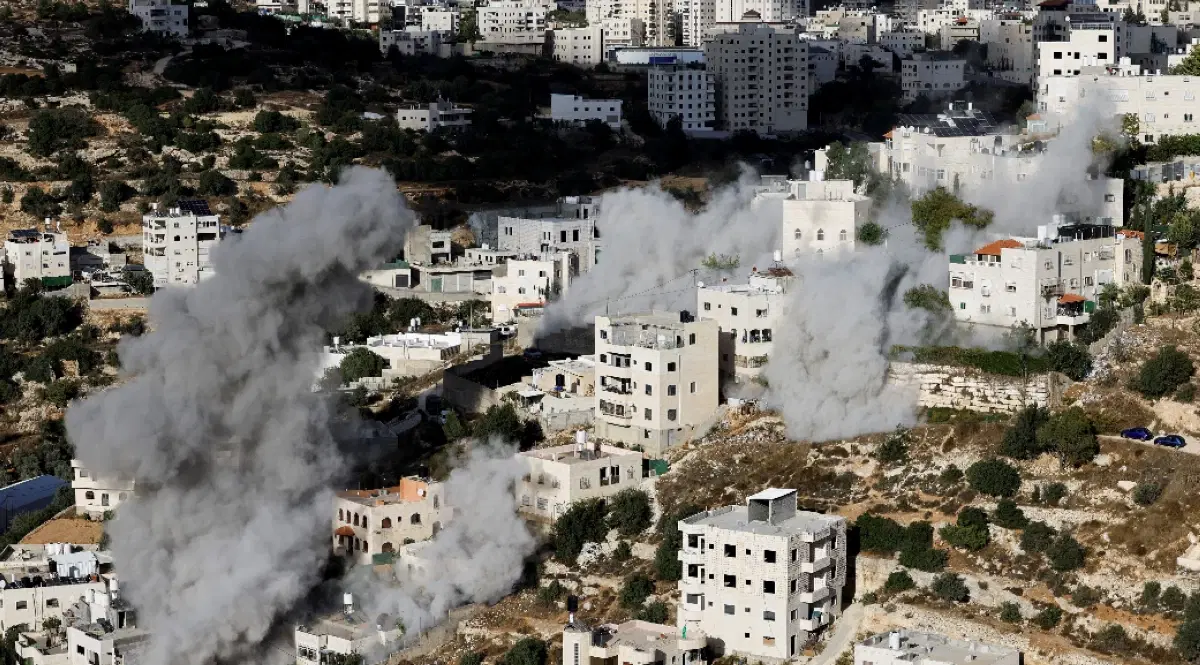
Demolition of 129 facilities and issuance of 11 notices
The Commission said that the occupation authorities carried out 62 demolition operations during October, affecting 129 Palestinian facilities, including 62 inhabited homes, two uninhabited homes, 14 facilities that serve as sources of livelihood, 46 agricultural facilities, and five other facilities.
The Jerusalem governorate recorded the highest toll of demolished facilities with 46, followed by Hebron with 37, Jericho with 11, Jenin with ten, Nablus with eight, while Bethlehem and Salfit recorded seven facilities each.
It added that the occupation authorities issued 11 notices during the month targeting Palestinian facilities and properties, concentrated in the governorates of Hebron and Jerusalem with three notices each, Ramallah and Al-Bireh and Bethlehem with two notices each, and one notice in Nablus.
The Commission indicated that the demolition operations caused direct damage to at least 220 documented citizens, including 125 children and 45 women. The Jerusalem governorate topped the list of affected persons with 99, followed by Salfit with 44, and Hebron with 29 citizens.
It confirmed that the demolition policy aims to undermine the pillars of Palestinian life and the possibilities of natural urban growth, especially in areas besieged by settlements, colonial projects, and bypass roads, where planning restrictions and demolition notices turn into tools to curb Palestinian expansion in exchange for expanding the space under colonial control.
10colonial master plans and 5 tenders including 1,629 units
Regarding the file of colonial expansion, the Commission said that the occupation authorities pushed forward with ten colonial structural plans in the West Bank and East Jerusalem during October, in addition to issuing five tenders, 3 of which are in East Jerusalem and two in the West Bank, as part of the continued expansion of settlement construction and the development of its planning and service infrastructure.
It explained that 5 plans were monitored in the West Bank outside the occupation's Jerusalem municipal borders, including the construction of 912 settlement units, most notably the "Avnei Hefetz" settlement plan in the Tulkarm governorate, which includes 720 units on an area of 267.33 dunams; the "Sha'arei Tikva" settlement plan built on the lands of Mas-ha town in Salfit governorate, which includes 126 units on an area of 51.879 dunams; and the "Elazar" settlement plan built on the lands of Al-Khader town in the Bethlehem governorate, which includes 66 units on an area of 28.356 dunams.
The plans also included regulatory adjustments and land uses in the "Barkan" industrial settlement and "Modi'in Illit".
In East Jerusalem, the Commission monitored 5 structural plans, three of which were approved, including 475 settlement units on an area of 14.501 dunams, most notably an urban renewal plan in "Talpiot" including the construction of 470 units within 3 towers, in addition to two plans in the "Ramat Shlomo" and "Gilo" settlements.
The occupation authorities also deposited two plans for the construction of public institutions and buildings in the "Ramot" and "Har Homa" settlements, on a total area of 22.42 dunams.
The Commission noted that the occupation authorities issued 5 tenders during October including the construction of 1,629 settlement units, including three tenders in East Jerusalem for the construction of 1,279 units, distributed as follows: 730 units in the "Pisgat Ze'ev" settlement, under tender No. 212/2026; 502 units in the "Gilo" settlement, under tender No. 133/2026; and 47 units in the "Givat HaMatos" settlement, under tender No. 109/2026.
It added that the occupation authorities issued tender No. 207/2026 in the West Bank for the construction of 350 units in the "Ma'ale Adumim" settlement, in addition to tender No. 205/2026 in the "Modi'in Illit" settlement, related to public building uses, employment, and commerce.
It confirmed that the timing of issuing tenders alongside the approval of plans and the depositing of new plans reflects the continuation of colonial expansion phases, starting from planning and reclassifying lands, through marketing projects, to providing the necessary infrastructure for their implementation. It also indicated that these measures aim to connect settlement blocs and enhance their demographic and service extension, in exchange for fragmenting the Palestinian space and undermining the geographical contiguity between Palestinian communities.
The Colonization and Wall Resistance Commission stressed that the October data reveals an escalation in settlement attacks and their integration with military operations, land seizure procedures, demolitions, and planning expansion, in an effort to impose new facts on the ground and accelerate de facto annexation.
The Commission called for serious international action that goes beyond statements of condemnation, includes practical measures to stop the attacks, protect Palestinian citizens, hold those responsible accountable, and halt all forms of support and empowerment for the Israeli colonial project in the occupied Palestinian territory.