The Arab vote imposes a new political equation in Israel
The Israeli opposition faces a test of stances
Amman9 min read
Share
Arab parties have moved past the protest stage into a space of influence
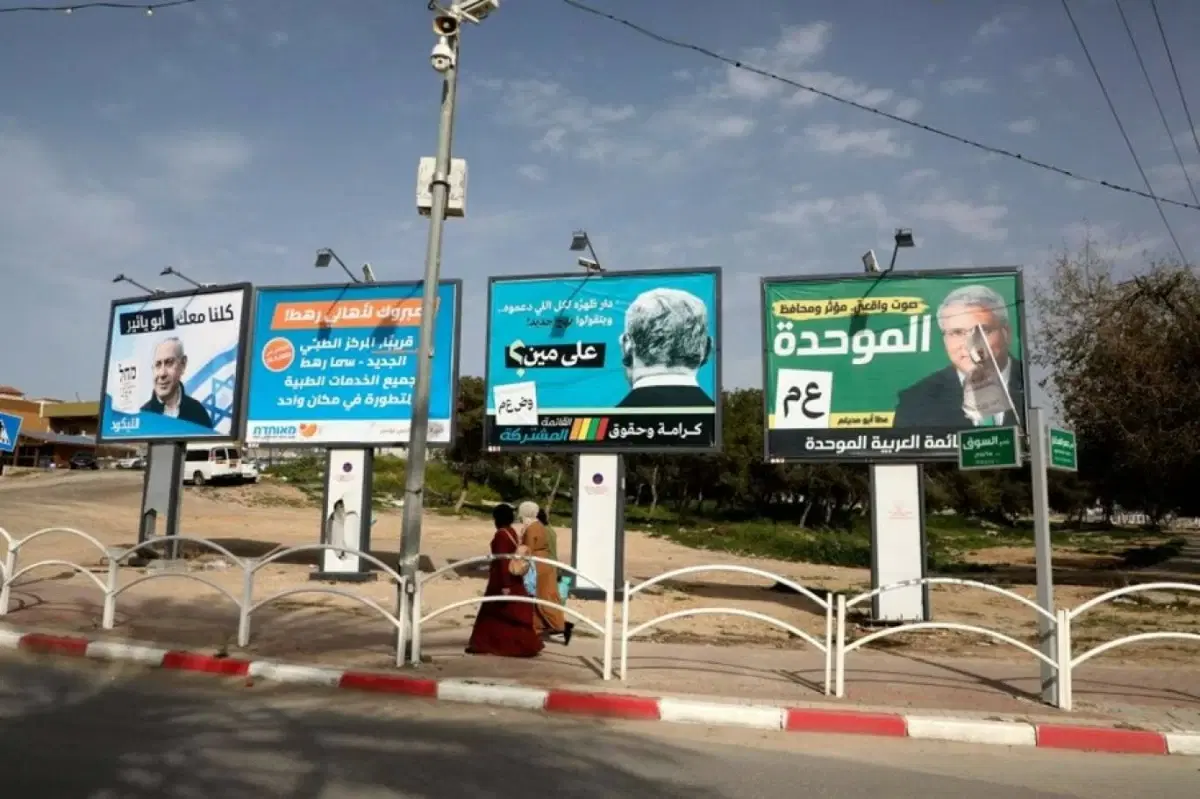
The broad participation of Palestinian Arabs within Israel in the 26th Knesset elections has imposed an influential variable in the equation for forming the next Israeli government, after preventing Benjamin Netanyahu from re-forming his extreme right-wing government and placing the "change camp" before a political test regarding its willingness to rely on Arab votes to topple his rule, or to hold onto the Zionist vision that refuses to grant Arab citizens an influential role in the political landscape.
Writer and political analyst Dr. Shafiq Al-Talouli believes that the Arab vote has moved beyond the protest stage into a space of influence and political action, and has become capable of contributing to the formulation of decisions related to the formation of the Israeli government.
He points to an intersection between the goals of the Arab parties and Avigdor Liberman's position regarding ousting Netanyahu, although the motives of the two sides differ; while Liberman is driven by considerations of competition for the premiership and political and personal calculations, the Arab parties are driven by a position that rejects projects aimed at liquidating the Palestinian cause and entrenching the Jewishness of the state at the expense of the rights of Palestinians and Arabs.
Al-Talouli confirms the Arab parties' adherence to supporting the Palestinian national project and the two-state solution, and their rejection of turning Israel into a state based on one nationality or reproducing the rule of the extreme right.
He considers the main challenge to be the seriousness of the opposition forces in dealing with the Palestinians and the Arab List, and whether they are seeking to actually involve them in decision-making, or are using their votes tactically to topple Netanyahu and overcome the political crisis.
He warns against imposing conditions aimed at pressuring the Arab position or circumventing it, stressing that any participation of the Arab parties must be linked to ensuring their political presence and their ability to defend the national project and confront forces of extremism and racism.
For his part, Jacky Khoury, news director at "Al-Shams" radio in Nazareth and a writer for the newspaper "Haaretz," indicates that Yair Golan's position calling for cooperation with Arab parties does not necessarily reflect the orientations of all parties in the "change camp," noting that the positions of Gadi Eizenkot, Naftali Bennett, and Yair Lapid still constitute one of the most prominent obstacles to establishing a coalition capable of ousting Netanyahu, in the absence of clear positions from them that would open the door for cooperation with the United Arab List.
Khoury presents three possibilities for the outcome of the political landscape; the first is the formation of a "unity government" based on rotation, under which Netanyahu remains prime minister for a limited period before the position passes to Eizenkot, Bennett, or another figure, an option he sees as difficult in light of the declared positions, unless there is direct American intervention.
The second possibility is for Eizenkot to take the initiative to cooperate with the Arab parties and form a minority government, but this path clashes with Liberman's refusal to ally with the Arab parties or with Likud led by Netanyahu and the Haredi parties.
As for the third possibility, it represents the continuation of the political stalemate and heading to new elections, which may allow Netanyahu to remain in charge of a caretaker government until next May.
In the same context, writer and political analyst Aouni Al-Mashni believes that the broad Arab participation has produced a clear political force, but converting this electoral presence into actual influence on decisions and government formation remains the responsibility of the Arab leaders.
He indicates that the parties of the "change camp" have not yet reached the stage of accepting the formation of a government based on Arab lists, in light of the continued manifestations of racism within Israeli society.
He believes that the chances of forming a stable, long-term government seem limited, and that the current results may pave the way for a new electoral round, even if its date is postponed.
For her part, writer and political analyst Dr. Reham Odeh confirms that the Arab participation has caused a wide resonance in right-wing circles, and that attempts to question the legitimacy of this vote reflect the extent of its potential impact on the political and legislative equation, in addition to the possibility of it contributing to the formation of a new government led by the change bloc.
Odeh expects Eizenkot to set preconditions for the Arab parties, including recognizing the Jewishness of the state and not opposing security plans related to dismantling Hamas in the Gaza Strip and military operations in the West Bank, conditions she suggests the Arab parties will reject.
She believes that the role of these parties may be limited, given these data, to supporting legislation aimed at curbing racism and combating crime within Arab society.
Odeh identifies four possible scenarios for the next stage; the first is Eizenkot joining a unity government with Netanyahu according to a rotation formula, whereby each of them serves as prime minister for two years, with the aim of dealing with Middle East war files. The second is Eizenkot's agreement to form a government with the support of Arab parties without imposing preconditions on them, in order to topple Netanyahu, with the possibility of this government being subjected to political attacks from Likud. As for the third scenario, it consists of a split occurring within the opposition and Netanyahu allying with Bennett and Lapid to form a government with a right-wing majority in exchange for political concessions.
The fourth scenario is the failure of attempts to form a government and a return to the ballot boxes.
Writer and analyst specializing in Israeli affairs Nihad Abu Ghosh confirms that the Arab voting rate exceeded 80 percent in these elections, noting that Netanyahu proposes an equation based on refusing to form a government that does not rely on a Jewish Zionist majority, and warning that this position might transfer to some parties of the "change camp."
Abu Ghosh believes that these positions reveal the contradiction existing between Israel defining itself as a Jewish and democratic state, as the Zionist forces, according to his reading, side with the Jewishness of the state at the expense of democratic practice when it comes to the political participation of Arab citizens.
He points out that Arabs make up about 21 percent of the population and 18 percent of eligible voters, considering that the number of seats they obtained does not proportionally reflect their demographic and electoral weight.
In turn, professor of political science Dr. Suhail Diab identifies three main political achievements of the Arab participation; the first is the defeat of two right-wing lists whose entry into the Knesset would have allowed Netanyahu to form a government more extreme than his previous one. As for the second achievement, it consists of placing the opposition before a direct political choice between fulfilling its electoral pledge to oust Netanyahu by relying on Arab support, or siding with the hardline Zionist vision that rejects partnership with Arab parties.
The third achievement is re-introducing the issue of national oppression that Palestinians are subjected to within Israel at the international level, which strengthens the debate regarding the nature of the Israeli political system and the extent of its equality among its citizens.
Diab proposes three paths for dealing with the next stage, the first is political and legal, based on the possibility of forming a government that enjoys a parliamentary majority that exceeds the number of those opposing it, even without reaching the 61-member threshold, with the possibility of support reaching 67 seats if the Arab blocs decide to support an Eizenkot government from the outside, alongside attempts to attract parties from the opposing camp, such as the "United Torah Judaism" party.
As for the second path, Diab describes it as the "horror scenario," and it consists of the possibility of a broad military escalation, perhaps against Iran, leading to the imposition of a state of emergency that pushes the opposition to accept the formation of a national unity government led by Netanyahu.
While the third path, which Diab favors, is what he calls the "shadow scenario," based on investing in the majority held by the "change camp," estimated at 67 seats against 53, to bring about parliamentary and legislative changes, including changing the Speaker of the Knesset, repealing the judicial amendment laws, and forming an official investigation committee into the "October 7" failures, in addition to taking steps that would limit Netanyahu's influence and create conditions for the formation of a more stable change government.
The entirety of the analysts' readings reveals that Arab participation has become a fundamental element in the calculations of forming the Israeli government, and that its results have forced the "change camp" to deal with the issue of partnership with the Arab parties, after it became difficult to overlook their electoral and political weight.
However, converting this weight into actual influence still faces a number of obstacles, foremost among them the reservations of Eizenkot, Bennett, Lapid, and Liberman about forming a government that relies on Arab support, in addition to the preconditions that conflict with the positions and national principles of the Arab parties, and the political campaigns aimed at questioning the legitimacy of the Arab vote.
Between the paths proposed by Diab regarding the possibility of bringing about parliamentary and legislative change from outside the government, and the scenarios expected by Odeh regarding the possibilities of forming a unity government or heading to new elections, the equation of government formation remains open to more than one possibility, while the main challenge lies in the ability of the Arab parties to translate their electoral weight into an influential political presence, in light of the disparities within the opposition camp and the limits of its willingness to cooperate with them.