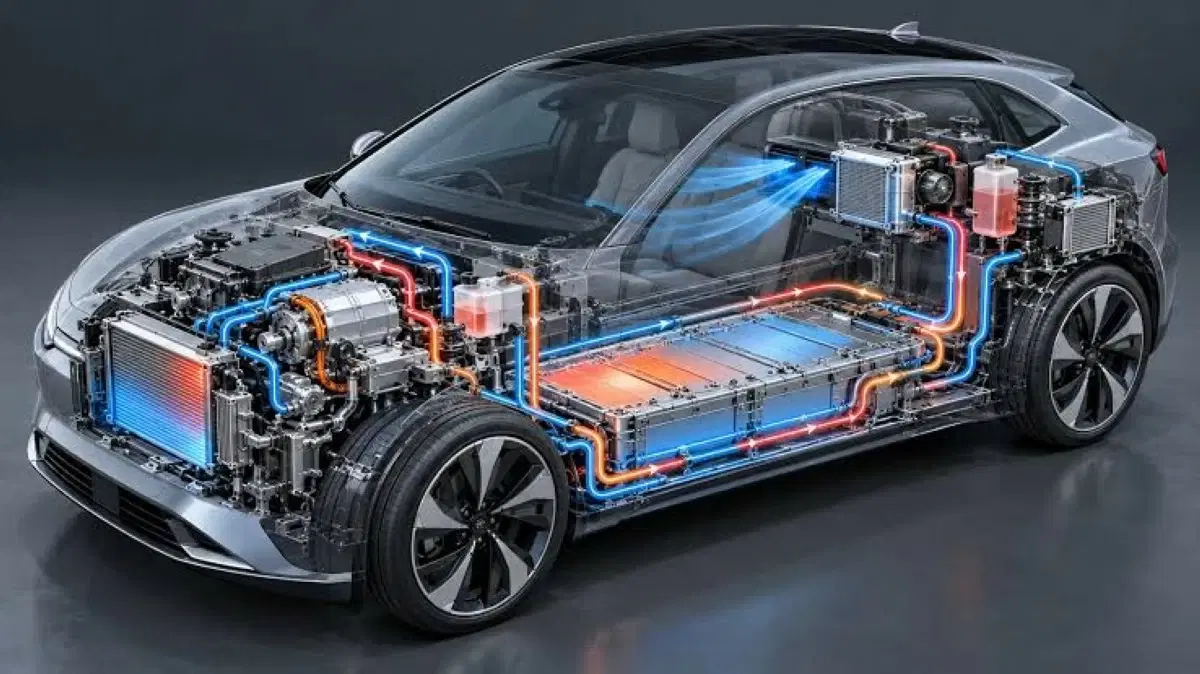
Technology detects electric vehicle battery risk before disaster
Amman4 min read
Share
The danger inside an electric vehicle battery may begin with a single cell heating up abnormally, before any clear indicators appear on the dashboard. If this temperature rise spreads to adjacent cells, the battery may enter what is known as "thermal runaway," a series of dangerous reactions that could end in the emission of toxic gases or the outbreak of a fire.
In an attempt to detect this danger early, a research team from China's Tongji University and the German Fraunhofer Heinrich Hertz Institute developed a monitoring system based on fiber optics that can detect abnormal thermal changes inside the battery and provide protection systems with extra time to intervene.
The results of the study were published in the journal "Nature Communications" on October 9, 2026.
540 heat monitoring points
The researchers relied on distributing micro-sensors based on fiber optics inside an experimental battery pack containing 270 cells, which increased the number of heat measurement points from 32 points in the traditional monitoring system to 540 points, without the need to extend hundreds of electrical wires.
These sensors work by monitoring the changes that occur to light within the fibers as a result of temperature differences, then a specialized algorithm analyzes the readings, focusing not only on the heat level, but also on the speed of its rise and the thermal differences between the battery's zones.
The importance of this method lies in its ability to detect an abnormal localized rise in temperature, which may not appear clearly when simply measuring the average temperature of the entire battery.
Early warning of up to 9 minutes
The team tested the system on 7 electric vehicles under actual operating conditions, for a total of 1284 operating days, and two cases of thermal runaway were recorded in two vehicles; the first during charging, and the second after it was completed.
In the first case, the new system issued a warning about 554 seconds, or 9 minutes and 14 seconds, before the traditional alarm standard used for comparison, while the difference in the second case was only 25 seconds.
The researchers also conducted additional tests on 23 battery cells and two experimental units, which included abnormal conditions such as overheating and overcharging, and the maximum advancement in warning timing during laboratory experiments reached 706 seconds.
The results show that the early warning time varies depending on the nature of the fault and the speed of its development, and cannot be considered a fixed grace period in all cases.
Does the technology prevent battery ignition?
The results do not mean that the system is actually capable of extinguishing fires or preventing thermal runaway, but rather its achievement lies in detecting danger indicators before the traditional comparison standard based on voltage change.
This additional grace period may provide protection systems with an opportunity to take preventive measures, such as stopping the charging or alerting the driver, provided the technology is integrated with effective response mechanisms.
However, the results still need further testing before they can be generalized; as recording only two cases of thermal runaway in actual vehicles is not enough to prove the system's efficiency with various types of batteries, and their differing ages, chemistries, and designs.
The application of the technology in commercial vehicles also requires proving its ability to work continuously on the vehicle processors used in production.
What do the results mean for electric vehicle drivers?
So far, this system is not available as a widely adopted technology in the cars on the market, and therefore the manufacturer's instructions and taking battery warnings seriously remain the basis for safety.
In the event of smoke, an unusual smell, or a warning indicating a risk in the battery, one should pull over to a safe place, exit the vehicle and move away from it, and call emergency services if there is danger, without attempting to open the battery pack or repair it yourself.
This study opens a new field for developing electric vehicle safety systems, not limited to improving battery capacity, driving range, and charging speed, but extending to detecting internal faults before they turn into dangerous accidents.