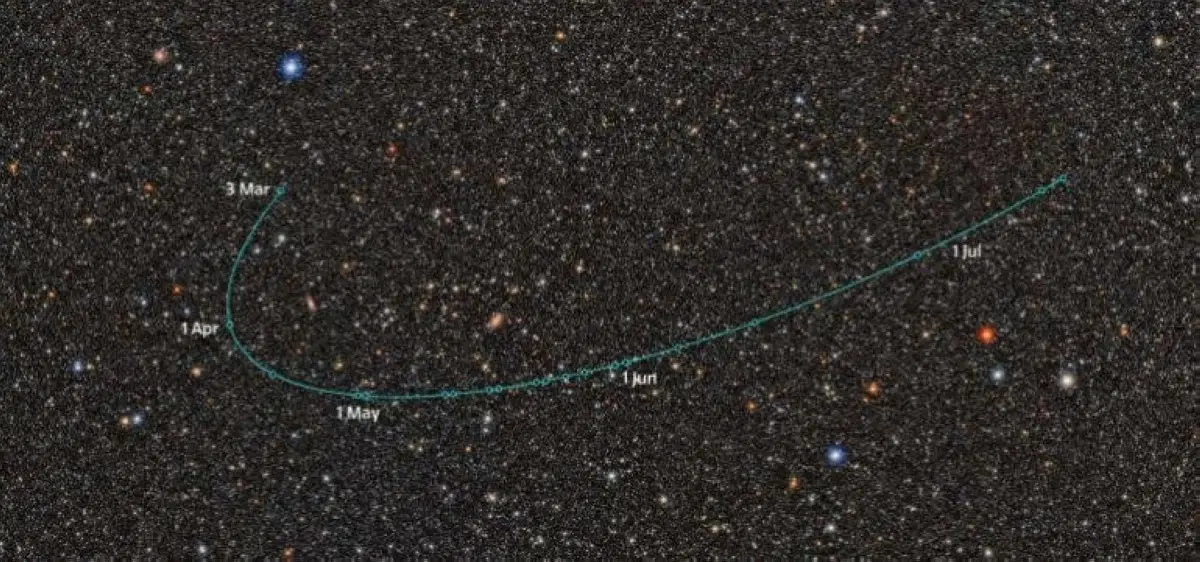
Rubin Observatory observes a potential dwarf planet
Amman3 min read
Share
Astronomers, using the Vera C. Rubin Observatory in Chile, have spotted a new celestial object located beyond Neptune's orbit, which may become the sixth recognized dwarf planet in the solar system if upcoming studies confirm its size and shape.
The new object is named 2026 ED138, and preliminary estimates suggest its diameter ranges between 600 and 1,500 kilometers, making it larger than Ceres, the smallest recognized dwarf planet, and potentially exceeding the radius of Pluto if the higher estimates are correct.
Matthew Holman, an astrophysicist at the Harvard-Smithsonian Center for Astrophysics, who contributed to developing the computer software that helped discover the object, said the discovery stirred a mix of excitement and disbelief in him, due to the rarity of objects with these specifications.
An object hiding amidst the stars of the Milky Way
The object is located about 6.9 billion kilometers from the Sun, equivalent to 46 times the distance between the Earth and the Sun, and orbits at an inclination of about 25 degrees relative to the orbital plane of most solar system planets.
This inclination made it harder to observe, as it appears in front of regions crowded with millions of stars, making it difficult to distinguish its slow movement using traditional telescopes.
However, the capabilities of the Vera C. Rubin Observatory, which began its ten-year scientific mission in July 2026, allowed for tracking the object through sequential sky images, thanks to its giant digital camera that detects changes in the positions and brightness of objects.
The discovery relied on software developed by Holman in collaboration with Kevin Napier to compare billions of astronomical observations and link images belonging to the same object. The researchers also used previous observational data spanning about ten years, which helped them determine its orbital path with greater accuracy.
Will it become the sixth dwarf planet?
2026 ED138 is located within the Kuiper Belt, the icy region beyond Neptune that includes thousands of rocky and icy objects, including Pluto.
The importance of this region lies in its objects retaining primitive frozen materials, such as water, methane, and ammonia, which could reveal secrets about the early stages of the solar system's formation.
The International Astronomical Union currently recognizes five dwarf planets: Pluto, Ceres, Eris, Haumea, and Makemake.
For the new object to join this list, it must be confirmed that it has sufficient mass for its gravity to shape it into a nearly spherical form, while failing to clear its orbital neighborhood of other objects.
Its classification remains tentative, as size estimates depend on its surface brightness, light reflectivity, and distance from the Sun, which are factors not sufficient on their own to determine its true diameter.
Scientists need further observation and measurements to determine its size, density, and to confirm its shape before finalizing the possibility of classifying it as a new dwarf planet.
The importance of the discovery is not limited to this object alone; scientists hope that the ongoing surveys conducted by the Vera C. Rubin Observatory over the coming years will reveal other distant worlds that have remained hidden from the eyes of previous telescopes.