Chinese telescope reveals the secret of a rare stellar family
Amman3 min read
Share
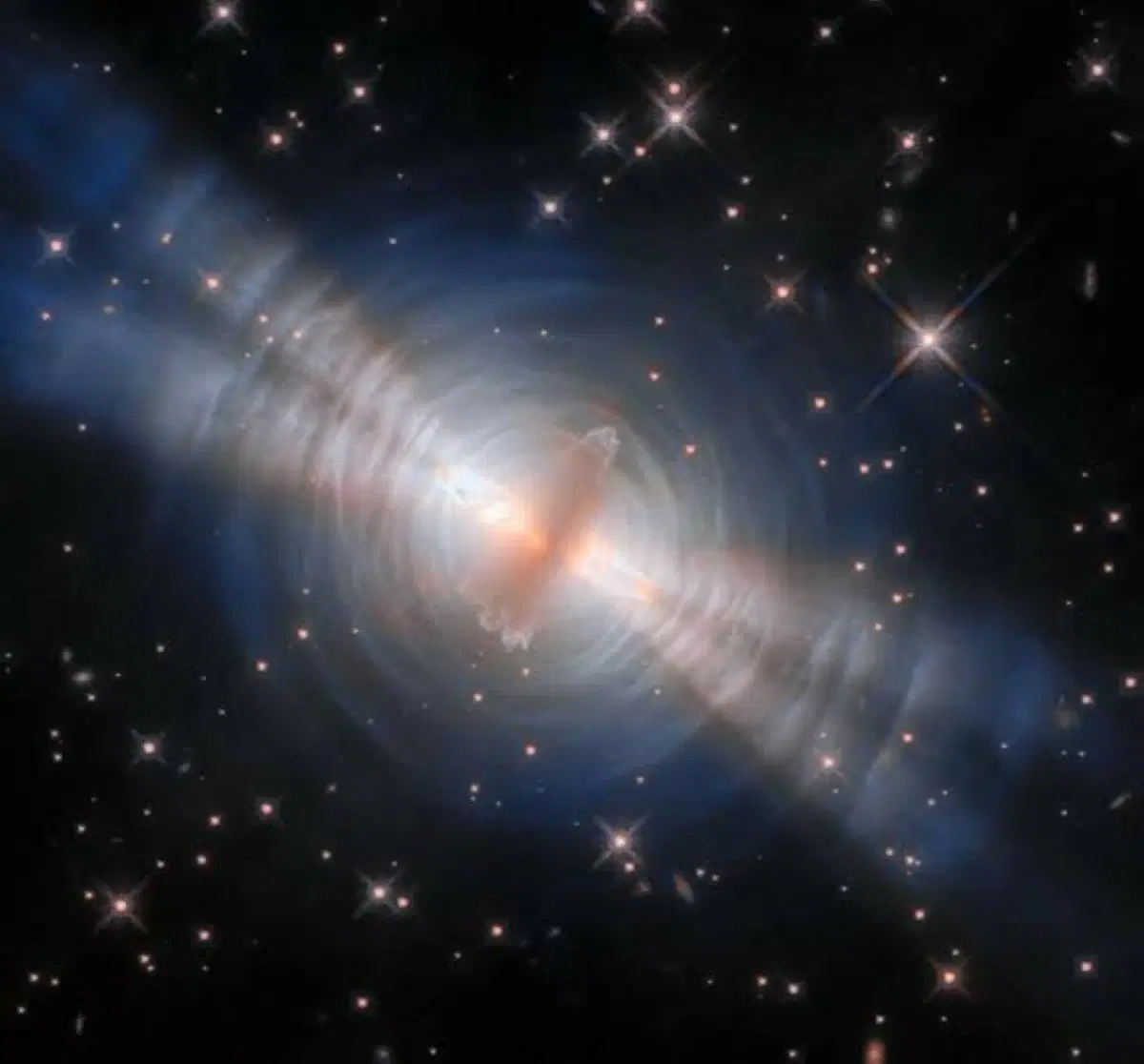
Astronomers have observed a rare stellar system comprising three stars at different stages of their lives, after mysterious pulses led them to discover the gravitational influence of a third star that had been hidden from view.
The giant Chinese radio telescope "FAST" was able to help uncover the secrets of the triple star system "PSR J0435+3233," which combines a pulsar, a white dwarf, and a sun-like star, in a scene that embodies the different fates of stars believed to have originated from the same cosmic cloud.
The National Astronomical Observatories of the Chinese Academy of Sciences announced the confirmation of this system's nature on October 9, 2026, coinciding with the publication of a scientific study in the journal "The Astrophysical Journal Letters." This is the second confirmed triple system containing a pulsar and two stellar companions, but it is the first known to contain a third star that is still in its normal stellar evolution phase.
Pulses revealed a hidden secret
The story began in June 2020, when the "FAST" telescope, with its 500-meter diameter dish, discovered the pulsar—the remnant of a massive star that exploded at the end of its life, characterized by its rapid rotation and the emission of regular radio pulses resembling lighthouse flashes.
The star sends signals every 3.2 milliseconds, but scientists noticed that their timing suggested an unusual slowing in its rotation. After five years of observation and analysis, it became clear that the mystery was not related to the pulsar alone, but to the gravitational influence of a third companion that was not initially apparent.
Researcher Han Jinlin and his team relied on 192 pulse timing measurements, along with optical and infrared data, and gamma-ray observations collected by NASA's "Fermi" telescope over approximately 17 years.
The results revealed that the pulsar orbits with a white dwarf—a remnant of a star that has exhausted its main stages and lost its outer layers—in an orbit lasting about eight days. As for the third star, whose mass is close to that of the Sun, it orbits the inner pair in an elliptical orbit lasting about 73.5 years.
This system is located about 6,900 light-years from Earth, and calculations showed that the gravity of the third star affects the motion of the inner pair, explaining most of the puzzling apparent slowing in the pulsar's pulses, without the need to assume that it is losing its energy at an exceptional rate.
Three stars.. and three fates
Scientists suggest that the three stars originated together but followed different paths; the largest turned into a neutron star, the second ended up as a white dwarf, while the third remains a normal star similar to the Sun.
This unique composition gives scientists a rare opportunity to study stellar evolution and the gravitational interaction between three bodies, as well as to test some aspects of gravitational theories under cosmic conditions that are difficult to simulate on Earth.
The importance of the discovery is enhanced by the presence of a star that is still in its normal evolutionary stage alongside stellar remnants, allowing researchers to study different stages of stellar life within a single system.
Scientists indicate that the third star may turn into a white dwarf in the future, after billions of years, for the system to become a family of three stellar remnants, witnessing the fates of stars and their changes throughout cosmic time.