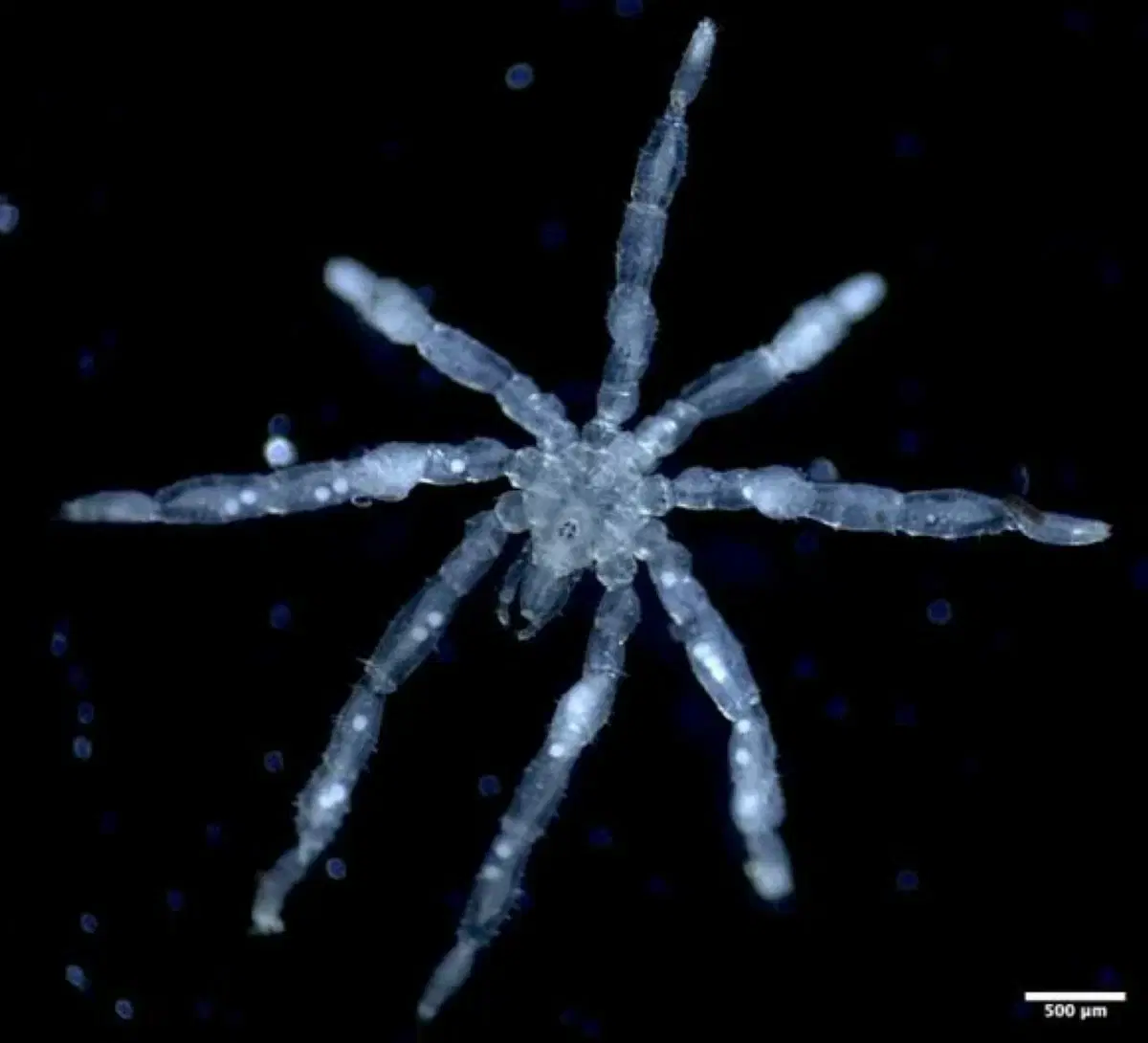
In a remarkable scientific discovery off Canada's west coast, researchers have spotted two new species of sea spiders, characterized by unusual features, from red eyes and hairy legs to the males' ability to carry and care for eggs.
The discovery was made in the waters of the Salish Sea, near the city of Vancouver, during scientific dives conducted by researchers from the University of British Columbia, and the results were published in the journal "Organisms Diversity & Evolution".
Hairy legs and red eyes
Researchers named the first species "Callipallene pilosuspides," in reference to its hair-covered legs. It is distinguished by two red eyes and a triangular-shaped proboscis ending in three lips, in addition to sensory hairs that help it explore the surrounding environment, and specialized appendages for cleaning its body.
As for the second species, "Tanystylum kexin," it possesses shorter limbs, which limits its ability to clean its body regularly and allows dirt and organic matter to accumulate on it. These accumulations provide a suitable environment for small parasitic organisms, creating a miniature biological system where organisms live on the body of another organism.
Researcher Cormac Toller-Scott described this phenomenon as an "ecosystem within an ecosystem within an ecosystem."
Strange characteristics and a unique method of reproduction
Despite being called sea spiders, these creatures are not spiders in the strict taxonomic sense, but belong to a group of marine arthropods evolutionarily related to spiders and scorpions.
The origins of this group date back hundreds of millions of years, and the sizes of its species vary between small creatures no longer than one centimeter and others that may exceed half a meter in length.
Among their remarkable characteristics is that they do not possess traditional lungs or gills, but rather obtain oxygen through their body surface.
As for reproduction, the female lays eggs on her limbs, then the male picks them up using specialized appendages known as "ovigers," and secures them with special secretions before carrying them through their growth stages.
A rare discovery that highlights marine diversity
The two species were discovered as part of a research project aimed at studying the impact of climate change and human activities on marine invertebrates in the Salish Sea.
The importance of the discovery lies in the fact that it represents the first scientific description of two new species of sea spiders in the region in about a century, according to the researchers.
It also highlights the lack of information regarding many small marine organisms, their habitats, and their ways of life, confirming that identifying these species is a fundamental step toward protecting them in light of climate change and increasing human pressures.