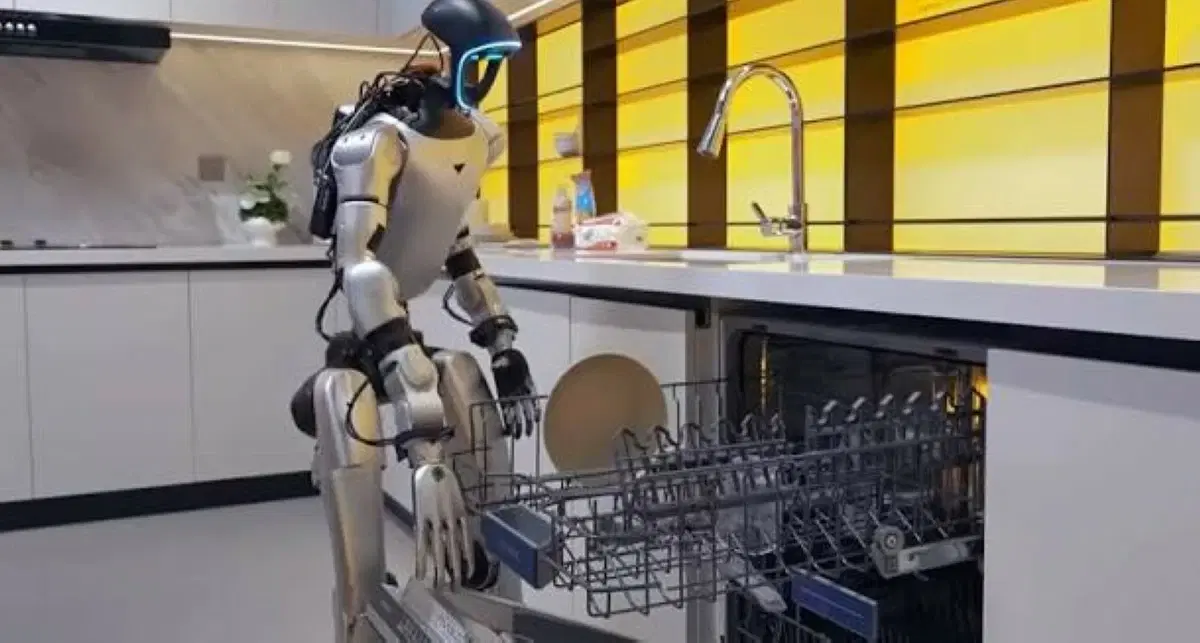
From washing dishes to training robots.. Chinese jobs turn daily movements into data
Amman3 min read
Share
In China, washing dishes or folding clothes is no longer just a household chore; it has become part of new jobs aimed at training robots to perform human tasks. Workers spend hours repeating simple movements hundreds of times a day, while sensors record the details of their performance to convert them into data used by technology companies to develop robots.
According to a report by the "South China Morning Post," the wages for these jobs range between 4,000 and 6,000 yuan per month, attracting the unemployed and young people looking for flexible job opportunities, despite the monotony and exhaustion they entail.
These jobs rely on wearing motion-capture equipment, including sensor-equipped bracelets and head-mounted cameras, then executing specific tasks according to instructions appearing on a computer screen.
The tasks include washing dishes, wiping tables, folding clothes, opening bottle caps, and moving objects from one place to another. During execution, human movements are recorded and collected in databases later used to train robots to handle objects in various environments, from homes to factories and shops.
Thus, simple daily movements are transformed into training material that helps machines learn how to perform tasks with greater precision.
According to coverage published by the "NDTV" website, citing the newspaper, workers may have to wash dishes or wipe tables about 200 times a day, while adhering to instructions and monitoring productivity indicators and completion speed.
The difficulty of the work is not limited to performing the task itself, but extends to repeating it consecutively according to specific requirements, which makes the job more exhausting than its simple nature suggests.
Some workers described this process as similar to teaching a two-year-old child, pointing to the need for constant repetition so that the systems can acquire the required skills.
Advertisements for these jobs are spread across social media platforms and Chinese recruitment websites, attracting people from various backgrounds, including those who have lost their jobs and students looking for training opportunities, in addition to people who prefer working from home or earning an income that suits their circumstances.
However, the flexibility of the work does not necessarily mean it is easy; some workers believe that the financial compensation does not compensate for the exhaustion caused by repeating movements for long hours, while others view it as a suitable opportunity to earn money.
These jobs highlight an invisible side of the robotics industry, which is the reliance of intelligent system development on data collected by humans through performing the tasks that machines are intended to learn.
Although this data may contribute to expanding the capabilities of robots to perform household chores and other tasks, it does not necessarily mean that these machines will be able to replace the workers who collect the training data, or that they will become capable of performing those tasks independently at a specific time.
Between the ambition to develop robots that take over repetitive tasks and the daily reality of workers who repeat the same movements hundreds of times, the paradox of this profession emerges: the path to automating human tasks still depends, at this stage, on continuous human effort to teach machines how to perform them.