Battery-free smart glasses monitor health indicators and draw power from blinking
Amman4 min read
Share
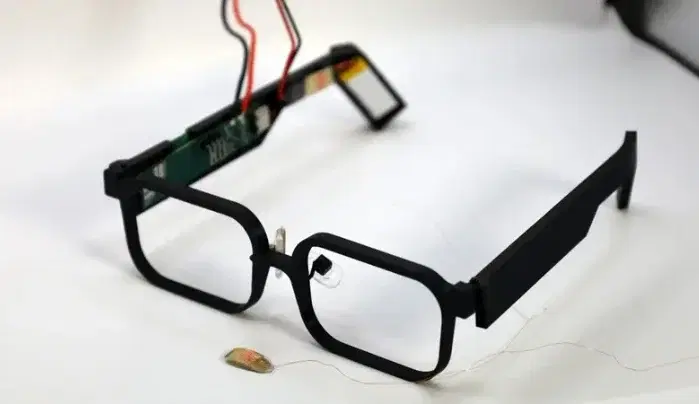
Engineers at Northwestern University have developed a prototype of smart glasses capable of monitoring multiple health indicators without a battery, by relying on energy generated from natural facial movements, such as blinking, smiling, jaw movement, and raising eyebrows.
The technology relies on harnessing repetitive daily movements to generate the energy needed to power sensors embedded in the glasses' frame, a step that could allow for the continuous monitoring of certain vital signs without the need to charge the device.
Nivedita Arora, the researcher at Northwestern University who led the project, said that the human face represents a rich source of health data, making the glasses that many people use a suitable platform for monitoring vital signs.
This technology differs from wearable devices, such as smartwatches and bracelets, which require periodic charging, as it seeks to turn everyday glasses into health devices that leverage the user's natural movements to provide power.
How do GlassTENG glasses work?
The prototype is called GlassTENG and relies on Triboelectric Nanogenerator (TENG) technology, which collects electricity generated from the contact and separation of two different materials, leading to the transfer of electrons and the generation of an electrical charge.
In these glasses, the flexible sensors contain layers that contact and separate with facial movement, allowing movement to be converted into electrical energy used to power the sensing system, instead of relying on a traditional battery.
The technology aims to monitor a range of movements and indicators, including pulse, blinking, jaw activity, and teeth clenching, which could help track conditions such as bruxism (teeth grinding), fatigue, and certain indicators related to cardiovascular health.
Three sensors to monitor pulse and jaw movements
The research team installed three sensors on the glasses' frame, with each responsible for monitoring a set of movements and indicators based on its location.
The first sensor was placed on the bridge of the nose near the angular artery to monitor pulse, blinking, and eyebrow movement, while the second was fixed at the temple above the superficial temporal artery to track pulse and jaw activity.
The third sensor was placed near the ear to monitor chewing movements and teeth clenching.
Each movement produces a distinct electrical pattern that the system can recognize; the signal resulting from the pulse ranged between 50 and 100 millivolts, while signals from blinking and raising eyebrows reached between 200 and 500 millivolts, and signals resulting from strong jaw movements reached 1.5 volts.
93.8% accuracy in recognizing facial movements
The researchers tested the system's efficiency using a machine learning algorithm trained to recognize patterns through previous examples, then analyzed the signals from 20 volunteers.
The results showed that the system achieved an overall accuracy of 93.8% in identifying the activity performed by the user, while its accuracy in recognizing the sound of teeth grinding was 99%, and 96% for strong jaw clenching.
The team tested pulse measurement separately in 10 participants who were sitting and at rest, and compared to a reference pulse measurement strap worn around the chest, the average difference in measurement was 1.82 beats per minute.
The results indicate promising potential for the prototype in monitoring facial movements and certain vital signs, although the technology still requires further development and testing.
Talking while eating limits system accuracy
Despite the positive results, the system faced difficulty in distinguishing between some similar movements, especially talking and chewing, as it might interpret jaw movement during conversation as chewing food.
Tests showed that the system correctly identified talking in 55% of cases, while it incorrectly classified it as eating in 37% of cases.
The researchers attributed this to the similarity of jaw movements during talking and chewing, in addition to both activities sharing the activation of the temporal muscle located on the side of the head, which makes distinguishing between them more difficult.