Experts: Water Security and Strategic Projects are Pillars of Sustainable Development
The Speech from the Throne pushes towards a new phase of economic and investment achievement
Amman10 min read
Share
Economic experts believe that the economic contents of the Speech from the Throne delivered by His Majesty King Abdullah II on Monday highlight the importance of accelerating the implementation of the Economic Modernization Vision, building on the achievements made by the Kingdom to strengthen its economic and investment position, and achieving sustainable economic growth that is tangibly reflected in the lives of citizens.
In interviews with Alrai, they pointed out that the Speech from the Throne constitutes a framework for the coming period and directs the government, the Parliament, and national institutions in both the public and private sectors to work in partnership to achieve national interests and accelerate the completion of targeted projects, thereby supporting the path of sustainable development.
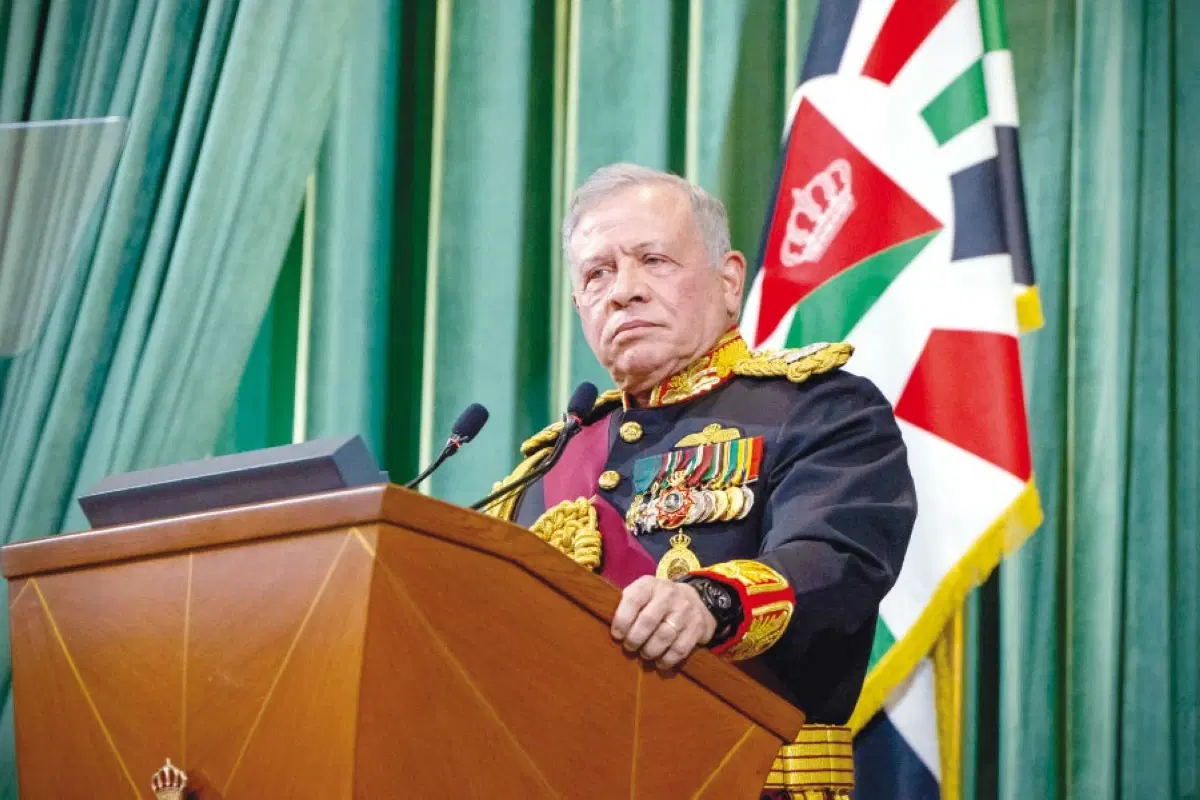
His Majesty King Abdullah II inaugurated the works of the third ordinary session of the 20th Parliament on Monday and delivered the Speech from the Throne.
The Chairman of the Jordan and Amman Chambers of Industry, Engineer Fathi Al-Jaghbir, believes that the economic contents of the Speech from the Throne highlight the importance of accelerating the implementation of the Economic Modernization Vision, building on the achievements made by the Kingdom to strengthen its economic and investment position, and achieving sustainable economic growth that is tangibly reflected in the lives of citizens.
Al-Jaghbir said that His Majesty’s indication that real development is what the citizen feels in terms of their livelihood, opportunities, education, healthcare, and their children’s future embodies the primary goal of the Economic Modernization Vision, and highlights the importance of directing economic efforts toward stimulating investment, expanding the production base, creating job opportunities, and improving income levels.
He added that His Majesty’s talk about the pivotal position that Jordan now occupies in the region constitutes an important opportunity to build on the competitive advantages enjoyed by the Kingdom, and to cement its position as a regional hub for industry, production, and exports, as well as a gateway to regional and global markets, benefiting from its strategic location, stability, and extensive network of trade agreements.
He pointed out that Jordanian industry possesses the elements that qualify it to perform this role, in light of the diversity of its production base and the development of its manufacturing and export capabilities, and the access of its products to wide global markets, noting that the coming phase requires attracting more quality industrial investments, enhancing Jordan's integration into regional and global supply and value chains, and developing high-value-added industries.
Al-Jaghbir emphasized that His Majesty’s directives to the government to accelerate the implementation of the Economic Modernization Vision highlight the necessity of moving at a faster pace from planning to execution, overcoming challenges facing productive sectors, improving the investment environment, and enhancing the competitiveness of national industry, enabling it to expand production and exports and create more job opportunities for Jordanians.
He indicated that the industrial sector, which contributes about a quarter of the GDP, represents a fundamental pillar for achieving the goals of the Economic Modernization Vision, pointing out that strengthening Jordan’s position as a regional industrial hub does not only increase exports and investments but extends to creating new economic opportunities, increasing local value added, and improving living standards.
Al-Jaghbir concluded by saying that the Jordan Chamber of Industry is committed to continuing to work and cooperate with the government and various partners to translate royal directives into practical initiatives and projects that contribute to strengthening the position of Jordanian industry regionally and internationally, and achieving economic development that the citizen feels the impact of in their daily life.
For his part, the Chairman of the Zarqa Chamber of Industry, Engineer Fares Hammoudeh, said that the Speech from the Throne was comprehensive regarding political, social, and economic issues, noting that His Majesty sent through it important messages regarding the deep-rootedness of the Jordanian state derived from its history and achievements, and the unity and resilience of the nation in the face of challenges and threats regardless of their source.
Hammoudeh pointed out that His Majesty highlighted national constants and the defense of the nation's causes in his speech, adding that the speech highlights the strength of the Kingdom and its reflections on various aspects of economic and social life, and the preservation of national interests.
He explained that His Majesty’s emphasis on the sensitivity of the water file and the importance of national projects to achieve sustainable water security places this file at the forefront of priorities, noting that the repeated reference to water reflects the importance of completing scheduled projects and preserving water resources as they are among the most important resources Jordan needs for industry, agriculture, and meeting drinking water needs.
He added that the focus on the sustainability of water resources for future generations opens up broad avenues for investment in water security projects and strategic national resources.
Hammoudeh pointed out that His Majesty focused on the importance of employing the economy to serve development and improve opportunities and living standards for the Jordanian citizen, noting that the royal directives emphasize the necessity for the citizen to feel the results of investment and development, especially in light of moving forward with Economic Modernization Vision projects and the major ambitious projects expected to boost the national economy.
Hammoudeh believed that the Speech from the Throne constitutes a framework for the coming period and directs the government, the Parliament, and national institutions in the public and private sectors to work in partnership to achieve national interests and accelerate the completion of targeted projects, contributing to achieving sustainable development.
For his part, economic expert Wajdi Makhamreh pointed out that the Speech from the Throne by His Majesty King Abdullah II before Parliament carries important political and economic messages and reflects the state's orientation toward a new phase that focuses on implementing major strategic projects and moving from the planning and reform phase to the phase of actual achievement.
He said that His Majesty’s reference to starting work on ambitious projects highlights the importance of investment in infrastructure and productive sectors, as they are fundamental engines for economic growth, job creation, and strengthening the competitiveness of the national economy.
Makhamreh added that major projects, especially in the sectors of water, energy, transport, and logistics, constitute an opportunity to bring about a qualitative shift in the Jordanian economy, stimulate local and foreign investments, and strengthen the Kingdom’s position as a regional hub for trade, transport, and services. These projects can also contribute to stimulating various economic sectors and raising the contribution of investment to the GDP.
He believed that the implementation of these projects should be accompanied by the provision of sustainable financing policies, expanding the partnership between the public and private sectors, and attracting foreign capital in a way that ensures no increase in the burdens of public debt and achieves real economic and developmental returns, especially in the areas of productivity, employment, and exports.
Makhamreh pointed out that the speech highlights the importance of maintaining political and security stability in light of regional challenges, as a fundamental pillar for attracting investments and strengthening confidence in the Jordanian economy. Furthermore, emphasizing the rule of law, combating abuse of power, and strengthening the role of Parliament in oversight and accountability highlights the importance of governance, transparency, and effective public administration as fundamental requirements for improving the business environment and strengthening the confidence of citizens and investors.
He added that the most prominent message in the Speech from the Throne is that the coming period must be a phase of real economic achievement, so that results are not measured by the number of announced projects or growth rates only, but by their ability to provide job opportunities, improve the living standards of citizens, increase productivity, and attract investments.
Makhamreh concluded that the real challenge facing the government lies in translating the royal vision into clear executive programs that include timelines and measurable performance indicators, making the impact of economic modernization tangible in the life of the Jordanian citizen.
For his part, financial and economic expert Dr. Mohammed Al-Hadab Al-Sarhan believes that the Speech from the Throne delivered by His Majesty King Abdullah II before Parliament set clear priorities for the coming phase, based on strengthening the power of the state and its institutions, consolidating the rule of law, and continuing economic modernization. He indicated that these pillars are interrelated, because building a strong economy requires a stable environment, efficient institutions, and sustainable confidence in the future.
Al-Sarhan pointed out that His Majesty’s talk about the importance of Jordan’s security and unity carries important economic dimensions, as stability constitutes a fundamental pillar for attracting investments and sustaining tourism and commercial activity. An investor does not look only at expected returns, but takes into account the stability of the business environment and the state's ability to protect its institutions and ensure the continuity of business.
He explained that the Jordanian economy has shown an ability to grow despite regional challenges, recording a growth rate of 3% during the second quarter of the current year. He believed that maintaining this performance requires moving from relying on stability as a relative advantage to employing it in attracting new productive investments, expanding the export base, and enhancing the competitiveness of the economy.
Al-Sarhan added that His Majesty’s talk about public service being a responsibility to serve the people, and that the law excludes no one, carries an economic message just as much as it includes an administrative directive. The clarity of procedures, the fairness of implementing legislation, and the reduction of violations reduce risks and costs for investors, enhance fair competition between companies, and raise the efficiency of using public resources.
He indicated that the King's call for the National Assembly to carry out its oversight role takes on special importance ahead of the discussion of the 2027 budget, as parliamentary oversight should focus on the efficiency of public spending, the effectiveness of economic programs, and the extent to which they achieve their objectives. What is required goes beyond merely tracking financial allocations, extending to ensuring that public resources yield economic and social returns commensurate with their scale.
Sarhan pointed out that the royal emphasis on water security places the management of limited resources at the top of development priorities, especially since water is a component of production costs in agriculture, industry, and services. Hence, the importance emerges of enhancing usage efficiency, reducing losses, and improving resource management in a way that protects economic activity and reduces future burdens on public finances.
He added that the King's statement about placing Jordanians' interests at the heart of decisions necessitates linking economic policies to labor market challenges, especially as the unemployment rate reached 16.1% in the second quarter of the current year. This requires directing incentives toward investments with the greatest potential to employ Jordanians, linking them to training, capacity-building, and the needs of economic sectors.
Sarhan concluded by saying that the Throne Speech presents a comprehensive vision of the relationship between state strength and economic strength, based on stability, rule of law, accountability, and productivity. He stressed that translating these directives requires effective coordination among the government, the National Assembly, and the private sector, so that institutional confidence turns into investment confidence, and economic improvement translates into sustainable growth that positively impacts Jordanians' lives.