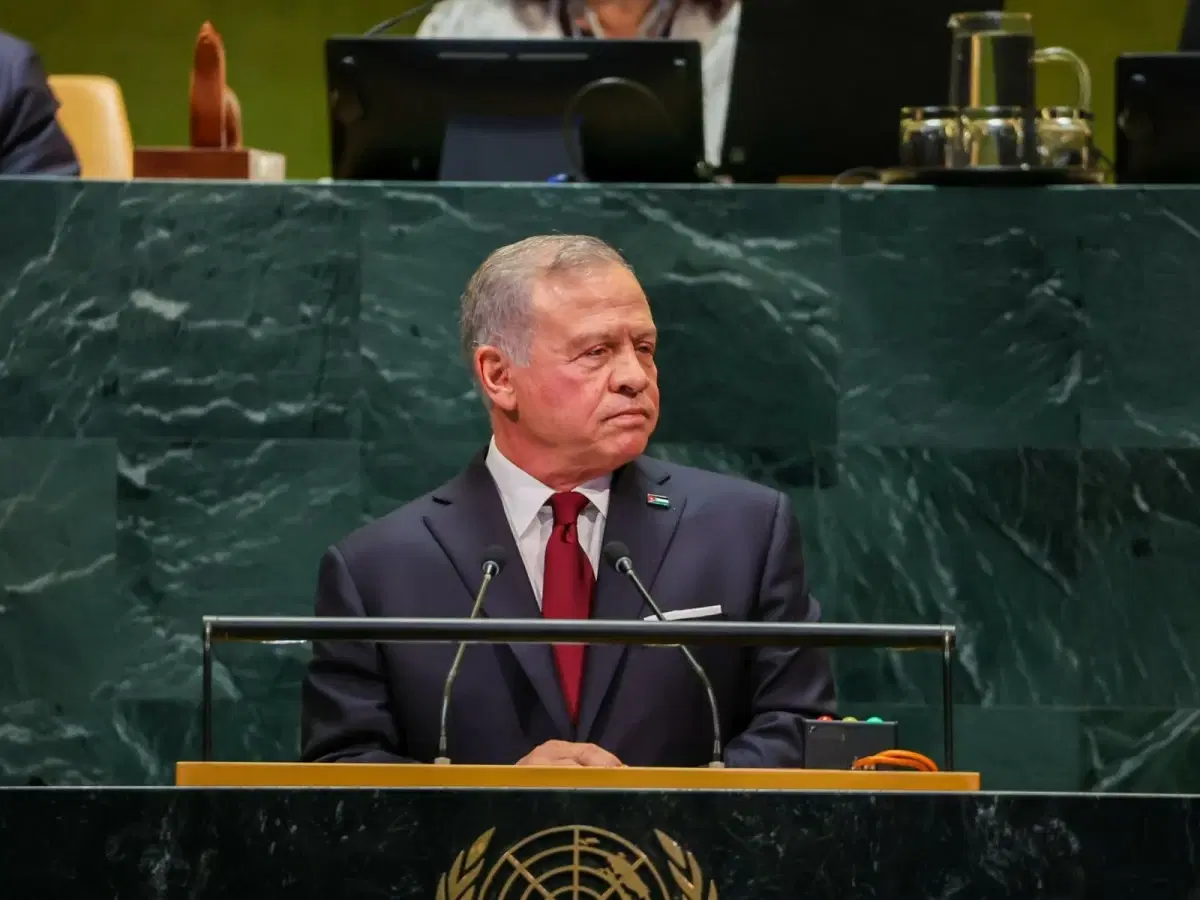
Events: The King's speech embodied the Kingdom's constants in defending its security and stability
Amman17 min read
Share
The Change Party stated that His Majesty the King's speech renews the constants of the Jordanian position regarding regional issues, foremost among them the Palestinian cause, the necessity of respecting international law, and addressing the roots of conflicts instead of merely containing their repercussions.
The party's Secretary-General, Dr. Fawzan Al-Baqour, said in a statement that what His Majesty the King raised regarding the situation in Gaza and the West Bank confirms that the continuation of the conflict without a solution exacerbates the state of instability in the region, stressing that protecting Palestinian rights and reaching a just peace require the international community to assume its responsibilities and move from positions to effective actions.
He added that His Majesty the King's warning against the transformation of violations currently being treated as temporary into a permanent reality highlights the danger of the lack of accountability, affirming that the effectiveness of international institutions is linked to their ability to apply international law and protect rights without selectivity.
Al-Baqour indicated that His Majesty the King's speech linked the region's crises to their repercussions, which transcend its borders to affect trade, investment, and the lives of peoples, explaining that addressing the causes of instability is a necessity to protect development opportunities and enhance regional and international security.
He pointed out that His Majesty the King's emphasis on protecting Jordan's borders, water security, and the interests of its people reflects the priority of national interests in dealing with regional developments, noting that Jordan's reliance on diplomacy and dialogue is accompanied by a clear position in protecting its security, sovereignty, and interests.
Al-Baqour affirmed that Jordan's adherence to a just peace and support for the steadfastness of the Palestinian people, alongside the Hashemite Custodianship of Islamic and Christian holy sites in Jerusalem, represents an extension of the constants of Jordanian policy, calling on the international community to assume its responsibilities and work effectively to end conflicts and consolidate security and stability in the region.
In turn, the Secretary-General of the Jordanian Al-Qudwa Party, Iyad Abdel Fattah Al-Najjar, affirmed that Jordan's participation in the meetings of the 81st session of the United Nations General Assembly reflects the Kingdom's political and diplomatic presence and its adherence to its national constants, foremost among them the Palestinian cause, Jerusalem, and regional security and stability.
Al-Najjar said in a statement that the General Assembly meetings are being held in light of intertwined international and regional shifts and crises, which makes them an important station to discuss the international community's ability to transform the principles and rules it declares into policies and positions that contribute to protecting security, peace, and the rights of peoples.
He added that the participation of His Majesty King Abdullah II in the meetings represents a political and diplomatic presence to present the Jordanian position and defend national interests, in addition to the meetings His Majesty holds with world leaders and heads of delegations, which allow for enhancing coordination and dialogue and building understandings on issues of common interest.
Al-Najjar affirmed that the Palestinian cause remains a central issue for Jordan, pointing out that the continuation of the conflict without a just political horizon reflects on the security and stability of the region and makes reaching a lasting peace more difficult.
He stressed that Jordan emphasizes the necessity of reaching a political solution that guarantees the legitimate rights of the Palestinian people and protects the foundations of stability in the region, in addition to preserving the identity and status of Jerusalem and protecting the Islamic and Christian holy sites therein.
He explained that Jordanian diplomacy is based on dialogue, communication, and building understandings with various parties in a way that serves national interests and enhances the Kingdom's Arab and international presence, pointing to the importance of Jordanian participation in international discussions related to sustainable development, climate action, health, and global challenges.
Al-Najjar indicated that Jordan carries to the international community a clear message based on adherence to security and stability, support for peace, respect for international law, and the right of peoples to security, dignity, and justice.
For its part, the General Secretariat of the Professional Associations Complex affirmed that the speech delivered by His Majesty King Abdullah II before the United Nations General Assembly reflected the firm Jordanian position toward Arab, regional, and international issues, foremost among them the Palestinian cause and the right of the Palestinian people to establish their independent state on their national soil.
The General Secretariat said in a statement that the speech carried Jordan's voice clearly, defended the values of truth, justice, and the dignity of peoples, and placed the international community before its responsibilities toward violations and human suffering, affirming that true peace cannot be achieved without justice and ensuring legitimate rights.
It affirmed its support for His Majesty the King's positions and its pride in the Jordanian role in defending Arab causes and in the Hashemite approach to protecting Jordan's interests and safeguarding its national and pan-Arab constants.
It reiterated its support for His Majesty the King's positions in defending Jordan's interests, issues, and national constants, noting that His Majesty's speech reflects the continuation of the Jordanian role in pushing toward achieving a just peace and consolidating security and stability in the region.
Furthermore, the Syndicate of Clearance and Transport Companies Owners affirmed that the speech of His Majesty King Abdullah II before the United Nations General Assembly was expressive of the firm and clear Jordanian position toward Arab, regional, and international issues, and carried a strong message to the international community on the necessity of moving from managing crises to addressing them, and from statements of condemnation to assuming responsibility and taking practical steps to protect security, peace, and the rights of peoples.
The Syndicate valued the contents of the Royal speech, which placed the international community before its historical and legal responsibilities, affirming that Jordan, under the leadership of His Majesty the King, will remain a firm voice in defending truth and justice, and at the forefront of countries seeking to stop escalation, protect civilians, and establish a just and lasting peace in the region.
The Syndicate affirmed in a statement that the Jordanian position toward the Palestinian cause has never been a passing position or linked to a political circumstance, but rather a firm and established position that places the establishment of an independent Palestinian state on the June 4, 1967 lines with East Jerusalem as its capital, in accordance with the two-state solution and international references, at the heart of any real path to achieving peace and stability.
The head of the Syndicate of Clearance and Transport Companies Owners, Dr. Dhaifallah Abu Aqoula, said that what His Majesty the King presents in international forums reflects the ability of Jordanian diplomacy to convey the voice and interests of the region clearly and responsibly, at a time when the peoples of the region need explicit positions that put an end to the continuation of crises, conflicts, and their humanitarian and economic repercussions.
He stressed that security and stability are not just a political issue, but are the foundation of the economy, trade movement, supply chains, transport, and logistics services, as regional unrest directly reflects on the movement of goods, transport and insurance costs, shipping times, and the flow of trade across borders, which makes achieving regional stability a national and economic interest for all countries in the region.
Abu Aqoula indicated that the clearance and transport sector stands with all its capabilities behind the Jordanian state and its institutions in protecting the national economy and enhancing its ability to face challenges, noting that those working in this sector were and still are on the front lines of Jordanian trade movement and continue to perform their duty in facilitating the flow of goods and commodities and serving the national economy despite the difficult regional circumstances.
He added that Jordan has proven, under the leadership of His Majesty the King, that protecting national interests does not conflict with openness and international cooperation, but rather requires a balanced political position and effective diplomacy that preserves the Kingdom's constants, defends its interests, and works at the same time to enhance stability and economic cooperation in the region.
Abu Aqoula said that His Majesty the King's speech before the United Nations represents a clear Jordanian message: no real stability without justice, no sustainable peace without just political solutions, and no strong economy in a troubled region.
The head of the General Trade Union of Workers in Public Services, Free Professions, Communications, and Information Technology, Khaled Abu Marjoub, affirmed that the speech of His Majesty King Abdullah II before the United Nations General Assembly clearly reflects the constants of the Jordanian position and the Kingdom's keenness to protect its security and national interests and defend the region's issues and the rights of its peoples in light of the escalating crises and challenges it is witnessing.
Abu Marjoub said in a statement that His Majesty the King's emphasis that Jordan cannot choose between facing emergency crises and continuing to build the future represents a clear vision based on moving forward on both paths together, enhancing the state's ability to protect its gains, and continuing the path of modernization and development, which reflects on the lives of citizens, job opportunities, and their standard of living.
He added that the Royal speech carried a clear message regarding the importance of commitment to international law and the necessity for the international community to assume its responsibilities toward the crises the region is witnessing, praising His Majesty's emphasis that peace and stability cannot be achieved through managing crises and postponing their solutions, but rather by addressing their roots and achieving justice and the rights of peoples.
Abu Marjoub indicated that the contents of the Royal speech intersect with the aspirations of the labor movement in enhancing economic and social development, providing decent job opportunities, improving working conditions and terms, and protecting labor rights, considering the worker a fundamental partner in the national building process.
He pointed to the importance of continuing to invest in people and skills, especially in the services, telecommunications, and information technology sectors, which are witnessing rapid transformations due to digitalization and technological development, stressing the need to qualify the workforce, empower it with the tools of the future, and enhance social protection for workers in emerging sectors.
For its part, the Irbid Chamber of Commerce affirmed its support for His Majesty King Abdullah II and its endorsement of the positions contained in His Majesty's speech at the opening session of the 81st United Nations General Assembly, which reflect the Jordanian stance toward the nation's issues.
The Chamber's Chairman and Board members said in a statement that the commercial sector in Irbid Governorate is proud of His Majesty the King's positions and his continuous efforts in international forums, affirming its unified stance behind the Hashemite leadership and its support for the Kingdom's national and pan-Arab positions.
The statement emphasized the commercial sector's support for the efforts exerted by His Majesty the King in defense of Jordan's interests, his keenness on its security and stability, and the strengthening of its presence and positions regarding Arab, regional, and international issues.
The Chamber expressed its pride in the Hashemite leadership, affirming its support for the homeland and its leadership, and backing everything that would preserve Jordan's security, stability, and national interests.
The Ajloun Chamber of Commerce also affirmed its pride in the national, economic, and humanitarian content carried by His Majesty the King's speech at the opening session of the United Nations General Assembly, and what it reflected of a firm royal vision, an effective Jordanian presence, and steadfast positions toward the various challenges the world is witnessing.
The Chamber said that His Majesty the King's speech embodies the status Jordan enjoys on the international stage and confirms its approach based on dialogue, cooperation, respect for international law, joint action to consolidate security and stability, and finding sustainable solutions to the challenges and crises facing the peoples of the world.
It valued the royal speech's emphasis on the importance of stability as a foundation for development and prosperity, and on the close link between security and stability and the movement of the economy, trade, investment, energy, and food security, due to its direct impact on the lives of peoples and the future of countries' economies.
The Chamber affirmed that the commercial sector in Ajloun is considered an authentic partner in the path of economic development, and that the stability of the economic and commercial environment forms a basis for enhancing business and investment, stimulating markets, providing job opportunities, and supporting the national economy.
It renewed its commitment to continuing its role in serving the sector, enhancing the interests of merchants, supporting economic and investment initiatives, and consolidating partnership with various national institutions, in a way that contributes to pushing the wheel of economic development.
The President of the Jordan Policy Dialogue Forum, Dr. Hameed Al-Batayneh, said that His Majesty the King's speech came in light of complex regional and international circumstances, carrying a clear Jordanian message that places the international community before its responsibilities in addressing the roots of crises and translating positions and decisions into practical steps.
Al-Batayneh added in a statement that the Palestinian cause was present at the heart of the royal speech as the core of the conflict and the key to stability in the region, stressing that the continuation of the war in Gaza and developments in the West Bank and Jerusalem cannot lead to peace, and that stability requires a just political solution that leads to the establishment of an independent Palestinian state based on the two-state solution and in accordance with international references.
He pointed out that the speech confirmed the constants of the Jordanian position toward the Palestinian cause, represented by the fact that managing the conflict cannot be a substitute for resolving it, and that achieving sustainable peace is linked to the establishment of a Palestinian state and ensuring the legitimate rights of the Palestinian people.
Al-Batayneh noted that Jerusalem was present in the speech within its religious and historical status, and the emphasis on the Hashemite Jordanian role in caring for Islamic and Christian holy sites and preserving their historical and legal status.
He explained that the speech linked the defense of the Palestinian cause to the protection of Jordan and its national interests, through the emphasis on border security and water security, reflecting the priority of protecting the Kingdom's sovereignty, security, and interests, while Jordan continues to perform its role in supporting the security and stability of the region.
He indicated that Jordan's security is linked to the security of its Arab surroundings, and that what Palestine, Syria, and the region are witnessing reflects on the regional security system, pointing out that respecting the sovereignty of states and rejecting the changing of facts by force constitute a basis for limiting the expansion of the circle of conflict and returning the region to the path of stability.
Al-Batayneh pointed out that the message Jordan carried to the international community confirms that true peace is not achieved by managing crises, but by addressing their causes and roots, and that stability is linked to protecting the rights of peoples and respecting international law, in addition to safeguarding Jordan's security, sovereignty, and national interests.
For his part, the President of the Jordanian Society for Scientific Research, Entrepreneurship, and Creativity, Dr. Reda Al-Khawaldeh, affirmed that His Majesty King Abdullah II's speech before the UN General Assembly reflected the clarity of the Jordanian vision toward the challenges facing the region and the world, and embodied the Kingdom's constants in defending its security, stability, and national interests, foremost among them the Palestinian cause and its direct repercussions on the region's security and future.
Al-Khawaldeh said in a statement by the Society that the royal speech carried a clear message to the international community on the necessity of dealing seriously with the crises and wars the region is witnessing, and not allowing them to continue or dealing with their humanitarian, political, and security repercussions as a normal matter, stressing that Jordan, which lies in the heart of this turbulent region, is directly concerned with finding just and sustainable solutions to these crises.
He added that His Majesty the King's emphasis on the centrality of the Palestinian cause and the necessity of ending the suffering of the Palestinian people, alongside respect for international law and international legitimacy resolutions, reflects the steadfastness of the Jordanian position and the Kingdom's adherence to a just peace that achieves security and stability for the region and its peoples.
Al-Khawaldeh pointed out that His Majesty the King's speech confirms the importance of continuing the Jordanian role in international forums, conveying the voice of the region and its issues, and defending the values of justice, humanity, and international law, in a way that enhances Jordan's status and role in facing regional and international crises.
He affirmed that the Society sees in the royal speech a clear national and international message that emphasizes the necessity of prioritizing dialogue, diplomacy, and political solutions, and building a more secure and stable future for Jordan and the region.
For its part, Al-Balqa Applied University, represented by its President Dr. Ahmad Fakhri Al-Ajlouni, affirmed its pride in the firm and established Jordanian position expressed clearly by His Majesty King Abdullah II in his speech before the UN General Assembly at its 81st session, which placed the international community before its political, legal, and humanitarian responsibilities toward the crises the region is witnessing, foremost among them the Palestinian cause.
The University valued in a statement the clear messages carried by His Majesty the King's speech that confirm Jordan's firm constants in defending the rights of the Palestinian people, rejecting attempts to impose a new reality on the ground, and emphasizing the necessity of respecting international law and international legitimacy resolutions, leading to the achievement of a just and comprehensive peace that guarantees the legitimate rights of the Palestinian people.
It affirmed its standing behind the Jordanian national position expressed by His Majesty the King, and what his speech included of an emphasis that Jordan's security, sovereignty, borders, and water are red lines that cannot be compromised, and that Jordan will continue to perform its role in protecting its national interests, defending the issues of its nation, and preserving the Islamic and Christian holy sites in Jerusalem.
It pointed out that His Majesty the King's speech came at a highly sensitive regional and international moment, carrying a clear Jordanian message calling on the international community to move from statements of condemnation to assuming responsibility, taking effective steps to protect civilians, ending the cycle of conflict, and addressing the roots of the crisis in accordance with international law and relevant United Nations resolutions.
The University expressed its pride in the Jordanian position represented by His Majesty King Abdullah II, affirming that Jordanian universities, as beacons of science, knowledge, and national awareness, will remain committed to the values of justice, human dignity, and peace, and to the national and pan-Arab constants upon which the Jordanian position is based.