Debate in Israel over a new formula for resolving the Palestinian issue
Ahead of the general elections
Amman7 min read
Share
As the Israeli elections scheduled for October 27, 2026, approach, the Israeli political arena is witnessing a state of anticipation and polarization, in light of a relative closeness between Prime Minister Benjamin Netanyahu's camp and the opposition, while the file of the war on the Gaza Strip and the future of the Palestinian issue occupies a prominent position in the public debate, albeit from divergent angles and positions.
Israeli and international articles and analyses published on the eve of the elections reveal a clear division in the Israeli public mood between denial and review, between refusing to take responsibility for the results of the war, and attempts to reformulate perceptions related to the future of the conflict and the political solution to the Palestinian issue.
In this context, Yossi Beilin, one of the most prominent figures of the Israeli left and negotiations, argues in an article published by the newspaper "Israel Hayom" that the camp of Netanyahu's opponents possesses, according to his estimate, about 70 seats, considering that there is no equality in the size of the two blocs.
At the same time, he criticizes the refusal of some opposition leaders to cooperate with Arab parties, warning that this position, in his view, weakens the opposition and serves Netanyahu's interest.
In parallel, Israeli analyses address what they describe as a state of intellectual stagnation in public opinion regarding the idea of a two-state solution, noting that the official political discourse repeatedly focuses on preconditions, keeping the discussion about a political settlement in a closed circle.
Proponents of these arguments believe that the obstacle is not limited to political calculations, but extends to the prevailing intellectual and cultural perceptions within Israeli society.
Regarding the issue of accountability for the war, Nir Hasson writes in the newspaper "Haaretz" that the Israeli military investigation system has proven, according to his assessment, its inability to deal comprehensively with the file of violations and crimes attributed to the Israeli army in the Gaza Strip and the northern West Bank.
He points out that a recent army statement addressed only five incidents, while the war, according to what he reports, witnessed hundreds of other incidents during which tens of thousands of Palestinians fell, without the investigations leading to trials or broad sanctions against soldiers or officers.
Hasson links these measures to what is known in Israel as the "judicial Iron Dome," referring to what he describes as attempts to use judicial mechanisms and internal investigations to reduce the possibilities of prosecution before the International Criminal Court or national courts in other countries.
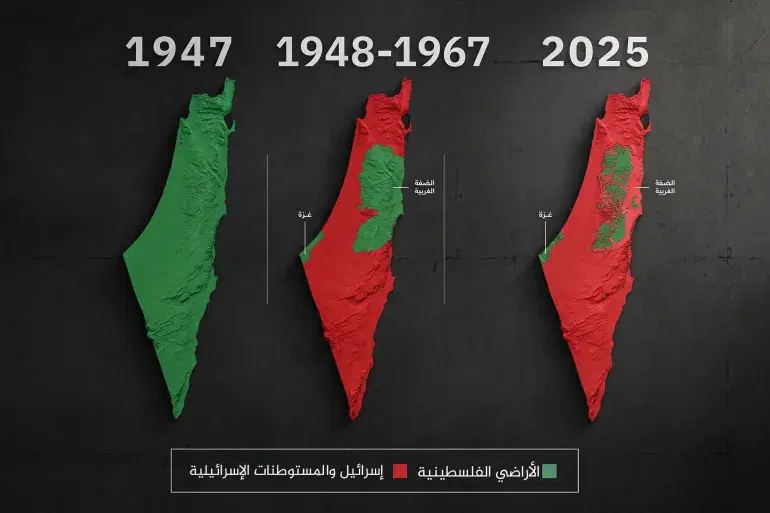
Conversely, some Israeli writings highlight an increasing debate about the two-state solution as one of the possible political paths to exit the conflict. In an article published by "Haaretz," political analyst Amos Schocken argues that establishing a Palestinian state would grant Palestinians the right to self-determination, dignity, freedom, and civil rights, which are rights he says were among the foundations upon which the Jewish state was built.
Schocken relies on principles contained in the UN Charter and Israel's Declaration of Independence, considering that settlement policies and land annexation contradict these principles.
He asserts that the Palestinians' right to self-determination does not differ, in principle, from the right of Israelis, calling for the establishment of a Palestinian state in cooperation with the Palestinian Authority, and considering that such a step would reflect a commitment to international law and humanitarian principles.
From another angle, Beilin proposes in "Israel Hayom" a vision for a solution based on establishing a Palestinian state that includes the Gaza Strip and lives alongside Israel in peace.
He believes that the Palestinian party that could form a partner for Israel, from his point of view, should be a national movement that adopts the option of peace, not an armed religious movement.
As for Yuli Novak, Executive Director of the organization "B'Tselem," she presents in an article published by "Haaretz" a more critical reading of the reality in the Palestinian territories.
She relies on what she calls the "erasure project," which is based on about two thousand testimonies, to argue that patterns of violence in the West Bank intersect, in her estimation, with what is happening in the Gaza Strip, and that the issue, according to her argument, is not only about the actions of extremist individuals, but about institutional policies and practices that affect the ability of Palestinians to remain in their areas.
Novak calls for rethinking the nature of the existing political system and moving, according to her vision, to a system based on freedom, equality, and security for all residents, instead of enshrining the sovereignty of one national group and its control over the other.
In an analysis published by "Yedioth Ahronoth," an argument emerges that the two-state solution will not be achieved through political decisions or negotiations alone, but also requires an intellectual and cultural transformation on both sides.
The analysis suggests that the Palestinians' realization of the importance of building a national civil state, and the Israelis' realization that peace can constitute a guarantee for their future, represent, according to this vision, a necessary entry point for any serious political path.
In another part of the discussion, the issue of the Israeli intelligence failure returns to the fore, with comparisons between the failure of the 1973 war and the events of October 7, 2023.
Dr. Michael Milshtein, head of the Palestinian Studies Forum at the Moshe Dayan Center at Tel Aviv University, points out in an analysis published by "Yedioth Ahronoth" that the 2023 failure was, in terms of results, more severe than the 1973 failure, based on the scale of losses, capture operations, and infiltration into Israeli settlements.
Milshtein cites previous statements by Meir Amit, the former head of the Mossad, in which he called after the October War for a comprehensive self-review and collective responsibility for the failure. He also quotes Brigadier General (Res.) Yossi Kuperwasser, the former head of the Military Intelligence Research Division, as saying that the events of October 7 were the result of a combination of factors, including the lack of diversity in intelligence assessments, ignoring the voices of lower levels, declining interest in early warning, the weakness of some information-gathering mechanisms, reduced reliance on human intelligence, and a decline in the number of researchers specializing in the Arabic language and culture.
These divergent arguments reveal an Israeli landscape divided on the eve of the elections, between a current that rejects internal and international criticism of the war and considers it a violation of Israeli interests, and political, media, and academic voices demanding a review of what happened in Gaza and the West Bank, holding institutions and leaders accountable, and reopening the debate on the future of the conflict.
In light of the continuation of the war and its political, legal, and humanitarian repercussions, it seems that the question of the "day after" is not limited to the election results or the identity of the next government, but extends to the nature of the solution that Israel can offer for the Palestinian issue, and whether the discussion about establishing a Palestinian state will remain marginal, or turn into one of the central files in shaping the next political phase.