How is Israel turning into a state with no option for peace?
Amman5 min read
Share
An Israeli study revealed a growing shift in the nature of the Israeli-Palestinian conflict, moving from a political and national conflict to one of a religious character, pointing out that the political and leadership in Israel have contributed, over the past decade, to solidifying this shift, which is particularly driven by extremist religious Zionist forces.
The study, published by the head of the Palestinian Studies Forum at the "Dayan" Center at Tel Aviv University, Dr. Michael Milstein, in the "Yedioth Ahronoth" newspaper under the title: "The Imminent Danger of a Religious War," stated that Israel "was not passively dragged into a religious war, but in recent years, led by extremist religious Zionist forces, it has reshaped a conflict that was essentially a territorial and national dispute, systematically transforming it into a religious war."
It added that this shift has appeared on three main levels: political discourse, settlement behavior, and the management of holy sites, in exchange for a price represented by the erosion of relations with Arab countries and the decline of Israeli internal consensus.
The study explained that the Israeli strategic tradition since the establishment of the state was based on framing the Arab-Israeli conflict as a national and regional dispute open to negotiation, meaning that the conflict has limits where room for settlement can be opened. However, the right-wing government formed in late 2022, which is considered the most extremist in Israel's history, directly introduced the biblical narrative into political language and the practice of governance.
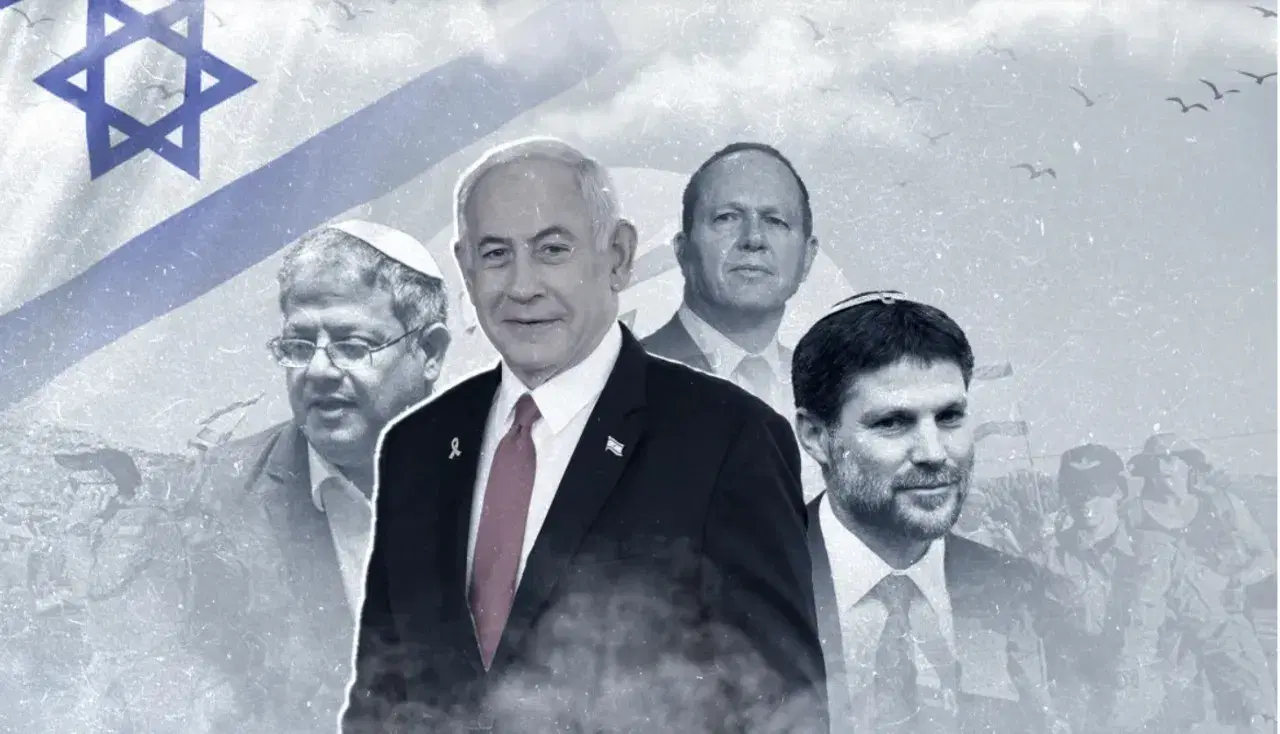
It considered that the statements of Finance Minister Bezalel Smotrich regarding the necessity of "annihilating the village of Huwara," his invoking of the "doctrine of Joshua bin Nun," alongside his description of Arab citizens as "temporary citizens," cannot be treated merely as electoral rhetoric, but rather reflect the establishment of a logic that rejects the possibility of a secular solution to the conflict. When an opponent is defined as a "biblical enemy," negotiations, according to this logic, become close to impossible.
The study pointed out that the religious settler movement, represented by Itamar Ben-Gvir, has gained unprecedented political status, and its agenda has come to directly influence the directions of the ruling coalition. This is no longer about a marginal current, but rather a political force that has come to control part of the centers of decision-making.
The West Bank stands out as the central arena for this shift. In secular logic, settlement expansion was presented as a bargaining chip with security and demographic dimensions, whereas in religious logic, it is transformed into the implementation of what is presented as a "divine command."
The "Ben-Gvir-Smotrich" government has pushed towards expanding settlement construction in the West Bank and Jerusalem, not only driven by security or political motives, but stemming from a perception that elevates control over what Israel calls "Judea and Samaria" to the rank of a religious duty.
This behavior reveals a clear paradox: while Israel officially announces its quest to expand its relations and normalization with Arab countries, its actual policies in the West Bank undermine the geographical basis of the two-state solution. As for Arab anger, it has not yet turned into effective deterrence, which the Israeli leadership has interpreted, according to the study, as evidence that "Israel only frightens itself."
The study believes that the core of this miscalculation lies in the fact that when politics is sacralized, external costs cease to be a fundamental part of the decision equation.
Jerusalem is considered one of the most dangerous arenas of this religious shift, as maintaining the status quo at the Al-Aqsa Mosque compound has constituted a fundamental matter for decades. However, religious Zionist forces are pushing to impose what they call "Israeli sovereignty" over the Al-Aqsa Mosque through intensifying incursions and religious visits, and raising public discussions about evacuating the mosque in preparation for building the Third Temple, which threatens to detonate this understanding.
Inside the Israeli home front, the study indicates that society is witnessing a deep division in light of the rapid population growth of the Haredis, which is reshaping the demographic structure, coinciding with the erosion of the social contract between secular and religious people, particularly regarding the burden-sharing of military service.
In light of these transformations, linking the state's strategic direction to the narrative of religious salvation does not represent, according to the study, merely a political gamble in foreign policy, but also a gamble on the nature of Israeli society, its future, and its internal cohesion.
The "Dayan" Center concluded that the religious shift in Israel is not a fleeting deviation in policy, but rather represents a long-term strategy for religious Zionist forces, driven by demographic changes and political coalition calculations.
The study emphasized that the core danger of this shift is not just "angering Arab countries"—this is merely a consequence—but rather that it robs Israel of the option of withdrawal and settlement. A state that defines its security and political borders according to a biblical narrative finds itself logically incapable of accepting any peaceful settlement that contradicts that narrative.
Herein lies the real dilemma: when war becomes sacred, peace becomes heresy.