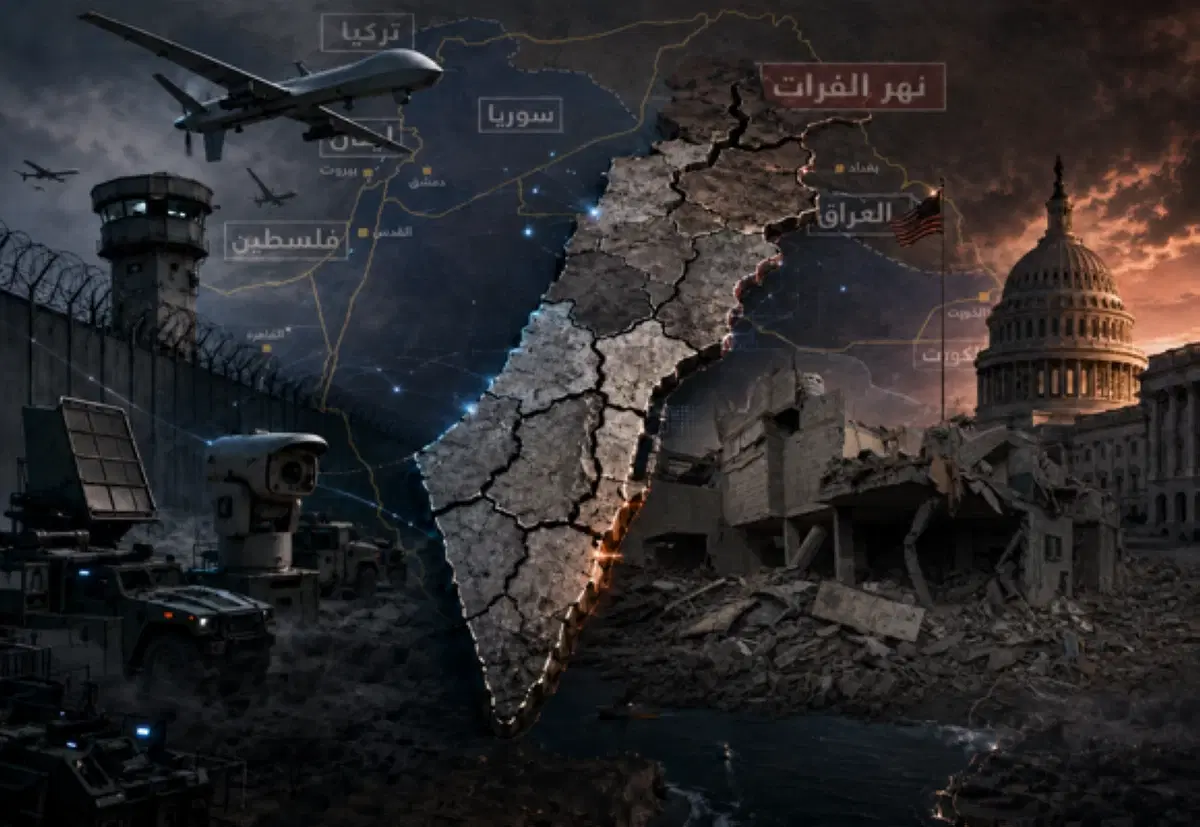
Israel between a ((regional power)) and internal collapse
“Iron Wall 2”.. A strategy that goes beyond deterrence to reshaping the region
Amman7 min read
Share
The Hebrew newspaper "Maariv" revealed, in a report by writer Shir-Li Golan titled: "Either we become a regional superpower or we collapse," the results of a study conducted by the "Mind Israel" foundation with the participation of about 100 experts, which discussed a set of issues that the foundation considers fundamental to Israel's future and its regional standing.
The report gains special importance as it is issued by a foundation active in the field of national security research and Israeli strategy, and it provides a vision of how segments of the Israeli security and strategic establishment are dealing with the transformations taking place in the Middle East, the future of relations with countries in the region, and the position of the Palestinian cause in this vision.
The "Mind Israel" foundation is headed by retired Major General Amos Yadlin, the former head of the Israeli Military Intelligence Directorate "Aman," while Dr. Avner Golov serves as Vice President for Research.
According to how the foundation describes itself, it works in the fields of national security and strategy, and seeks to provide knowledge and consulting to institutions concerned with national security, and to contribute to the formulation and implementation of long-term Israeli strategies.
The research falls within a broader program that addresses files including Iran, Middle East dynamics and regional rivalries, the Palestinians and the region, competition between major powers, and US-Israeli relations.
At the heart of this vision emerges the idea of "Iron Wall 2," which Golov explains by saying that Israel is required to move from the traditional "Iron Wall" concept to a new phase, such that it does not suffice with preventing its enemies from breaching the wall it has built, but rather works to "design the reality" on the other side of it.
This idea revives the "Iron Wall" concept that was historically associated with the Zionist leader Ze'ev Jabotinsky, but it is presented here in a different context, as it is not limited to deterrence and defense, but moves, according to the report, toward influencing the regional environment surrounding Israel and reshaping it in accordance with its strategic interests.
In this context, he quotes Golov as saying that Israel needs, alongside walls, "bridges," and that it must build a "regional camp that breaks geography" and enhances Israel's position and attracts Arab countries to it.
This proposal reveals a vision based on combining military power with networks of economy, technology, and security, with the aim of building a regional system in which Israel becomes a major hub for links between participating countries.
This intersects with regional projects such as the "India-Middle East-Europe Economic Corridor" (IMEC), which aims to connect India to Europe through a network of infrastructure, ports, railways, and trade corridors.
According to Western analyses of the project, Israel's geographical and technological location could grant it a pivotal role in this network, thereby enhancing its status as a link between markets and continents.
In the vision presented by the Israeli research, these projects appear to be part of a broader process of reshaping regional relations based on economic, security, and technological interests.
However, the question that arises here relates to the position of the Palestinian cause in this equation. While the vision talks about "breaking geography" and building a cross-border regional network, the Palestinian cause does not appear at the center of the political project, but is rather addressed within a broader security and regional framework, which raises questions about the extent to which this vision is prepared to deal with the Palestinians as a political party with national rights, rather than just a security or demographic file.
The demographic dimension also appears in the issues identified by the study as files that need to be addressed, including the relations between the Haredim and Arabs inside Israel.
This indicates that the issue of integrating Arab citizens is discussed, in some of these perceptions, within the considerations of the state's security, economy, and demographics, alongside its civil and political dimensions.
As for the West Bank and the Gaza Strip, studies issued by Israeli security research centers present perceptions based on separation between Israelis and Palestinians, with continued Israeli security control to varying degrees.
Some of these perceptions propose arrangements related to land, governance, and the economy, while maintaining a wide margin of Israeli security control.
The vision becomes clearer in another phrase the report quotes from Golov, in which he calls for moving from the concept of "shared values" to "partners of value," so that Israel becomes a party that other countries rely on for technology, security, and academia, leading to the construction of a system of relations based on mutual dependence, but with Israel retaining a central position in it.
This proposal intersects with broader discussions in American think tanks about the shift in the concept of Israeli national security, and whether Israel is moving from a strategy based primarily on deterrence to a strategy that relies more on military initiative, preemption, and the use of force to change the environment surrounding it.
But what is striking in the study is not only what it says about Israel's regional ambition, but also its admission of internal weaknesses that the Israeli security and strategic establishment believes may hinder the realization of this ambition.
Golov says, according to the report, that Israel is capable of becoming a "regional superpower," but he warns at the same time that its "foundations are rusty," and that failing to address these foundations could lead, in his words, to the collapse of the entire structure.
The study identifies six basic files that need to be addressed, including Israel's regional standing, the quality of human capital, the relationship between the economy and security, governance and national resilience, demographic changes, and relations with the United States and the Jewish diaspora.
These priorities reflect an awareness within some Israeli national security circles that military power, no matter how great, is not enough on its own to build a sustainable regional power, and that political and social divisions, governance crises, and relations with allies can turn into factors that limit the ability to implement the strategic project.
In this context, Golov's phrase that "civilizations are not liquidated from the outside but commit suicide" appears as a warning of the dangers of internal erosion, not a declaration of a complete victory for the Israeli project.
Thus, the report presents a complex picture: an increasing Israeli ambition to enhance regional standing on the one hand, and an admission of internal weaknesses that could undermine this ambition on the other.
For the Palestinians and Arab countries, the importance of this discussion lies in the fact that the vision presented does not place a political settlement of the Palestinian cause at the forefront of the process of reshaping the region, but rather focuses more on building a regional system of economic, security, and technological cooperation, in which Israel is one of the main power centers.
This raises a fundamental question about whether regional integration projects can continue without addressing the Palestinian cause, or whether bypassing the conflict will lead to postponing it rather than solving it.
Also, the talk about "partners of value" opens a discussion about the nature of the relations that Israel seeks to build with Arab countries: are they relations based on mutual and balanced interests, or a system in which Israeli superiority in technology and security becomes a key factor in determining the shape and limits of the relationship?
Ultimately, this vision reveals a shift in strategic thinking among Israeli sectors from focusing on protecting the state from its regional environment to attempting to influence this environment directly and reshape it. Between the traditional "Iron Wall" and the currently proposed "Iron Wall 2," the fundamental issue seems to be the transition from a policy based on waiting for adversaries behind Israel's borders to a policy that seeks to shape the regional reality before its threat reaches those borders.
But the success of this project, as the study itself reveals, is not linked to military power alone, but to Israel's ability to address its internal contradictions, maintain its international relations, and build a regional system that the countries of the region accept, in addition to how it deals with the Palestinian cause, which remains one of the most important determinants of stability in the region.